
Why Does My Daughter Serve Well in Practice but Miss in Volleyball Games?
When a volleyball player serves cleanly in practice but misses long or into the net in matches, she is usually dealing with a mental block, often described as serving anxiety. In the vast majority of cases this is not a technique problem as evidenced by the practice-versus-match results: the athlete performs well in practice and the skill is still there, but under match pressure her nervous system shifts into a stress response that is involuntary in nature. More serving reps and pre-serve routines rarely fix this type of true mental block, and it is not uncommon for that type of training to teach an athlete’s mind to stay dysregulated compared to nervous system training which conditions the athlete’s mental state to stay steady under that pressure and become comfortable with discomfort. Athletes dealing with this issue should work with a sport psychology expert who has specialized training in EMDR, Brainspotting and biofeedback.
Published on 10/7/26, written by Benjamin Foodman, CMPC, LCSW, CSCS
Ben Foodman is a licensed psychotherapist & Certified Mental Performance Consultant (CMPC) through the Association for Applied Sport Psychology (AASP). He owns his private practice located in Charlotte North Carolina where he specializes in working with athletes to help them overcome mental blocks (the yips), increase mental toughness and improve focus using techniques such as Brainspotting, biofeedback, exercise science and sport psychology. If you are interested in services, use the link here! Enjoy the article below!

Is It a Technique Problem or a Mental Block?
If she misses in practice in addition to competition, it is most likely a technique problem, and her coach should be the first professional in line to help her. But if her serve is clean in practice and breaks down only when she is being watched, scored, or playing a match, a mental block is the more likely explanation. Other co-occurring factors that can determine if this is a mental block is if the athlete is struggling ‘off court’ with things like grades, social life, poor sleep, or increased mood dysregulation. These athletes can also struggle with what is called Athlete Identity, which is when an athlete bases their whole self-worth on their performances.
Coaches are right that many missed serves come from mechanics. An inconsistent toss, a contact point that drifts, or a swing that changes from serve to serve will send the ball long or into the net in any setting. Comparing video of practice serves with match serves is a smart first step, and good coaches do it. But that explanation stops working when the mechanics are fine all week but not in competition.
If she can repeat the serve in the majority of practices, the real question is why the same movement changes only in matches. Research on mental blocks describes a continuum from movement-based breakdowns to pressure-triggered ones, and when pressure scenarios are introduced compared to ‘low-stakes’ practices, this should be the giveaway. Regardless of the athlete or level of competition, our brains respond in a very specific way to pressure.
Missing serves in matches can come from four different problems, and they look the same to a parent watching the game:
She can’t describe why she misses - Her serve is reliable in many situations, but it breaks down when a miss costs her team a point or just randomly throughout the match. This is the classic mental block.
She does not trust her serve - She genuinely does not know where the ball will go, and this can be seen in practice too. She gets nervous because of this and needs technical work first, because no amount of confidence fixes a toss that changes every time.
She is terrified of letting others down - People underestimate the power of social psychology and how the fear of failing others is more often than not, far more terrifying than letting yourself down. This can be because the individual has a high-level of Athlete Identity.
She is exhausted but unaware of how depleted her ‘battery’ is - athletes are masters of dissociation and do not do a good job of taking into account how poor their recovery is. A depleted mental battery will lead to these types of involuntary mental blocks.
Many players have at least one of these issues going on, and it is not uncommon to have all of these happening at once. A simple way to sort it out is to ask her coach to run the same serve under three conditions: unscored, scored with the coach watching, and a game-like drill with a real consequence. If her toss and swing hold up in the first and come apart as the stakes rise, the problem is not her technique. Her technique is how the problem shows up. Another thing parents and coaches can do is if the athlete wears a Whoop strap, they can look at the recovery data to see how the athlete is doing from an energy standpoint. Typically, poor HRV scores are associated with poor mental states which can lead to these types of mental blocks.
Does It Matter When in the Match She Misses?
Yes. If her misses pile up at specific moments, like her first serve, the serve after a miss, or close scores, the problem is most likely pressure, not technique. A technique problem shows up regardless of the score. The timing of her misses also shows what triggers her stress response. This could be due to a variety of reasons that extend to bio-psychosocial circumstances such as family conflict, non-sport related health concerns, or pressure to do well so she can either compete in college or stay on the team.
We tend to think of sports as a separate issue from traditional life stress. But young folks in their late teens and early twenties unconsciously are using sports as a canvas to create a sense of stability and self-worth when it comes to their identity, otherwise known as athlete identity. Research in this area has shown that Athlete Identity can lead to burnout, or other negative mental health or mental performance issues such as mental blocks. This is important when it comes to the ‘when’ mental blocks occur because in my professional experience athletes that are going through the negative symptoms of high athlete identity will often exhibit these symptoms during key parts of their career such as junior year of high school when college scouts show up to competitions, senior year of high school when recruiting is being finalized, or freshmen and sophomore year of college when coaches are starting to look at performance metrics.
Parents and coaches usually notice one of four patterns when these symptoms begin to manifest:
She misses her first serve of the match. She has been thinking about that serve since warmups. By the time she gets the ball, she is already experiencing excessive tension. She reports increased heart rate, temperature changes or increased muscle stiffness.
One miss leads to another. After a miss, she walks back to the line still thinking about it and ‘locks up’ before she even tosses the ball. She starts to create negative momentum against herself and cannot get out of the cycle.
She misses mostly at close scores. Her serve holds up when her team is ahead and falls apart in tight games. The score is what changed and she does not have a predictable system to overcome this new psychological hurdle.
She misses all match, even with a big lead. The pressure is no longer tied to big moments. Just being in a match is enough. This usually means the block has been around for a while.

Why Don't Routines and Pressure Drills Fix a Serving Mental Block?
Pre-serve routines and pressure drills are meant to either create levels of focus that match the level of competition (e.g. more focus is needed at collegiate level sports compared to youth level sports) or implement motor learning and skill acquisition principles. A mental block is typically an involuntary nervous system response where an individual’s stress threshold capacity has been overwhelmed by the pressure of the environment. In order to help athletes overcome this, they need to utilize nervous system training that desensitizes them to the intense sympathetic nervous system response that occurs because of high pressure moments. This process helps athletes become comfortable with discomfort.
Most advice for this problem, from coaches, websites, and influencer accounts ends up being the same: build a pre-serve routine, take a breath, pick a target, think positive thoughts, and practice serving under pressure. That advice is sound for a player who gets a little nervous. A consistent routine gives her something familiar to do, and pressure drills help practice look more like a match.
A player with a real block is in a different situation. She is not choosing to tighten up at the service line, and she cannot reason her way out of it in the moment. A stress response of this kind is involuntary and limits the parts of the brain that handle deliberate, step-by-step control, which is why Bessel van der Kolk describes the thinking brain losing ground to the body's alarm system under threat. Imagine that your brain is made up of two roommates: the neocortex which would be like a college guidance counselor, and the subcortical brain which would be like a blind-folded alligator. The mental block is created by the alligator, and when you tell that roommate to stop ‘thinking too much’, that part of the brain will have no clue what you are saying.
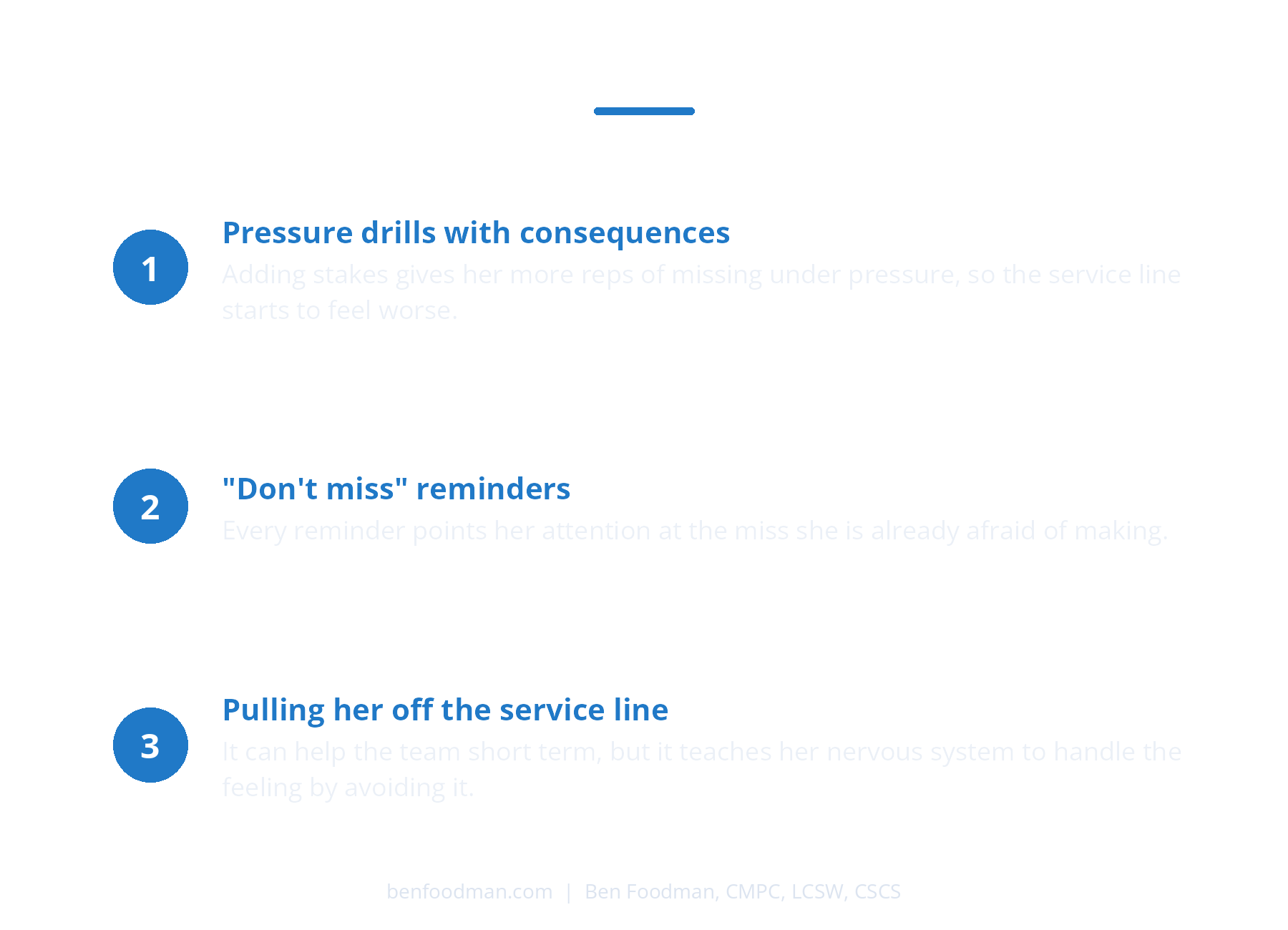
What I have found over the years dealing with this all of the time is that there are three common fixes can backfire for a player with a block:
Pressure drills with consequences. If every drill adds stakes, she gets more reps of missing under pressure, and the service line starts to feel worse, not better. This is like trying to use a hammer for every problem you have…it may just not be the right tool.
"Stop thinking too much" instructions. Every reminder points her attention at the miss. A player who is already afraid of missing does not need another reason to think about it. But telling athletes they are ‘thinking too much’ is not helpful, actionable, or even the accurate fix.
Pulling her off serving or moving her to underhand. It can be the right short-term call for the team. It also teaches her body that the way to handle the feeling at the line is to avoid it, and avoidance tends to make a block last longer.
What these fixes have in common is that they work on the serve. The block is not in the serve. It is in how her body responds to serving under pressure, and that is what has to be trained. An athlete needs to use tools that focus on the subcortical brain region, not the neocortex.
What Actually Helps a Player Serve Well in Matches Again?
What usually helps is training her nervous system to become comfortable with discomfort through the use of somatic, desensitization techniques. These approaches enhance an athlete’s nervous system to be able to take on more stress and become comfortable with discomfort. Methods like Brainspotting and biofeedback work directly on the stress response. The sessions are typically mentally difficult while she is in them, followed by elimination of performance anxiety, and most athletes need 15 to 25 sessions on average. Following this intervention, the serving mental block typically goes away.
A multi-modal approach is typically the most effective approach. The first part of this approach involves in-person mental coaching that utilizes interventions such as desensitization techniques like EMDR (Eye Movement Desensitization & Reprocessing) or Brainspotting, but under the guidance of a professional who has both advanced training and applied experience working with athletes. These individuals typically possess the CMPC certification (Certified Mental Performance Consultant) through the Association for Applied Sport Psychology, graduate degrees in sport psychology, and in some cases also possess mental health licensure. This combination of training allows them to tailor the EMDR and Brainspotting to the athlete’s needs. Ideally, these sessions are done in-person but in some cases where appropriate, they can be done online. Sport psychologists are starting to see the value in utilizing these approaches because there is emerging research that has shown how these types of interventions can help athletes overcome mental blocks in their sport.
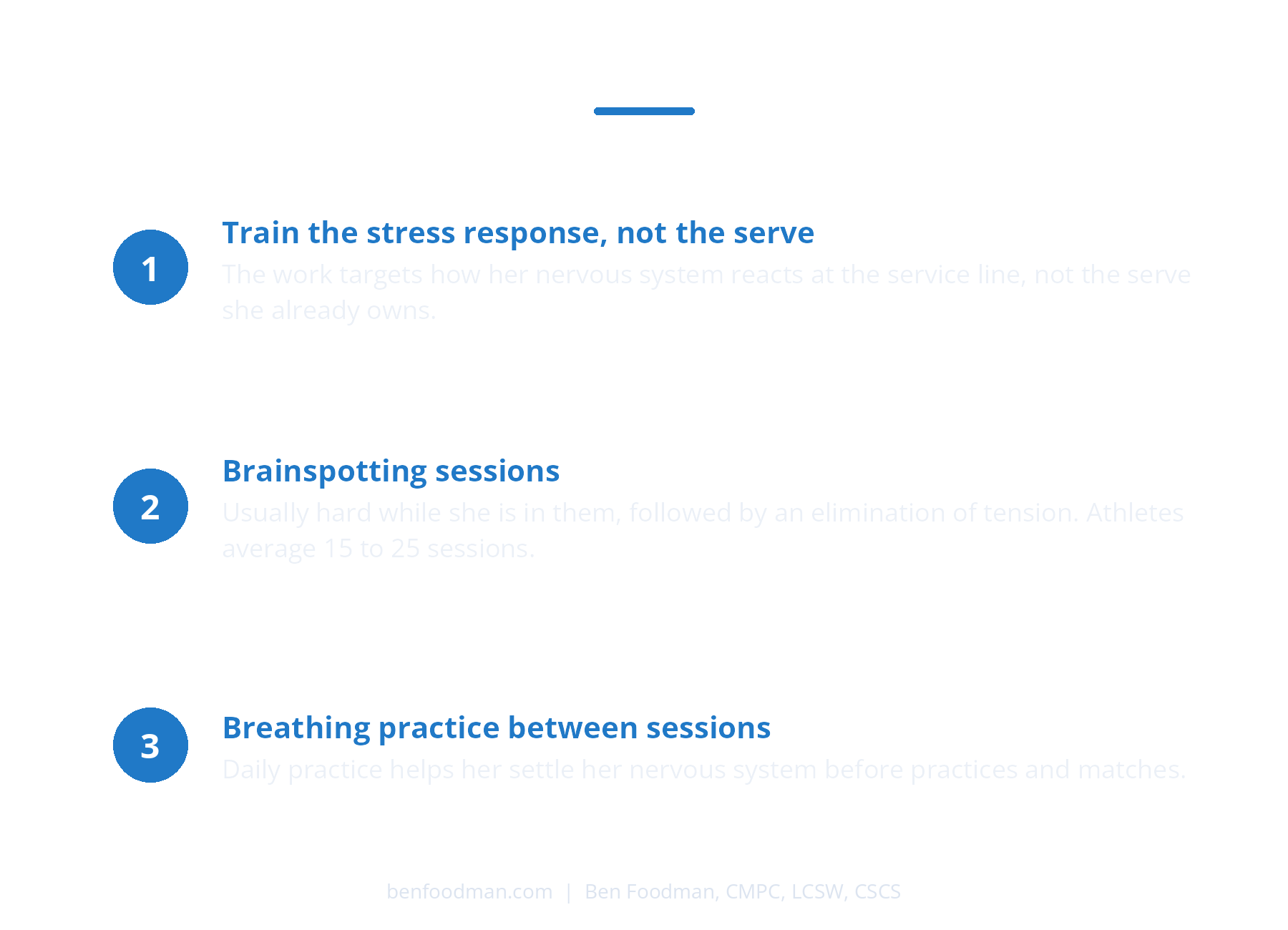
The second part of the approach is the out-of session work that the athlete needs to do. This should involve a combination of specific types of breathworks such as diaphragmatic breathing, biofeedback, and energy management techniques that involve stress-recovery tracking. These practices and interventions need to be integrated into the athlete’s schedule with oversight from a Certified Mental Performance Consultant who has training and advanced knowledge on the autonomic nervous system as well as exercise science protocols. This is because these interventions need to be slowly and methodically integrated in the same way a strength coach uses periodization to help build up an athlete’s physical strength. What I have found is that when athletes are dedicated to the process, it can take them anywhere between 3-4 months to successfully integrate their mental conditioning program into their regimen. Once athletes do this, it significantly reduces the chances that they will experience mental blocks in their sport again. There are several common benefits that athletes report after undergoing this specific mental training protocol:
reduced symptoms or complete elimination of the mental block
performance anxiety symptoms turn into excitement nerves
athletes report increased energy
many athletes report experiencing elimination of burnout
the athlete’s support system reports that the athlete exhibits behaviors consistent with being comfortable with discomfort
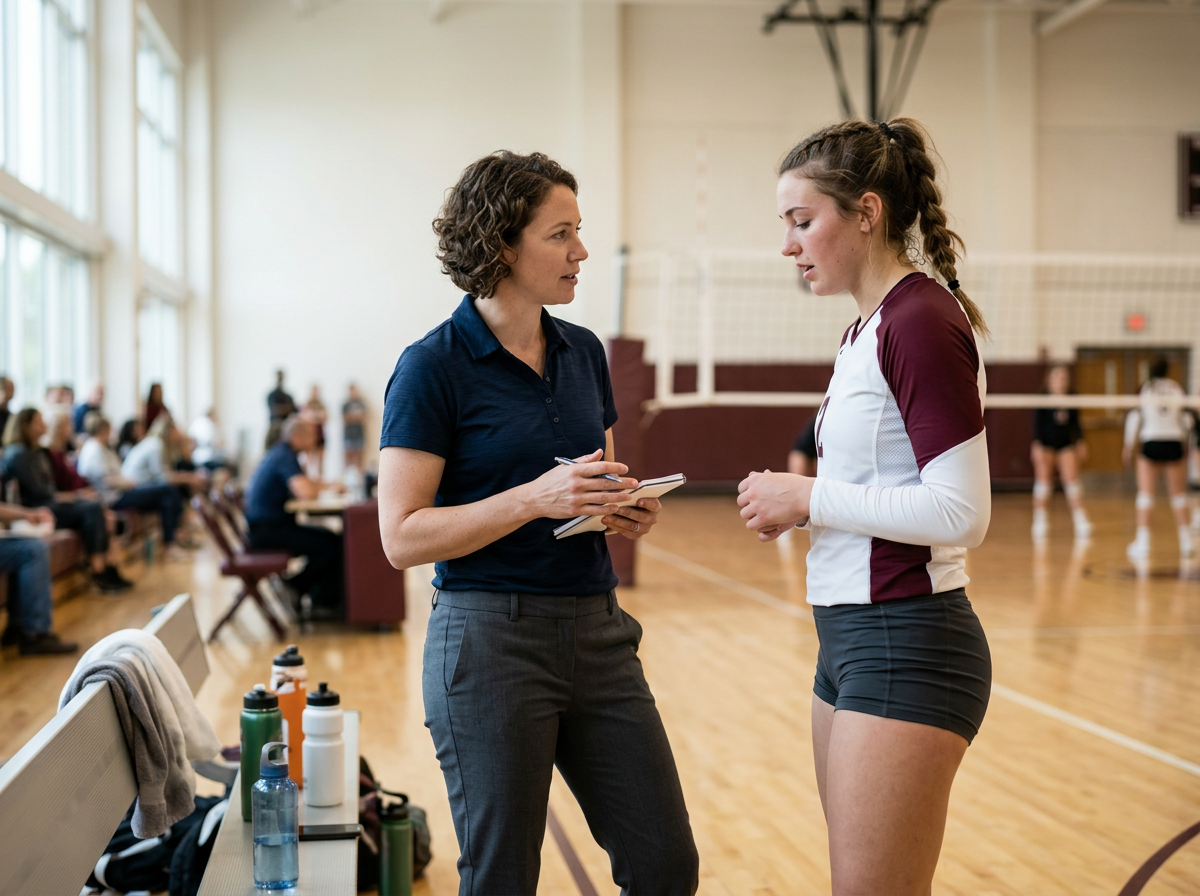
Case Study: How Brainspotting mental training helped a D1 Volleyball player overcome her mental block on serves
The client’s personal information and other descriptions of this case have been changed to protect their identity, but the core events of the story are true. We will refer to the athlete using the alias Kylie. Kylie was a BIG10 volleyball player and was highly ranked as a recruit coming out of high school. She began experiencing a mental block with serving during her junior year of high school but was able to hide the problem until the middle of her freshmen year. She had previously worked with a mental health therapist and sport psychologist with no success. Her family and coach reached out to me to have her begin her mental training with me. It took is slightly above the average number of sessions to overcome her mental blocks with serves, but after multiple brainspotting appointments and using the out of session mental conditioning program, she went back to serving at a high level and became an invaluable starter for her team throughout the remainder of her time at the university she was competing for.
Kylie had experienced multiple injuries in high school which included 2 concussions and 1 ACL tear, all of which were sport-performance related injuries. She had also been involved in a car accident during early childhood that required her to be in a wheelchair for several months. Prior to working with me, during her freshmen year at the BIG10 University she was attending, she began to experience significant problems with her serve which were the result of her mental block. She reported experiencing increased symptoms of muscle tension, sweating in her hands, racing heart, and temperature changes in her forehead. She was referred to the sport psychologist for the university as well as the university counseling center but had no improvements in her issue. They had given her the following strategies to help overcome her issue:
daily journaling to write down positive affirmations
create reminders to focus on the positive experiences within the competition
when anxiety arises, take 10 deep breaths using box breathing
spend more time focusing on the controllables and ignore the past
visualize positive serve outcomes
consider quitting the sport
After multiple sessions with no success, her coach and family reached out to me to get her started on her mental training to overcome the issue. One of the primary interventions I used was Brainspotting. In Brainspotting there are 2 different approaches that you can use: activation or resourcing.
Activation can be a faster approach where you have athletes focus on the thoughts and feelings that cause distress. This conditions their brain to be desensitized to negative emotions and negative thoughts surrounding the sport movement.
Resourcing on the other hand has the athletes spend more time focused on calming their nervous system while visualizing negative sports thoughts. This approach allows athletes to be grounded while processing uncomfortable thoughts and emotions.
Both are highly effective, but one approach can sometimes be more effective for some athletes compared to others depending on the individual athlete’s needs and psychological dispositions.
For Kylie, we went with a resource model. During the sessions I would have her first identify where she felt most calm in her body (often times it was her feet) and then we would find the eye positions that she felt allowed her to focus on her feet the most, while processing her negative sport experiences and injury history. She would visualize the bad serves that resulted in sports humiliations as well as some of her previous injuries. While there were some initial setbacks in our work (having good performances followed by really bad performances), she noticed that the symptoms she had been experiencing prior to working with me slowly began to fade. Her anxiety symptoms eventually transformed to excitement, and she was able to consistently serve the ball with hardly any errors as well as perform with confidence. She also reported that if she experienced a mental error or setback, she could regain her composure incredibly fast and mentally reset quicker than ever before. If you would like to get more details about what Brainspotting sessions are like, I encourage you to check out my step-by-step process using this intervention with athletes.
Frequently Asked Questions About Volleyball Serving Mental Blocks
-
If she misses in practice too, yes. A serving coach is the right call when her toss, contact, or swing is inconsistent in every setting. If her mechanics hold up in practice and fall apart only in matches, more technical lessons usually will not reach the part that is breaking down.
-
Either can help, and the method matters more than the title. The title sport psychologist generally means a licensed psychologist, while Certified Mental Performance Consultants are certified through the Association for Applied Sport Psychology. Many professionals in both groups rely on routines, self-talk, and imagery, so for a true block, ask whether they work directly with the body's stress response.
-
Usually longer than a few weeks. Sessions typically run about an hour, weekly or every two weeks, and athletes need 15 to 25 sessions on average. Some move faster and some complex cases take longer. Changes often show up in how she feels at the line before they show up in her match serving numbers.
-
Often, yes. Parents tend to say serving anxiety, coaches say nerves, and athletes in other sports say the yips, but they are usually describing the same thing: a skill she owns breaking down under pressure. The same pattern shows up in baseball players who lose their throw.
-
No, because this is not a mechanics problem. Oftentimes when athletes try to make adjustments to their mechanics, this can cause more problems, because even with those adjustments, it is more likely than not that they will still experience the symptoms that go along with this issue. Working with a mental performance expert that has specialized training in EMDR and/or Brainspotting is usually the best approach to start with.
-
Less than you think. She already knows she missed, so skip the post-game breakdown and the "just relax" or "you’re thinking too much" advice. Ask how the serve felt, let her coach handle technique, and make it clear the problem is solvable and does not change how you see her.
When Should a Parent Get Help for a Volleyball Serving Mental Block?
It depends on the athlete’s goals. If an athlete is just playing recreationally, get help when her serve holds up in practice but keeps breaking down in matches after her coach has worked on it and routines and pressure drills have not changed anything. At that point the problem is no longer her technique, and more serving practice will not reach it. If an athlete is preparing to play collegiately, they really should get help sooner rather than later. The psychological stress that comes with competing at that level of competition requires that the athlete engage in regular mental training in order to be prepared for those demands. Working with a Certified Mental Performance Consultant (CMPC) or licensed psychotherapist with specialized training in sport psychology is the safest approach and will allow athletes to have long, productive collegiate careers.
For volleyball players who are just playing recreationally, start with her coach, and add a private serving coach if her mechanics break down in practice too. If the coach has already worked on her serve and the answer has become "just relax" or "stop thinking too much," that is the sign she needs a different kind of training. When looking for a sport psychology expert, parents need to make sure that the professional focuses on somatic-based, desensitization protocols. This is because the part of the brain that is producing the mental block response, otherwise known as the subcortical brain region, primarily processes the environment through sensory information. These approaches help bypass the regions of the brain that are not involved with volleyball serving mental blocks and directly access the ones that are.
If this sounds like your player, please understand that there is effective help out there that can help her overcome this incredibly stressful problem. If you are interested in learning more, please check out my services page here. However, if you would like to speak with me directly, use the contact form below or use this link here to directly schedule with me to learn more about my services to see if my approach is possibly what you are looking for. For first time discovery calls, they are confidential video calls that run about an hour. I will send you a pre-call assessment to get a better sense of what your athlete is experiencing in order for me to be as prepared as possible for the time we have on the call. We will talk through what is happening at the service line, whether this kind of training fits her situation, and if it does not, I will point you toward someone who does.
Ready to implement these tactics? Book a consultation to see if services are right for you!
Sign up to learn more about new updates with Ben’s practice!
Check out older Training Report articles below for more resources!