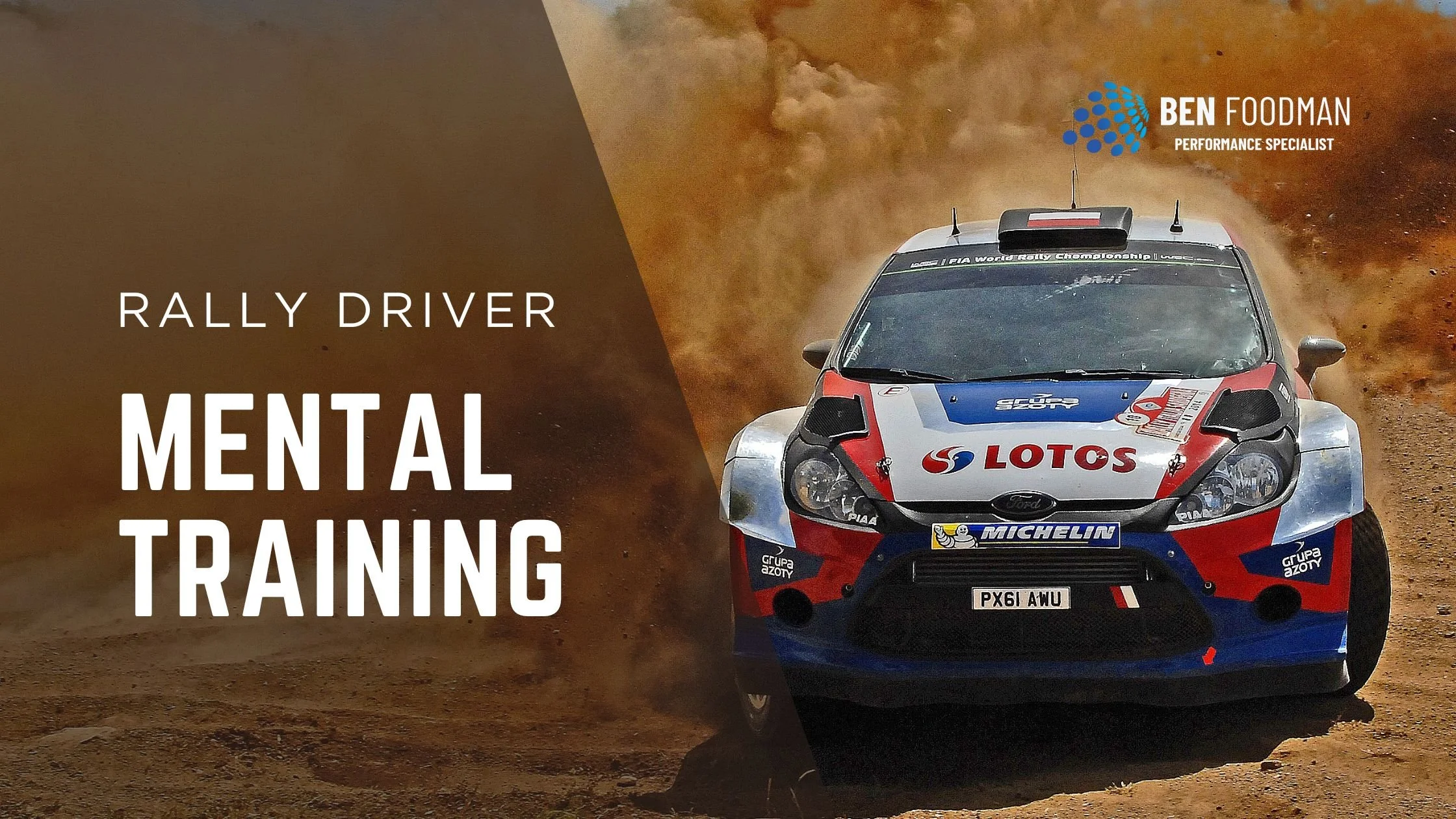

How Do WRC Rally Drivers Train For Mental Stress During Competition?
WRC Rally drivers train for mental stress by treating their preparation as a complete system: endurance-level physical conditioning to handle the 3000 to 4000 calories a race can demand, prehab-based exercise psychology to keep the body free of the pain and imbalances that steal focus and concentration, and Brainspotting to process the crashes, performance anxiety, and accumulated stress that motorsport inevitably produces. Because rally courses change surfaces, run through unpredictable terrain, and cannot be rehearsed in simulators, drivers must protect their memory, reaction time, and mental toughness by training the nervous system itself, not just the mindset.
Updated on 7/21/26, written by Benjamin Foodman, CMPC, LCSW, CSCS
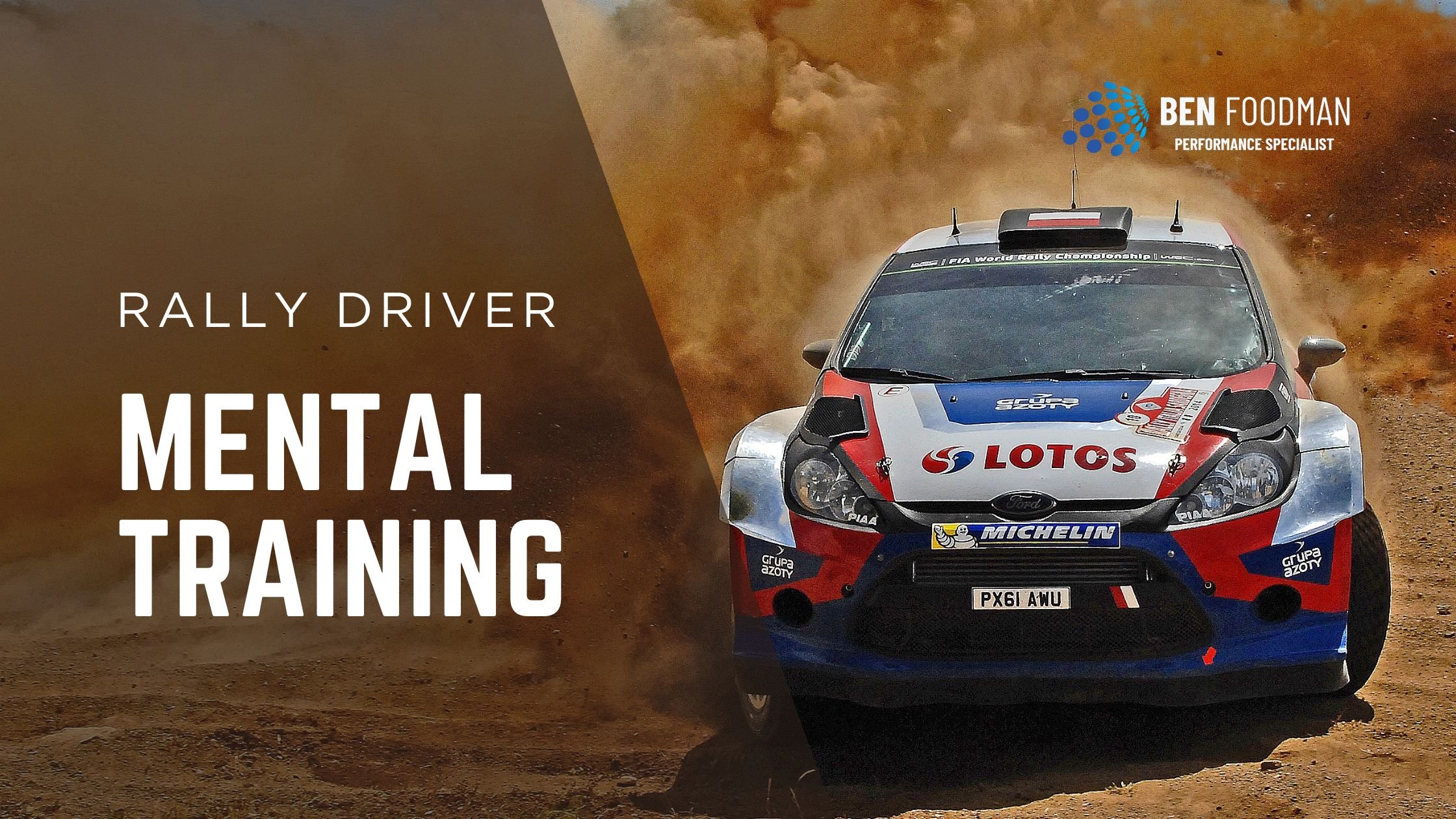
About the Author
Ben Foodman is a licensed psychotherapist & performance specialist. He owns his private practice located in Charlotte North Carolina where he specializes in working with athletes to help them overcome mental blocks (the yips), PTSD, ADD / ADHD and achieve flow states through the techniques of Brainspotting & Neurofeedback. If you are interested in services, use the link here! Enjoy the article below!

Table Of Contents
Why Is Rally One Of The Most Mentally Demanding Motorsports?
Rally driving demands a level of mental toughness and psychological focus that is nearly unmatched in sports: constantly changing surfaces, courses that must be run from memory at full speed, and no simulators to rehearse on. The mindset and mental training methods WRC drivers use to handle this stress have universal application for athletes in every sport.
I have been fortunate to work with some of the most talented racecar drivers on the planet. Being located in the motorsport’s capital of the United States certainly has put me in frequent contact with these athletes such as NASCAR drivers competing in the Cup Series, Xfinity and truck series or IndyCar drivers. But one of the most unique series in all of motorsports to work with are Rally racecar drivers. This sport requires a level of psychological focus that is almost unmatched in all athletics regardless of the sport category.
I believe that many of the training methodologies used by Rally drivers have universal application to all athlete populations. So, for this issue of the Training Report, I want to explore some of the training methodologies I have used with this athlete population as well as other motorsport athletes. For part I. I will discuss some of the physical demands required of Rally race car drivers. For part II. I will discuss some of the exercise psychology interventions I use with race car driver populations. Finally in part III. I will discuss a mental training strategy called Brainspotting that I use with these athletes.
Why Are WRC Rally Drivers Considered Endurance Athletes?
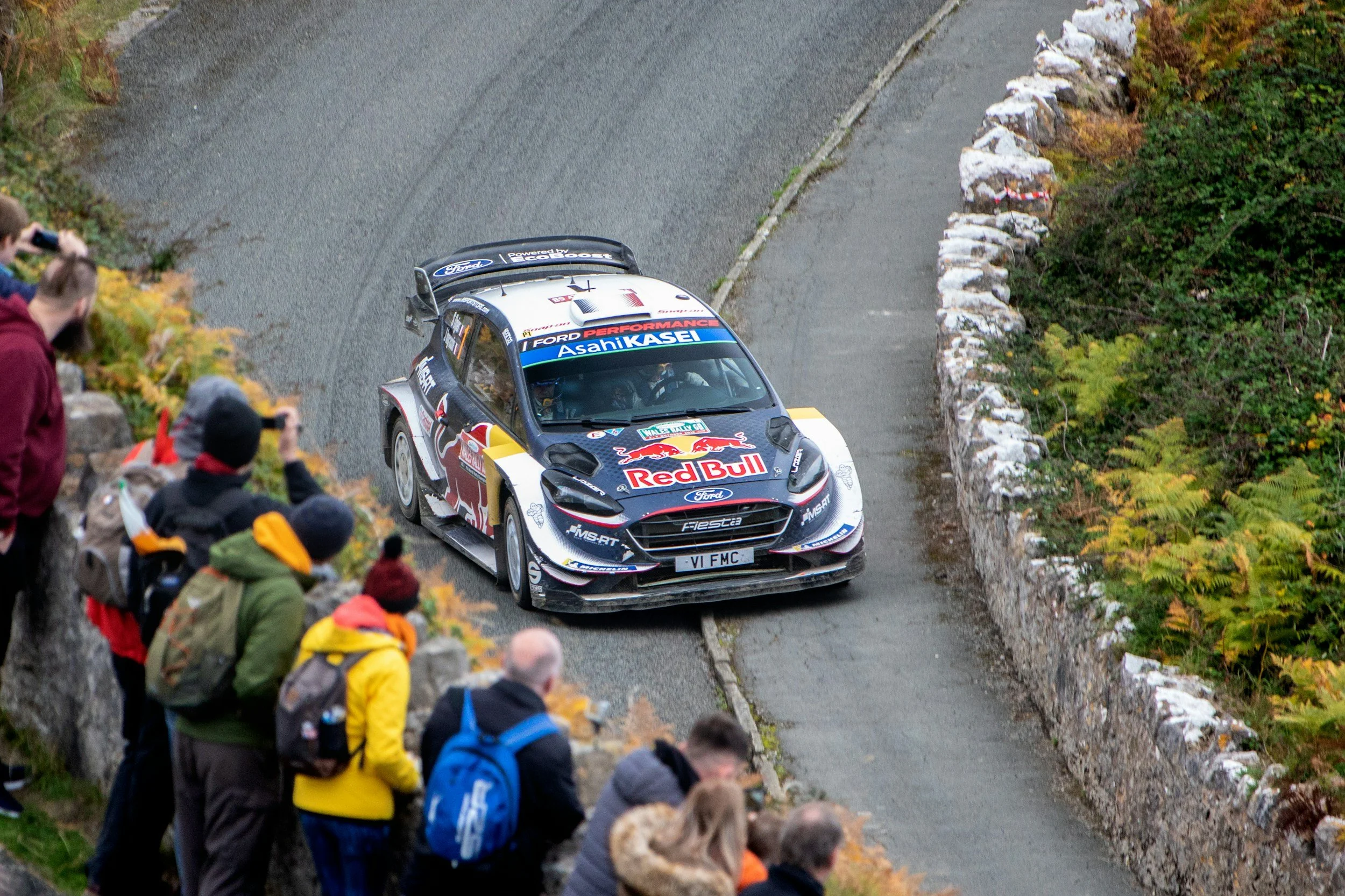
WRC drivers can burn an estimated 3000 to 4000 calories per race through static muscle tension against the car's forces, the heat of the helmet and fire suit, and the repeated strength demands of braking and throttle. Add courses that shift between mud, dirt, gravel, concrete, and ice, and rally becomes an endurance sport that tests memory, concentration, and split-second reaction times.
While the physical demands are somewhat similar in Rally driving versus NASCAR or IndyCar, there are some unique aspects as well. Rally drivers will expend incredible amounts of energy during performances, and some research has shown that these athletes can burn anywhere from 3000 to 4000 calories per race. There are many factors that can affect this, but some influencing factors include the heat produced from the body hold static muscle positions to compensate for the force of the car, the heat of wearing the helmet and fire suit, and the repetitive strength needed for braking and the throttle.
Other factors that are especially unique to Rally drivers are the reaction times that they have to deal with. The road courses that they run are often different in terms of the ground composition (the course can change from mud, dirt, concrete, gravel and even ice), these courses can change in elevation (drivers can be driving up narrow mountain passes or winding roads) and these drivers are not using simulators unlike NASCAR athletes. This means that they need to have incredible memories to run the correct race line, and fast-twitch reflexes that can respond to any stress stimuli in a heartbeat. So, what is one method these athletes use to train and prepare for these conditions?

How Do WRC Drivers Use Exercise Psychology?
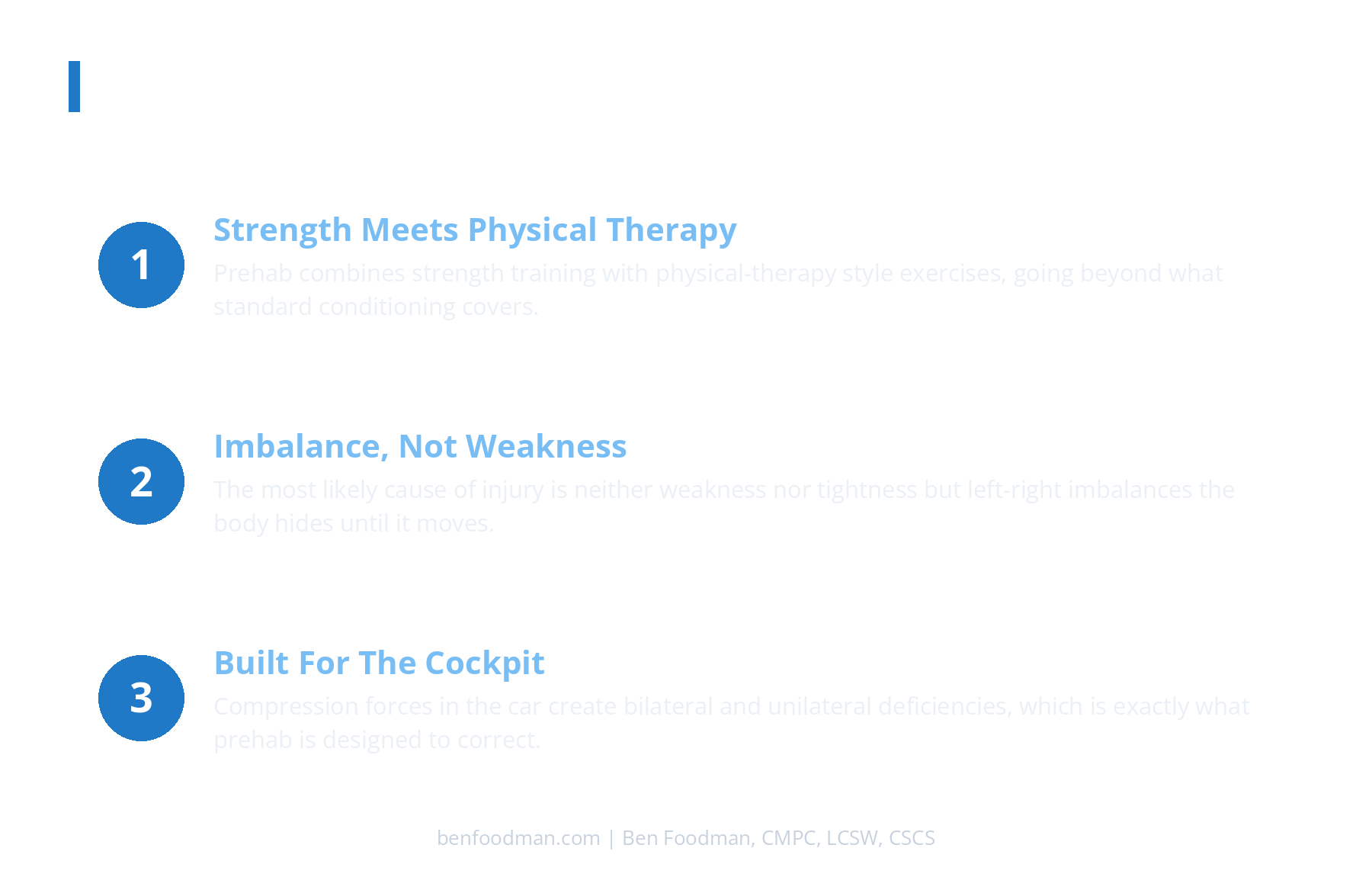
WRC rally drivers typically use exercise psychology through prehab: strength training combined with physical-therapy style exercises that injury-proof the body against the compression forces of the cockpit. The mental performance payoff is focus, because a driver whose body is free of pain and imbalance can keep his concentration on the race line instead of on what hurts.
Most sport psychologists use exercise psychology strategies to help people lose weight and stay motivated through a health crises. However, in my practice and in some of the more elite sports performance facilities, we are beginning to use exercise psychology tactics to enhance mental training outcomes. For example, one form of strength & conditioning training that actually has a exercise psychology-based application is Prehab. There are many different definitions and interpretations of what ‘prehab’ is. In the book The 4-Hour Body by Timothy Ferris the author quite simply defines prehab as ‘injury-proofing- the body. You could make the argument that all strength & conditioning is ‘injury-proofing’ the body, but when speaking with different exercise science professionals and bio mechanists, most of these individuals consider prehab to be a combination of strength training with physical-therapy style focused exercises. In Mr. Ferris’s book, he provides an example of how prehab specialists think about this issue: According to Gray the most likely cause of injury is neither weakness nor tightness, but imbalance. Think doing crunches or isolated ab work is enough to work your core muscles? Think again. ‘The core, as just one example, often works fine as long as one’s hips aren’t moving. It’s when the hips are moving-a more realistic scenario-that the core starts to compensate for left-right differences.’ That’s when you get injured.
Other experts in the field provide similar content to support the need to focus on Prehab interventions. In the book Becoming A Supple Leopard by Dr. Kelly Starrett, the following excerpt provides additional rational for this type of thinking: Prioritizing spinal mechanics is the first and most important step in rebuilding and ingraining functional motor patterns, optimizing movement efficiency, maximizing force production, and avoiding injury. In order to safely and effectively transmit force through your core and into your extremities, you need to organize your spine in a neutral position and then crease stability throughout that organized system by engaging the musculature of your trunk, which is knowns as bracing. This is the basis of midline stabilization and organization. To oversimplify this, if you are a professional racecar driver and your body is in pain, aching or your HRV is not in a good state, your mental focus will be compromised, and you will have a lot of disappointing performances.
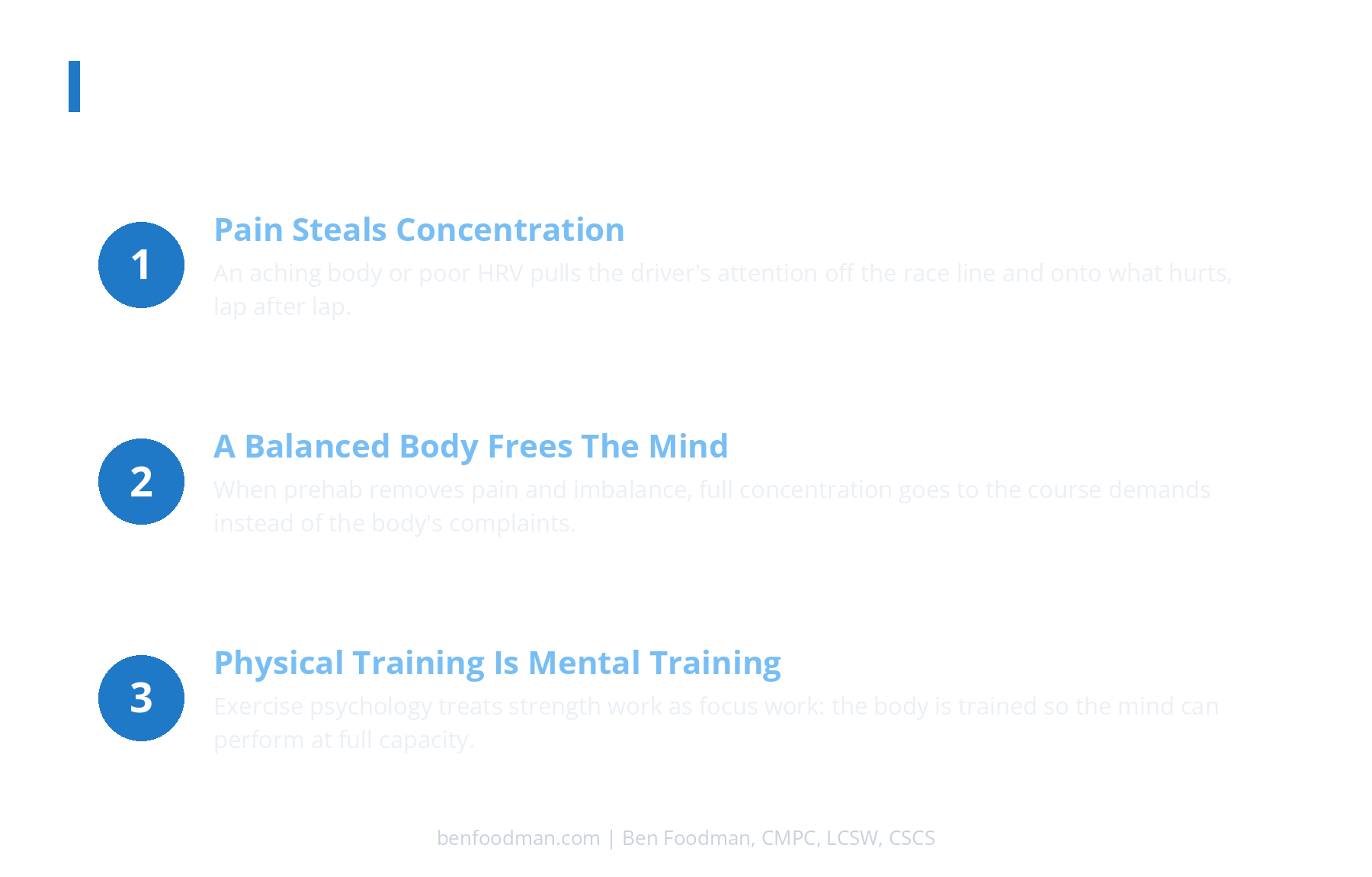
So what exactly does Prehab have to do from an exercise psychology perspective? Certified Strength & Conditioning Specialists and exercise physiologists follow the principle that all athletes should train using sport-specific movements. When we think about the physical demands of Rally drivers (and all motorsport athletes), prehab would be an ideal training methodology because the body will inevitably suffer from compression forces in the car, creating bilateral and unilateral deficiencies. However, I believe it is important to consider the psychological component of these driving stressors, because when Rally drivers and other motorsport athletes enter the cockpit, they will need to have their mind focused on the race line and course demands to achieve peak performance outcomes…not unwanted pain that is experienced in the body. But there is an additional mental training approach that these athletes should use to offset the negative outcomes of motorsport competition: Brainspotting.
How Do Racecar Drivers Use Brainspotting For Mental Training?
Brainspotting uses a driver's field of vision to access the brain regions where mental blocks, performance anxiety, crash trauma, and chronic pain from injuries are stored. Because nearly half the brain is dedicated to vision, holding a relevant eye position engages the regions responsible for regulation and bypasses the ones that are not, helping drivers rebuild confidence and move from constantly coping toward not needing to cope at all.
Brainspotting is a brain-based psychotherapy technique that utilizes the client’s field of vision to identify unresolved psychological issues. In Brainspotting we say, ‘where you look affects how you feel’ and through this process clients have the ability to access the parts of their brain that traditional psychotherapy approaches such as cognitive behavioral therapy are unable to do. This results in clients being able to directly address the true ‘underlying’ issue (which we refer to as a Brain Spot) that has created conflict allowing individuals to move from needing to constantly cope, to not needing to cope at all. Brainspotting can be used to help anyone who is dealing with mental blocks, the yips, psychologically traumatic events, chronic pain issues from injuries, as well as individuals who are trying to access deeper levels of creativity or cultivating mental flow states. When we think about the potential issues that all racecar drivers in every racing series deal with such as concussions, TBIs, car crashes, witnessing colleagues crash, sport humiliations, sports-injuries, out of sport trauma (e.g. car accidents, interpersonal relationship issues), it can be easy to see why this intervention pairs perfectly with this athlete population.
The goal of all psychotherapy interventions are to help clients move from dysregulation to regulation. For instance, if you are a racecar driver and you have been experiencing mental blocks such as increased pre-performance anxiety or fear responses, this can be considered a state of dysregulation. Because almost half of the brain is dedicated to vision, we use the client’s field of vision combined with focused mindfulness to help engage the regions of the brain that are responsible for regulation and bypass the regions that are not! This physiological approach can help clients achieve their desired psychological outcomes. When athletes work with a sport psychologist who uses Brainspotting, they will first identify what the issue is that they would like to resolve. These issues can range from experiencing pre-performance nerves in sports, to having decreased response times during driving performances. Clients discuss the issue in-depth and then the sport psychologist invites clients to have their eyes follow a pointer that the clinician will move in certain directions to identify the eye position that is relevant to the topic that the client is looking to resolve. Once the eye position is identified, the client will hold that eye position for several minutes up to two hours potentially until the issue is resolved. Racecar driving is inherently dangerous and there will be predictable and inevitable stress outcomes induced on the body. Rally car drivers need to mentally train to stay ahead of these issues and Brainspotting is the perfect intervention for this! If you still want more information on this, check out my mental training guide specifically for racecar drivers here or you can also review my advanced guide on Brainspotting mental training for elite athletes here.
Frequently Asked Questions About WRC Rally Driver Mental Training
-
Rally drivers face a combination of stressors that most other series do not: course surfaces that change between mud, dirt, gravel, concrete, and ice, elevation changes through narrow mountain passes, and no simulators to rehearse on. This means drivers must run the correct race line from memory while maintaining split-second reaction times, a combination of concentration, mental toughness, and recall that few sports demand at once.
-
Prehab is a combination of strength training and physical-therapy style exercises designed to injury-proof the body, particularly against the compression forces and left-right imbalances that racing creates. The mental performance payoff is focus: a driver whose body is free of pain and imbalance can keep his concentration on the race line and course demands instead of on what hurts.
-
Brainspotting uses the driver's field of vision to access the regions of the brain where crash trauma, performance anxiety, mental blocks, and chronic pain from injuries are stored. Because racing predictably produces these stressors, drivers use this work to process them at the root rather than constantly coping with the symptoms. Fair warning: sessions are usually very uncomfortable and difficult while you are in them, with the massive tension release typically coming after, and on average this work takes 15 to 25 sessions.
Note To Reader:
If you are an athlete reading this segment of the TRAINING REPORT, hopefully this content was helpful! I put the Training Report together because I felt like many of the discussions on issues such as the Yips/mental blocks, strength training & other subject matter on athlete performance concepts were really missing the mark on these ideas (e.g. how trauma is the direct cause of the Yips). If you are interested in learning more, make sure to subscribe below for when I put out new content on issues related to sport psychology & athlete performance! Also, if you are looking to work with a mental performance specialist, you are in the right place! USE THIS LINK to reach out to me to see if my services are the right fit for your goals!
ARE YOU ON THE LIST?
Make sure you’re signed up to Ben’s mailing list to receive news & updates on new strategies in sport psychology, upcoming workshops & products. Don’t wait, sign up now!
Check Out The Previous Training Reports!