
HOW DO RACECAR DRIVERS TRAIN THEIR MENTAL PERFORMANCE?

Advanced mental performance training for professional racecar drivers is structured training that targets how a driver's brain and nervous system respond to the psychological demands of competition. Instead of relying on traditional approaches built on willpower or positive self-talk, advanced training uses methods such as biofeedback, Brainspotting, and exercise psychology to build the processing speed, composure, and recovery capacity that racing requires.
Last Updated [7/9/26] | Written by Ben Foodman, CMPC, LCSW, CSCS — a Certified Mental Performance Consultant, Certified Brainspotting therapist and licensed psychotherapist based in Charlotte, NC, specializing in helping professional racecar drivers competing in NASCAR, IndyCar, & IMSA overcome mental performance blocks and increasing aggression. Learn more here.

What Is Advanced Mental Performance Training for Racecar Drivers?
Advanced mental performance training for professional racecar drivers is structured training that targets how a driver's brain and nervous system respond to the psychological demands of competition. Instead of relying on traditional approaches built on willpower or positive self-talk, advanced training uses methods such as biofeedback, Brainspotting, and exercise psychology to build the processing speed, composure, and recovery capacity that racing requires.
Racing asks more of the brain than almost any other sport. A driver processes track position, grip changes, entry security, traffic, spotter or engineer communication, and car feedback in real time, at speeds where a decision arrives and expires within fractions of a second. All of this happens in a cockpit that can reach 140 degrees, under sustained g-load, across races that can run for hours. The margin between making the podium and missing it is often measured in tenths of a second. At that margin, the limiting factor is frequently not the car and not the driver's talent. It is the state of the driver's mind and nervous system when the pressure arrives.
Outside of baseball, racecar drivers are one of the sport populations I have the most experience with, spanning NASCAR, IndyCar, and IMSA. The drivers who reach out to me are almost never short on talent or preparation. What they describe instead is a gap between what they know they can do and what happens in the car at specific moments: during qualifying they tighten up, hesitate at corner entry after a crash, drive timid (trying not to lose rather than win), and cannot tap into the necessary aggression needed to beat their competitors. Most of these responses are involuntary and happen faster than conscious thought. Their team tries to help by saying things like 'just relax' or 'you're overthinking, stop thinking too much' and yet despite these comments or all the adjustments that are made to the driver's setup, the positive coaching and the adjustments to the car rarely change anything. The body language is still bad, and everyone on the team feels it. If mental training is going to work, it has to reach the level of the nervous system where those responses originate from.
That is what this guide covers: what racing actually demands from a driver's brain, the specific challenges drivers bring to this work, how mental training fits into the structure of a race week, and the methods I use in my own practice. Quick side note before you keep reading: if you are a driver dealing with something you have not been able to train your way out of, reach out to me and book a free consultation call using this link here.
Why Is Racing One of the Most Mentally Demanding Sports?
Racing is one of the most mentally demanding sports because it forces the brain to make high-stakes decisions at speed while the body is forced to endure severe physical stress. The same competition that taxes a driver's focus also floods the body with stress hormones and drives core temperature up, and those physical demands directly degrade the mental processing a driver depends on.
Consider what the body goes through in the car. A study of rally drivers measured stress hormones and heart rate before and after a single competitive stage and found significant increases across nearly every marker: epinephrine, norepinephrine, cortisol, and aldosterone all rose, and heart rate climbed by roughly 93 percent. That was one stage, not a full race. The takeaway is not the exact numbers, which vary by racing series and driver, but the scale of the response: competition drives the body into a severe stress state, and it does so in the most brutal, unrelenting fashion.
Another aspect of professional racecar competition is the heat that drivers must endure. Research on stock car drivers during an actual NASCAR race documented core body temperature rising over the course of the event, along with measurable fluid loss and thermal strain. The mechanism is specific to the sport. A driver is sealed inside fire-protective clothing that is built to keep heat away from the body in a crash, which means it also blocks the evaporative cooling that sweating would normally provide. The cockpit itself can reach 140 degrees while the driver is working inside a hot box with the body's main cooling system switched off. While there certainly are support mechanisms in place such as cool shirts, in my experience I have seen many of these mechanisms fail and create even more harsh conditions. Multiple times, drivers I have worked with reported to me that not only did their cool shirts fail, but the system would occasionally pump boiling hot water, raising their core temperature even more. The published numbers above come from shorter races under normal conditions. At the extreme end, in long events where the cooling system quits, wearable biometric data from drivers I have worked with has shown calorie burn in the 6,500 to 7,000 range and body weight losses approaching 10 pounds. While those are outliers, they are worth knowing about, because they show what this environment is capable of demanding from a driver.
Regardless, here is why that matters for the mind and not just the body. The brain has a large metabolic appetite, and high-stakes cognitive work under stress burns through its available resources quickly. In normal, optimal conditions, despite the brain only encompassing approximately 2 percent of an individual's total body weight, it consumes approximately 20 percent of all energy reserves. But in less optimal conditions such as a NASCAR Cup Series cockpit, as core temperature climbs and stress hormones stay elevated across a long race, the same processing speed and decision-making a driver relied on early becomes harder to sustain. This is the physiological reason a driver can feel sharp in the first stint and then find that focus, reaction time, and judgment quietly erode as the race goes on. It is not a character flaw or a lack of mental toughness. It is the predictable result of asking a stressed, overheating brain to keep performing at its ceiling. The laws of nature get the final vote no matter what.
This is the part most people outside the sport underestimate. When I walk people through what a driver's body and brain are actually doing during a race, the reaction is usually surprise that anyone can make precise, split-second decisions in that environment at all. While many drivers can relate to the experiences I have just described, even they are surprised at how much of this is out of their control. The reason these racecar drivers can do it is because they are extraordinary athletes. But the environment sets a hard ceiling on mental performance and raising that ceiling is exactly what focused mental training is built to do.
What Mental Performance Challenges Do Racecar Drivers Face?
Racecar drivers most often struggle with qualifying pressure, hesitation at corner entry after a crash or near miss, and a loss of the controlled aggression the sport requires. These are not failures of talent or mental toughness. They are an involuntary nervous system response to a brutal, harsh environment that punishes athletes physically and mentally, where mistakes carry real, long-term consequences.
Qualifying is where this shows up most visibly. A driver has one or two laps, no traffic to blame, and a number that goes on a board for the entire garage to see. Under that pressure the same driver who is fast in practice will lift a fraction early, brake before the marker, and lose commitment through the corner that decides the lap. The driver usually knows this is going to happen before the event starts but is helpless to stop this response from happening, which is its own kind of frustrating. I have written a full breakdown of why the nervous system does this and how drivers mentally train out of it in this guide to qualifying pressure.
Then there is what happens after a crash. This is the challenge drivers are least likely to bring up on their own, and the one that most often brings them to me eventually. A driver who has been in a hard wreck will frequently find that the corner where it happened, or a corner that simply resembles it, produces an involuntary hesitation outside of his control. The throttle comes up early. The commitment is not there. The corner is dangerous, and he knows that. Every corner in this sport carries risk and drivers accept that risk before they ever strap in. What has changed is that his body has started responding to that corner as a threat, and that response arrives before he has a chance to decide anything.
It is worth being clear that this is not only a problem exclusively for drivers who have crashed. In my experience the same pattern shows up in drivers who watched a teammate get hurt, drivers who were close enough to a serious wreck to understand exactly what they were looking at, and drivers who have simply accumulated multiple seasons of near misses that individually seemed like nothing. The brain does not carefully sort experiences by whether they happened to you or not, but it registers that something in this environment can end badly, and it starts scanning for it.
Here is the mechanism underneath all of this. When an event overwhelms the brain's capacity to process it in the moment, the memory does not get filed the way ordinary memories do. It stays partially unprocessed, and the body keeps an alarm running so it can catch that event coming next time.
That alarm produces an anticipation response: the driver approaches a bend that resembles the one where the wreck happened, the brain flags a threat that is not actually there, and the throttle comes up for a fraction of a second before conscious thought has any say in it.
This is worth stating plainly, because drivers hear the word trauma and assume it means something is clinically wrong with them. It does not. Nearly every driver accumulates stress events over a career, and the overwhelming majority of them do not have PTSD.
Trauma in this context simply means a stress experience the brain never fully processed, and an unprocessed stress experience is enough to cost a driver a tenth in exactly the place he cannot afford to lose it. I cover how crashes specifically affect driver reaction time in this article on mental blocks in motorsport.
The version of this that drivers describe most often, and the one crew chiefs feel first, is a loss of aggression.
The driver stops racing to win and starts racing not to lose. He leaves a car length he does not need.
He takes the safe line. His body language in the debrief looks awful, and the team notices.
Drivers rarely name this problem out loud because naming it feels like admitting something about their grit, which most of the time is not what is happening at all.
What is happening is that the nervous system that is in a hypervigilant state cannot also produce the committed, aggressive driving that a fast lap requires.
The two states are physiologically incompatible.
Aggression is not a thing a driver decides to have.
It is what becomes available once the alarm is off.
For drivers dealing with the physical side of this, particularly after impacts, I have written about whiplash syndrome and its effect on driver aggression.
Do Racecar Drivers Work With Sport Psychologists?
Yes. Racecar drivers across NASCAR, IndyCar, and IMSA increasingly work with mental performance professionals, though the field includes several different roles that are easy to confuse. Sport psychologists, Certified Mental Performance Consultants, licensed psychotherapists, and mental coaches are not interchangeable, and the differences matter when a driver is deciding who to call.
The category is genuinely crowded, and the titles are more confusing than they should be. No state issues a license called sport psychologist. Anyone using that title is a licensed psychologist who, unfortunately, may or may not possess specialized training in working with athletes. The title alone does not help a driver identify who has the correct expertise. This is exactly the problem the Certified Mental Performance Consultant credential exists to solve. The CMPC, issued through the Association for Applied Sport Psychology, is the field's leading certification for applied sport psychology, and unlike a title, it cannot be claimed without completing graduate-level coursework in the field, a supervised mentorship, and a certification exam. Whatever a professional calls himself, the CMPC is the clearest way for a driver to verify that sport-specific training actually took place. Beyond that, licensed psychotherapists, a category that includes licensed clinical social workers and licensed counselors, are trained to work with mental health conditions, and a large number of people work as mental coaches or mindset coaches with no licensure or certification requirement at all. All of these can be found working in motorsport paddocks.
What separates them in practice is less about the title and more about both their applied experience and what the professional is actually trained to do when a driver's problem turns out to be a nervous system problem rather than a thinking problem. A great deal of traditional work in this field is what practitioners call top-down: building insight, restructuring self-talk, teaching routines. That work has some value, but it also has a ceiling, and drivers hit that ceiling regularly, which is why a driver can understand exactly why he lifts early in turn three and that understanding still does not prevent him from involuntarily lifting early in turn three.
In regard to my specific training, I am a Certified Mental Performance Consultant (CMPC) through the Association for Applied Sport Psychology, a licensed psychotherapist, a Certified Strength and Conditioning Specialist, and a Certified Brainspotting Therapist. My work with racecar drivers specifically focuses on mental performance: I help drivers condition their nervous system responses so that they are aggressive and focused, but my work is not focused on helping drivers process early childhood experiences. I have written in more detail about why this distinction matters and what it looks like in practice in this case study on mental performance coaching for racecar drivers.
My clinical license allows me to identify when there is an underlying clinical issue that goes beyond performance. Occasionally it does. When that happens, I am able to have an honest conversation about it rather than coach around something that needs different attention, and depending on what the driver needs, that may mean working with me in a different capacity or being referred to someone better suited to it. Most of the drivers who contact me do not need that. They need the alarm turned off so they can drive the way they already know how to drive.
How Do Racecar Drivers Train Mentally During the Race Week?
For elite racecar drivers, mental training is not something that happens once. It is built into the structure of the race week, from midweek preparation through the minutes right before the driver climbs into the car. The most effective drivers treat the mind the way they treat the car: something to be set up deliberately. Drivers are not finding their talent on the track, they are bringing it to the track.
Based on my applied experience, the foundation is nervous system training done away from the track, and the most practical tool for it is biofeedback. Biofeedback uses equipment to show a driver what his own physiology is doing in real time, heart rate, breathing, and heart rate variability, and teaches him to shift himself into a calmer, more efficient state on command. This is not relaxation for its own sake. A systematic review of heart rate variability biofeedback across a range of sports found that athletes improved their performance through this kind of training in the large majority of the studies examined. For a driver, the payoff is specific: a nervous system that returns to baseline faster between runs, burns less energy across a long race and keeps decision-making sharper deeper into the event. The goal throughout is a nervous system that recovers quickly and holds its composure under load.
Then there is the work that happens in the final hour, and this is where most drivers leave time on the table. Borrowing a concept from Olympic weightlifting, I have drivers use a preload routine before they get in the car. Preloading is the recognition that just because a driver's mind is ready does not mean his body is, and just because his body is ready does not mean his mind is. The routine synchronizes the two before the driver ever gets into the cockpit, so he is not still trying to find focus on the out lap. I build it in three phases.
The first phase is body prehab. Before and after driving, drivers benefit from targeted activation work, core stability, glute activation, and the specific areas that absorb the punishment of the cockpit. This is not general fitness, but instead is making sure the body is not quietly sending distraction signals to the brain while the driver is trying to focus, because a driver managing lower back pain in the car is a driver spending focus he needed for the track.
The second phase is exercise psychology. Low-intensity, coordination-focused movement done shortly before getting in the car helps synchronize the mind-body connection in a way that sitting in the hauler does not. This is a genuinely under-used tool in motorsport, and it comes directly from how Olympic strength and conditioning specialists prepare athletes: the body needs a physical activation protocol to bring the mind and body online together, not just a mental one.
The third phase is reflex and focus enhancement, done as close to getting in the car as possible. Short reflex and eye-tracking work warms up the exact systems the driver is about to rely on, so he starts the session already sharp instead of building into it over the first several laps. In the professional paddocks I have worked in, some version of this is standard operating procedure among the drivers who take preparation seriously. I have written more about building modern mental skills into a driver's routine in this article on mental skills training for racecar drivers.
Heat training deserves its own mention here. Drivers can train the body to become heat-adapted, and most do not. The physiological benefits are well established, but the part that interests me is what it does for the mind. In one study, rally drivers who completed four days of repeated heat exposure while running simulated stages showed reduced perceived thermal strain, improved psychomotor performance, and after using the protocol before an actual rally, reported that they tolerated the heat better and controlled the car better. Repeated, controlled exposure to the heat teaches a driver's nervous system that this environment is survivable and workable. The same cockpit temperature that used to consume his attention becomes something his body handles in the background. That is focus he gets back on race day, and it is why I consider heat adaptation part of a driver's mental preparation and not just his physical one.
Underneath all of it is energy management. The brain is the single most metabolically expensive organ a driver has, and every lap of high-stakes decision-making draws down a finite reserve. Much of race-week mental training is really about protecting that energy reserve so the driver still has the psychological capacity to stay focused and aggressive when the race is decided, which is almost never on lap one. I go deeper into how drivers manage mental and physical energy across an event in this piece on energy management for drivers.

What Mental Training Interventions Do I Use With Racecar Drivers?
I use a specialized set of methods with racecar drivers, to help them both overcome mental blocks and withstand the psychological pressure associated with their occupation. Brainspotting, biofeedback, exercise psychology, and communication training all target the nervous system rather than the driver's conscious thinking, which is why they reach responses that insight and self-talk cannot.
The primary method I use is Brainspotting. Brainspotting is a brain-based mental training technique that utilizes the driver's visual field in order to access the part of the brain that produces mental blocks while bypassing the regions that don't. In practice, this is what allows a driver to finally deal with the stress responses attached to the corner where he crashed, or to the qualifying run where he tightens up. After Brainspotting, drivers can perform without their bodies producing responses they never wanted.
I want to be candid about what the process is actually like, because most descriptions of this work are not. Brainspotting sessions are usually very uncomfortable and difficult. Drivers access memories and emotions they have spent considerable effort dissociating from, and it does not feel good while it is happening. What drivers consistently report afterward is a massive release of tension, and a sense that something they had been carrying is no longer sitting in their body. That sequence is not incidental to the method. It is the method. Part of what a driver is training is the capacity to become comfortable with discomfort, which happens to be the same capacity a fast lap requires. I have written specifically about how Brainspotting helps NASCAR drivers with mental blocks, and I go into the full method, the research behind it, and what a session involves in my complete guide to Brainspotting for athletes.
Alongside Brainspotting, I use biofeedback to train the nervous system's baseline and its recovery, exercise psychology to synchronize the mind and body before a driver gets in the car, and a polyvagal-informed understanding of how a driver's system moves between states of composure, mobilization, and shutdown. Which methods a driver needs depends on what is actually in the way, which is what a first conversation is for.
What Is a Time Controlled Plan for Racecar Drivers?
A Time Controlled Plan, or TCP, is the structured protocol I build with a driver that governs what he does mentally and physically before, during, and after a performance. It is what turns individual mental training tools into a repeatable routine the driver can run on his own, at every race, without me there.
Most drivers I meet have pieces of a routine. They have something they do the morning of a race, or a basic breathing technique someone taught them, or a random habit they picked up from a teammate. What they do not have is a plan that accounts for the entire arc of a performance, sequenced so that each piece sets up the next, and built specifically around what their own nervous system does under load. That is what a TCP is for.
A TCP moves through six steps. The body warm up prepares the driver physically with prehab and exercise psychology work, so the body is not sending distraction signals. The body tune up addresses the specific areas that absorb the punishment of the cockpit. Feeding and hydration tactics protect the energy reserve the brain will draw down over the course of the race. The psychological warm up sharpens focus and primes reaction time immediately before the driver gets in the car. Competition analysis is the honest review of what actually happened in the car, separated from the emotion of the result. And the physiological cool down, done immediately on exiting the cockpit, brings the nervous system back down rather than leaving it elevated for hours after the checkered flag.
The point of a TCP is self-sufficiency. Because I am not constantly on the pit box, and a driver who constantly needs me or relies on me long-term in order to be ready has not actually solved anything. The plan is designed so that the driver eventually runs it himself, adjusts it himself, and knows why each piece is there. He becomes his own mental performance coach.
How Does Communication Affect a Racecar Driver's Performance?
A driver's communication with his crew chief and engineers directly impacts how fast his car can be. A driver who cannot decode the feedback he is given or cannot describe what the car is doing underneath him, ends up in a car that never gets fixed, and the losses compound across a season.
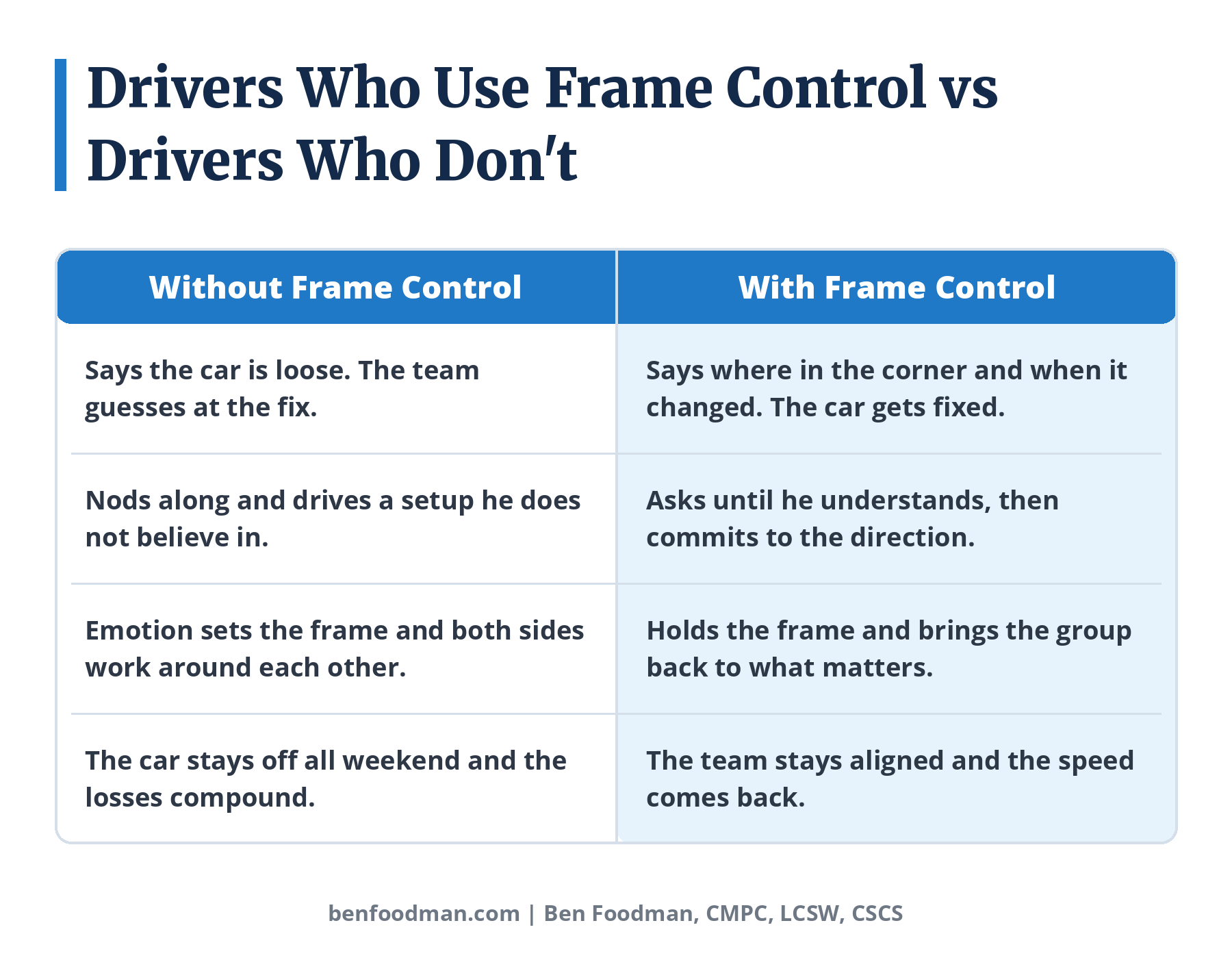
This is the part of driver performance that almost no mental training addresses, and it costs real positions. The engineering group can only work with what the driver tells them. When a driver says the car is loose and cannot specify where in the corner, or on which type of entry, or whether it changed as the tires went off, the team is guessing. They make an adjustment, but it does not fix the problem, and because the problem was described imprecisely, the driver loses confidence in the setup, and the team loses confidence in the feedback. Both sides start quietly working around each other and none of that appears on a timing screen as a communication failure. It appears as a car that is off all weekend.
The reverse failure is just as common. Crew chiefs and engineers speak in a technical register, and a driver who does not fully understand what he is being told will nod, get in the car, and drive a setup he does not believe in. Nobody says anything. Everyone assumes the other party is aligned.
Underneath both failures is the absence of what I consider to be one of the most important and powerful communication tools athletes and coaches can use: frame control. The frame is the shared understanding of what is actually happening and what matters right now, and in a race weekend the driver is more responsible for it than anyone realizes. He is the leader of that team, whether or not he thinks of himself that way. The frame in frame control is the mental filter, context, or set of boundaries used to perceive and interpret reality. Frame control means being able to set that shared understanding under pressure, hold it when a session goes badly, and bring people back to it when emotion pulls the group somewhere else. It also means being able to influence and persuade, because a driver who needs the team to commit to a direction has to be able to move people toward it. The distinction that matters is what the influence is for. A driver who wins the argument and loses the crew chief has not won anything. The goal is alignment, not getting his way.
Frame control is trainable, and it is nervous system work as much as it is a communication skill. A driver whose alarm is running cannot hold a frame, because a body in threat mode does not lead, it reacts. This is why the communication work and the nervous system work are not separate projects. They are the same project, approached from two directions. If any of this sounds like what is happening in your car, that is worth a conversation. You can book a free discovery call here.
What Does Working With Me Look Like?
Working with me starts with a conversation, not an assessment form. From there, most drivers move through a similar arc: I go through psychoeducation with athletes on what their nervous system is actually doing under stress-load, how doing the Brainspotting work builds the capacity to be comfortable with discomfort, and building a customized Time Controlled Plan drivers can run without me. The Brainspotting work itself takes 15 to 25 sessions on average, with additional sessions for psychoeducation and nervous system training, though the shape of it varies more in motorsport than in any other sport I work in.
The first conversation is a free, video discovery call. I want to understand what is happening in the car, when the problems started, what mental training is currently in place, what the driver has already tried, and what he thinks the problem is. That call also tells both of us whether I am the right person for the problem, and sometimes the candid answer is that I am not.
If we work together, the early sessions are about identifying what is actually driving the response. This is not a long process. Drivers tend to know exactly which corner, which session, which crash, even when they have never said it out loud to anyone. From there we begin with psychoeducation on the brain, we introduce nervous system regulation techniques, and then the bulk of the work is Brainspotting training.
During the nervous system regulation training, the driver begins with biofeedback training as we move into Brainspotting so that way they have something to consolidate into.
As the responses clear, we build the Time Controlled Plan around what the driver's own physiology needs, and the goal from the first session onward is that he eventually runs it without me.
Typically the Brainspotting arc takes 15 to 25 sessions on average, and I will not know where a specific driver falls in that range until we have started.
Psychoeducation runs around five sessions on average, depending on how much help each driver needs integrating that into their performance development.
Some cases stay looser than the arc above. A driver in the middle of a season with a specific corner problem is a different engagement than a driver rebuilding after a career-altering wreck.
Schedules complicate all of this, which is why motorsport looks different from my other sports. A driver on the road most weekends often cannot hold a weekly appointment. In those cases I work in intensives, longer sessions run over consecutive days, deliberately scheduled with a gap before the next performance so the nervous system has time to settle before it is asked to compete. The intensive model covers the same ground as the standard arc; it just compresses it into the calendar a race season actually allows. I work with drivers privately on a private pay basis, and I do not put a driver's mental performance work into an insurance record. For drivers who want to understand the work before reaching out, I have written about what actually resolves mental blocks for racecar drivers.
Frequently Asked Questions About Racecar Driver Mental Training
-
Not every driver does, and the ones who do need it for different reasons. Elite drivers often benefit from having a mental performance coach who is a support system away from the team, someone with an unbiased perspective on their situation. Younger drivers who are new to a specific racing series often need to learn baseline skills to enhance their overall performance. Regardless of the situation, mental performance training often can help drivers find the competitive edge they have been looking for.
-
The Brainspotting work typically takes 15 to 25 sessions on average, with additional sessions for psychoeducation and nervous system training. I cannot tell a driver where in that range he falls until we have started, because it depends on how long the response has been running, whether there were prior events layered underneath it, and what other stress the driver is dealing with. A driver dealing with a specific corner after one wreck is a different engagement than a driver rebuilding after a career-altering crash. What I can say is that this work is not open-ended. It is designed to end with the driver running his own plan without me.
-
Yes. Brainspotting sessions are usually very uncomfortable and difficult. Drivers access memories and emotions they have spent considerable effort dissociating from, and it does not feel good while it is happening. What drivers consistently report afterward is a massive release of tension and the sense that something they had been carrying is no longer sitting in their body. That sequence is the method working, not a side effect of it. Part of what a driver trains through this process is the capacity to be comfortable with discomfort, which is the same capacity a fast qualifying lap demands.
-
A Time Controlled Plan, or TCP, is the structured protocol I build with a driver that governs what he does mentally and physically before, during, and after a performance. It moves through six steps: a body warm up, a body tune up, feeding and hydration tactics, a psychological warm up, competition analysis, and a physiological cool down. The purpose of a TCP is self-sufficiency. It is built so the driver eventually runs it himself, at every race, without me there.
-
Yes. My office is in Charlotte, North Carolina, but drivers are on the road most weekends of a season and very few of them can hold a weekly appointment. For those drivers I work in intensives, longer sessions run over consecutive days and scheduled with a deliberate gap before the next performance, so the nervous system has time to settle before it is asked to compete. The intensive model covers the same ground as a standard arc of sessions. It compresses it into the calendar a race season actually allows.
-
Yes. Outside of baseball, racecar drivers are one of the sport populations I have the most experience with, and that work spans NASCAR, IndyCar, and IMSA. The specific pressures differ across those series. A NASCAR Cup race is an endurance problem in a cockpit that can reach 140 degrees, while other disciplines are shorter and more explosive. The underlying nervous system responses, the hesitation at corner entry, the tightening up in qualifying, the loss of aggression after a wreck, look remarkably similar across all of them.
-
Yes, and this is one of the most common misunderstandings about this work. The same responses show up in drivers who watched a teammate get hurt, drivers who were close enough to a serious wreck to understand exactly what they were looking at, and drivers who have accumulated multiple seasons of near misses that individually seemed like nothing. The brain does not sort experiences by whether they happened to you. It registers that something in this environment can end badly and it begins scanning for it. Qualifying pressure, timid driving, and the inability to find aggression when it is needed are all common in drivers who have never been in a serious wreck.

MEET YOUR MENTAL PERFORMANCE EXPERT…
BEN FOODMAN
LCSW, CMPC, CSCS
CONTACT BEN TO SCHEDULE A FREE DISCOVERY CALL TODAY
ARE YOU NOT ENTERTAINED?! NO WORRIES, IF YOU STILL WANT MORE MENTAL TRAINING CONTENT, CHECK OUT MY PUBLISHED WORK BELOW!