
ABOUT BEN FOODMAN: MENTAL PERFORMANCE CONSULTANT IN CHARLOTTE, NC

Ben Foodman is a licensed psychotherapist, Certified Mental Performance Consultant (CMPC), and Certified Strength & Conditioning Specialist (CSCS) based in Charlotte, North Carolina. He is one of the rare professionals in the field of sport psychology holding dual training in clinical mental health and sport science, and he works exclusively with athletes.

BEN’S ATHLETES COMPETE FOR THE FOLLOWING ORGANIZATIONS:
FIA WRC
•
NFL
•
NASCAR
•
Red Bull
•
ACC
•
SEC
•
Toyota
•
Ford
•
Subaru
•
Chevrolet
•
MLB
•
IMSA
•
FIA WEC
•
PGA
•
FIA WRC • NFL • NASCAR • Red Bull • ACC • SEC • Toyota • Ford • Subaru • Chevrolet • MLB • IMSA • FIA WEC • PGA •
Most professionals in this field can address either the performance side of an athlete's mind or the clinical side, and refer out when the problem crosses the line between the two. Athletes rarely live on one side of that line. The competitor dealing with the yips is often also dealing with unprocessed stress the nervous system has been holding for years, and the athlete working through anxiety or trauma is still expected to perform when needed. Ben built his practice to address both, in one place, with one person who understands what they are going through.
Ben has worked with athletes competing in NASCAR, IndyCar, and IMSA, MLB players, NFL players, PGA golfers, Red Bull athletes, Olympians, and ACC & SEC collegiate athletes. Athletes he has worked with have won at the highest levels of their sports, including the Olympic Games, the NASCAR Cup and Xfinity Series, and the NFL Playoffs. When working with Ben, some of the issues athletes bring to Ben include overcoming mental blocks such as the yips and twisties before qualifying events, and building the mental resilience to become comfortable with performance discomfort.

What Are Ben Foodman's Credentials and Training?
Ben holds two graduate degrees, one in sport psychology and one in clinical social work, along with five professional certifications spanning mental performance, clinical practice, and strength and conditioning.
Graduate Education:
The University of Tennessee, Knoxville, Kinesiology Department: Master of Science, Sport Psychology & Motor Behavior Concentration
North Carolina State University: Master of Clinical Social Work
Licensure & Certifications
Licensed Clinical Social Worker (LCSW)
Certified Mental Performance Consultant (CMPC), Association for Applied Sport Psychology
Certified Brainspotting Therapist
Certified Strength & Conditioning Specialist (CSCS)
Tactical Strength & Conditioning Facilitator (TSAC-F)
Professional Memberships
The Association for Applied Sport Psychology (AASP)
Clinical Counseling Sport Psychology Association (CCSPA)
The National Strength & Conditioning Association (NSCA)
The National Association of Social Workers (NASW)
Each credential covers a different piece of what athletes actually need. The clinical licensure means Ben can legally and competently treat anxiety, depression, and trauma, not just coach around them. The CMPC is the highest certification in applied sport psychology, with supervised hours specifically in athlete populations. The Brainspotting certification underpins his primary method for mental blocks and the yips. The strength and conditioning credentials give him a deeper understanding of the interplay between the mind and the body, which lets him use exercise itself as a psychological tool to help his athletes gain an edge in their mental performance training.

How Did Ben Develop His Approach to Mental Performance?
Ben came to this field from being an athlete himself and a clinician: first as a competitive Olympic-style weightlifter whose career ended in injury, then as a clinical psychotherapist working with severe trauma. His practice exists at the intersection of those two experiences.
Ben's original plan had nothing to do with psychotherapy. He was a competitive Olympic-style weightlifter with a clear path mapped out: become a physical therapist, open a boutique clinic, and coach elite weightlifters at the highest level. A serious injury in college ended that. Forced to medically retire from the sport, and unable to finish the physical therapy track on time, he graduated with a degree in psychology instead, a detour that felt, at the time, like the end of the plan rather than the beginning of a better one.
The clinical training that followed took him about as far away from the sport world as possible. Working as a psychotherapist, Ben studied psychopathology, neuropsychology and provided psychotherapy to people experiencing extreme trauma, learning firsthand how the human mind and nervous system behave at their most overwhelmed state. The experience was invaluable, and it raised the question that has driven his work since: if this is what the mind looks like at its breaking point, what does it look like at its peak?
The pull toward athletes had never left. His years as a weightlifter, and his passion for the process of preparing for peak performance outcomes that came from Olympic weightlifting, made the answer obvious once he found it: a path that blended clinical mental health training with athlete development. He then went on to complete his second graduate training with a Master of Science degree in sport psychology to pair with his clinical degree, and built a practice around what almost no one else in the field can offer: one professional trained extensively at understanding what breaks the human mind and what it takes to push it past its known limits. Training athletes' minds to break new barriers and shatter expectations has been, and continues to be, one of the most fulfilling professional experiences of his life.
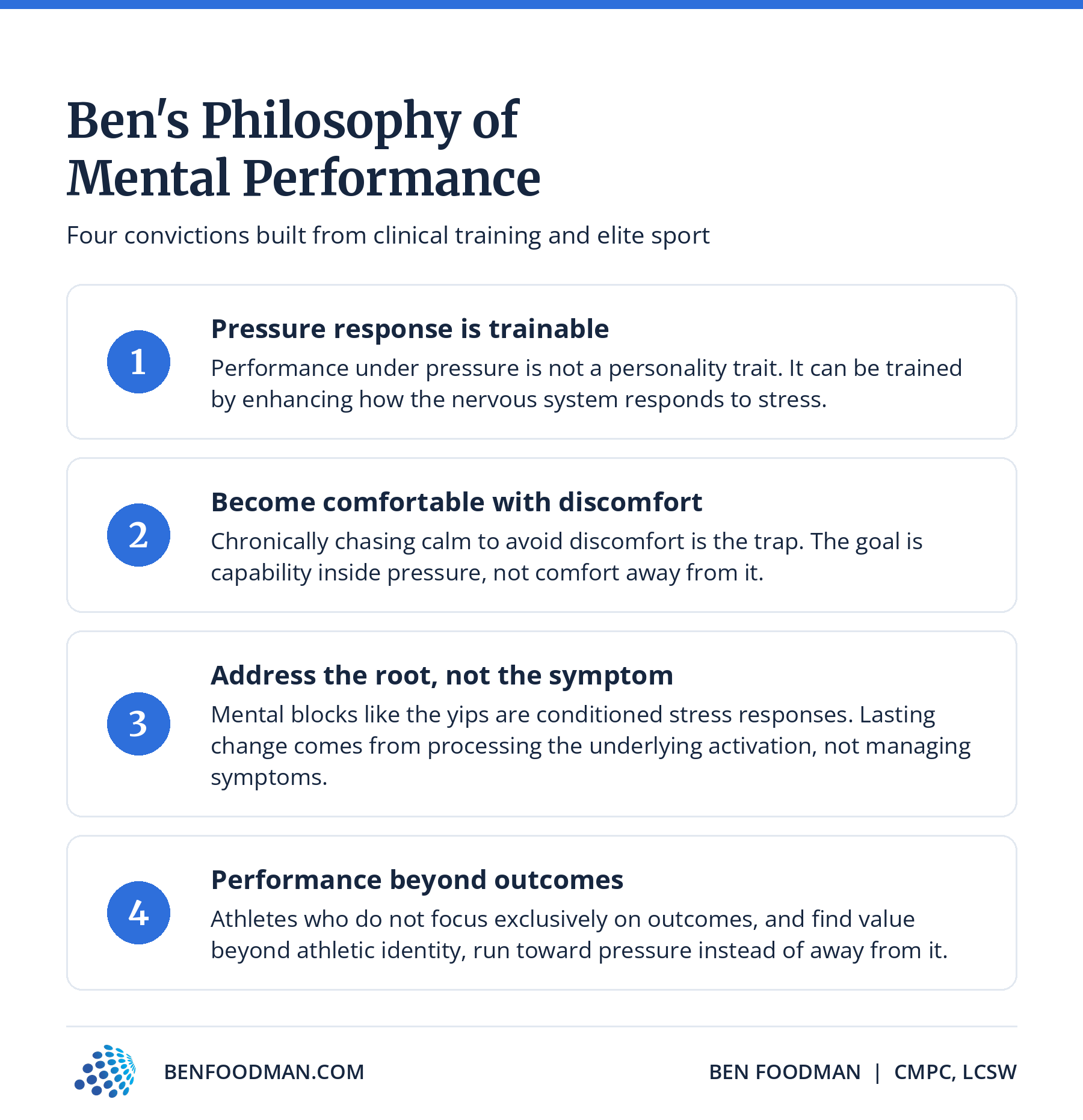
Other critical experiences that influenced his development occurred in 2020, when Ben was selected for the US Navy's Distinguished Visitor Program aboard the USS Nimitz, where he observed Naval Aviators completing pre-deployment qualifications. He was also able to experience an arrested landing and catapult launch. Upon completion, he received his NAFOD certification (No Apparent Fear of Death). The Navy gives it to visitors as a humorous parting gift, but this experience completely transformed Ben’s philosophy towards working with athletes. Watching elite performers (Navy Pilots) execute under conditions where errors are unrecoverable deepened a conviction that runs through all of his work: performance under pressure is not a personality trait. It is something that can be trained, and it can be done with minimal resources.
What Have Athletes Working With Ben Accomplished?
Athletes Ben has worked with have won at the highest levels of their sports, including the Olympic Games, the NASCAR Cup and Xfinity Series, the NFL Playoffs, IMSA, MLB and ACC & SEC Championships.
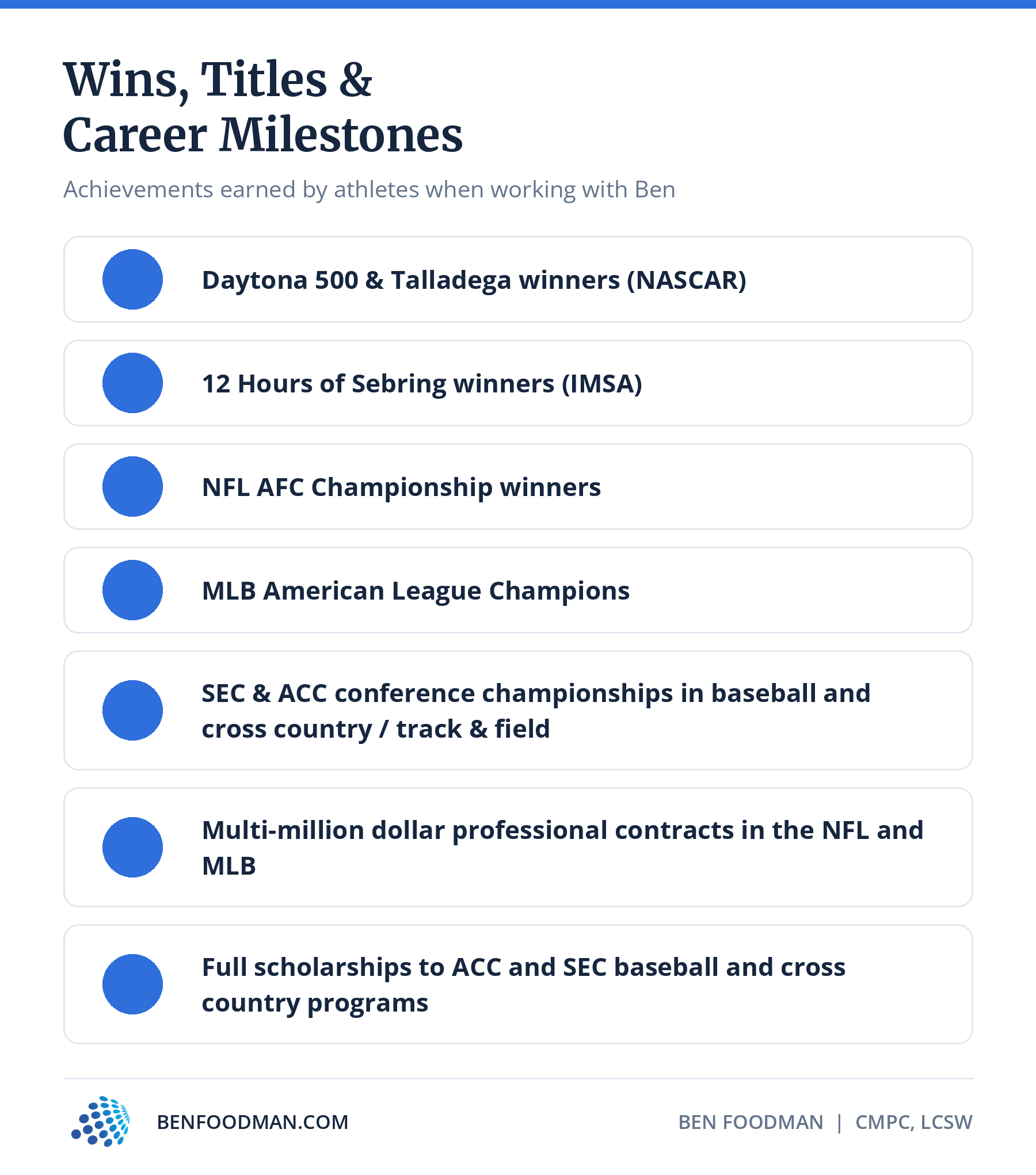
Ben does not claim credit for these outcomes, because the athletes are the ones that put themselves in position to be successful. In the same way a strength coach is one part of helping the athlete’s overall development, the mental training Ben provides helps remove the psychological obstacles that were in the way of the athlete, unlocking their intrinsic potential. Ben doesn’t help athletes create something new, he just helps them access what was already there. What the list above represents is not a trophy case, it is evidence that the methods hold up in the environments where pressure is highest and margins are thinnest: a title race, a playoff run, an SEC championship.

What Does Ben Believe About Mental Performance?
Ben's work rests on one central conviction: performance under pressure is not a personality trait. It is something that can be trained by enhancing how the athlete's nervous system responds to stress, and that training happens through discomfort, not by avoiding it.
There is nothing wrong with feeling calm, confident, and positive, and athletes who work with Ben often do. The problem is chronically chasing those feelings as a way to avoid discomfort. The athletes that are taken seriously and committed to their craft are not the ones who feel no pressure; they are the ones whose nervous systems have been trained to function inside it. Comfort is not the goal. Capability under discomfort is.
That conviction also extends past sport. Much of Ben's work helps athletes detach from outcome-based, materialistic pursuits and loosen the grip of athletic identity, finding value in who they are as a person rather than only in what they produce. This is not a soft add-on to performance training. It is a part of what makes the performance durable: the athlete who does not focus exclusively on outcomes is the one who runs toward the pressure of their environment.

ARE YOU READY TO CONQUER MENTAL BLOCKS & ACHIEVE PEAK MENTAL PERFORMANCE?
Get ready for the release of Ben Foodman’s upcoming book Breakthroughs Need Breakdowns! Check out the link below to learn more about his new book on the psychology of mental blocks in sports (AKA The Yips) and how to reach your true potential!


INTERESTED IN SERVICES?
Use the contact form below to schedule a free video discovery call to see if Ben’s services are the right fit for what you are looking for!