

WHAT ARE THE BASEBALL YIPS & HOW DO PLAYERS CURE THEM?

The yips are a neurological and psychological phenomenon that cause baseball players to suddenly lose the ability to perform basic movements like throwing or hitting that they have executed thousands of times before. While many coaches and players believe the Yips are a mechanics problem, the most current sport psychology research demonstrates that the Yips originate in the deeper regions of the brain responsible for involuntary stress responses. This guide explains exactly what the Baseball Yips are, why they affect pitchers and hitters differently, and which sport psychology interventions have the highest success rate at helping players overcome them.
Last Updated [6/26/26] | Written by Benjamin Foodman, CMPC, LCSW, CSCS — a Certified Mental Performance Consultant and licensed psychotherapist based in Charlotte, NC, specializing in helping MLB, SEC, and ACC baseball players overcome the Yips. Learn more here.

TABLE OF CONTENTS
What Is the Difference Between the Throwing Yips and the Hitting Yips?
Why Are the Yips a Nervous System Problem and Not a Mechanics Problem?
How Does Polyvagal Theory Explain Why MLB Players Suddenly Can't Throw or Hit?
What Sport Psychology Interventions Actually Cure the Baseball Yips?
How Does Brainspotting Work for Baseball Players With the Yips?
How Does EMDR Help Baseball Players Process the Trauma Underneath the Yips?
How Does Biofeedback Training Prevent the Yips From Coming Back?
Case Study: How an Elite Baseball Pitcher Overcame the Throwing Yips
How Do Baseball Players Find a Qualified Sport Psychologist Who Specializes in the Yips?
Meet Ben Foodman, Charlotte-Based Yips & Mental Performance Specialist

What Are the Yips and Why Do Baseball Players Get Them?
For a player experiencing the yips, the movement that used to feel automatic suddenly becomes conscious, effortful, and unreliable. A second baseman who has made the routine throw across the diamond his entire life suddenly can't get the ball where it needs to go. A hitter who has always trusted his swing finds himself frozen, late, or unable to pull the trigger. A pitcher that once had great command and high velo can no longer even do simple catch play. What makes the yips so disorienting, and so miserable for the player, is that nothing about their physical ability has changed. The athlete that could make the play yesterday is the same athlete that can't make it today.
This is exactly why the yips are so often misunderstood. Coaches, teammates, and even the players themselves tend to assume it must be a mental toughness or mechanics problem, so they respond by drilling the movement harder, breaking it down, and rebuilding it. The athlete with the yips is constantly told ‘stop overthinking it’ or ‘just get out of your head’ and my favorite ‘just be more aggressive’. But this usually makes the problem worse, because it pulls even more conscious attention onto a movement that is supposed to run automatically. The harder a player tries to consciously control the throw or the swing, the more the involuntary interference takes over.
The baseball yips are a sudden, involuntary loss of the ability to perform a basic, well-practiced movement, like throwing to first base or making contact at the plate…all movements that a player has executed thousands of times without thinking. Despite how it looks, the yips are not a mechanical breakdown or a sign that a player has lost their talent. They are an involuntary, nervous system response, and they can affect even the most accomplished players in baseball.
So why do baseball players get the yips at all? It's tempting to assume it only happens under the bright lights of the big leagues, but the yips show up at every level of the sport — from high school and travel ball to SEC college baseball and the minor leagues. That's the first clue that the yips aren't simply caused by the objective stakes of the competition. The harder truth is that the yips are the end result of how a player's nervous system perceives threat, and that perception is deeply individual. A high-pressure situation that one player barely registers can be the breaking point for another. A high school pitcher may feel the intense sensations of performance pressure just as acutely as a starting pitcher in the majors. When the nervous system perceives enough threat, whether from a single high-profile failure, accumulated stress, or an underlying experience the body hasn't fully processed, it can hijack the smooth, automatic execution of a movement and replace it with hesitation, tension, and misfire.
The rest of this guide breaks down exactly what is happening in the brain and body when the yips take hold, why they are fundamentally a nervous system problem rather than a mechanical one or a lack of insight, and which sport psychology interventions actually help players resolve them and regain control. For example, a study published in the Journal of Applied Sport Psychology examined the use of EMDR with athletes who experienced troubling pre-performance mental imagery. Participants experienced a reduction in the negative impact of that imagery, and several also showed measurable decreases in competitive anxiety. This is the type of evidence we will dig into throughout this guide, to help baseball players overcome the suffering the yips create and get them back to their own baseline standards of performance. Quick side note, if you would like to learn more or are dealing with the baseball yips, you can reach out to me on my contact form here to set up a free discovery call to see if the services and interventions I discuss in this guide would possibly be helpful for you or someone you know.

What Is the Difference Between the Throwing Yips and the Hitting Yips?
The throwing yips and the hitting yips share the same root cause, an involuntary nervous system response that disrupts an automatic movement, but they show up in different parts of the game and feel different to the player experiencing them. The throwing yips interfere with a player's ability to make an accurate, high-velo throw, while the hitting yips interfere with the timing, aggression, and fluidity of the swing.
The throwing yips are the more widely recognized of the two, and the more visible. A player who has made the same throw thousands of times suddenly can't release the ball aggressively or accurately. The throw might sail past the catcher, bounce, or get short-armed, and the harder the player tries to aim it or guide it, the worse the situation tends to get. This shows up most often in positions where the throw is routine and repeated, like catchers, infielders, and pitchers, where the movement is supposed to be automatic but has instead become conscious and effortful. The player is no longer trusting the throw. They constantly "overthink" how they should tweak their mechanics, and that conscious interference is exactly what breaks it down.
The hitting yips are less talked about but no less real. Rather than a breakdown in a throwing motion, the player experiences a disruption in the swing, such as hesitation, late timing, an inability to pull the trigger, or a loss of the fluid, committed mechanics they once had. A hitter dealing with this might feel frozen at the plate, second-guess pitches they used to attack instinctively, or find that their body simply won't commit to the swing the way it used to. Because hitting is often framed purely as a matter of mechanics or "seeing the ball," the psychological and nervous-system component frequently goes unrecognized, which means hitters often suffer longer before anyone identifies what is actually happening. In my own practice, baseball players going through hitting slumps tend to come to me much later in their careers than pitchers, for a couple of reasons.
First, their coaches are far less likely to label what they are going through as the yips compared to pitching coaches, so they primarily focus on swing mechanics.
Second, most athletes who consult a sport psychologist start with cognitive behavioral-based interventions before they ever seek out more advanced approaches such as brainspotting.
Despite these differences in how they present, it is important to understand that the throwing yips and the hitting yips are not two separate conditions.
They are two expressions of the same underlying problem: a nervous system that has shifted into an involuntary, self-protective state that is interfering with a movement that is supposed to feel natural.
This is consistent with the broader research on performance blocks. For example, in work published in the Journal of Sport Psychology in Action, researchers describe performance blocks as a sudden, temporary loss of fine or gross motor control, and note that practitioners increasingly use the broader term "performance blocks" precisely because the same underlying disruption shows up differently from one sport to the next. This is why treating either the throwing yips or the hitting yips as a purely mechanical issue, rebuilding the throw or re-calibrating the swing, so often fails. The mechanics were never the problem. The breakdown is happening upstream, in the way the brain and body respond to perceived threat, and that is the level at which it has to be addressed.

Why Are the Yips a Nervous System Problem and Not a Mechanics Problem?
The yips are a nervous system problem because the breakdown happens in the involuntary, threat-detecting regions of the brain and body, not in the muscles or mechanics that execute the movement. The throw or the swing fails not because the player forgot how to do it, but because their nervous system has shifted into a protective state that interferes with an action that is supposed to run on its own.
To understand why this matters, it helps to look at how a well-trained movement is supposed to work in the first place. When a player has repeated a throw or a swing tens of thousands of times, that movement becomes automatic. It runs without conscious thought, carried out by deeper motor systems while the player's attention stays free for reading the hitter, holding a runner, or tracking the pitch. This is what athletes are describing when they talk about being "in the zone" or letting the body take over. The movement is fast, fluid, and repeatable precisely because the ‘thinking mind’ is staying out of the way. The yips are a breakdown in that automaticity, but the cause is not mechanical. The player's body still knows how to make the throw. The interference is coming from a different system entirely; the nervous system's threat-response structures located in the subcortical brain.
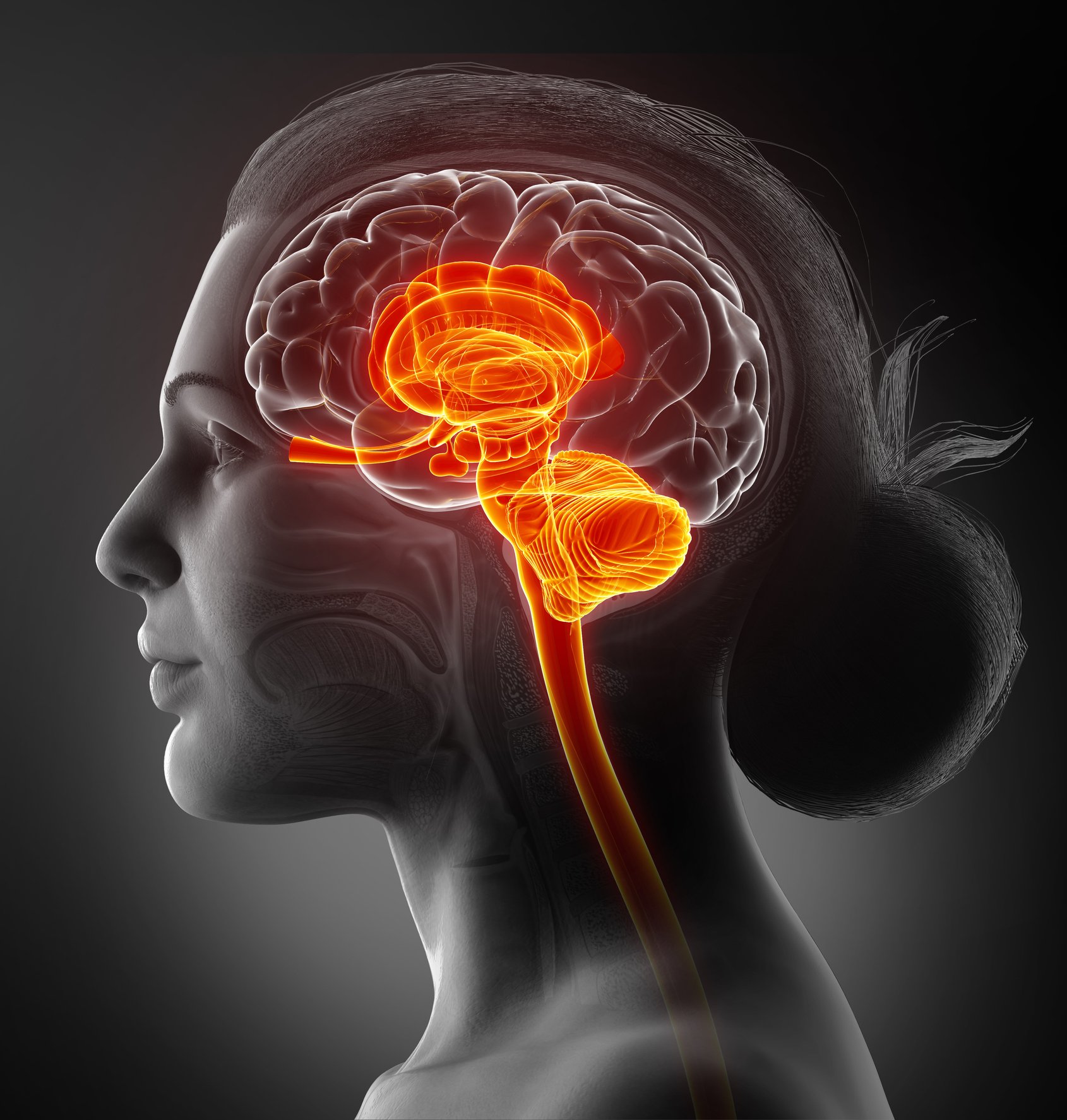
When the subcortical region of the brain registers enough threat, whether from competitive pressure, a specific past experience, or accumulated stress the body has not fully processed, it shifts into a protective, self-monitoring state. In that state a fear response actually downregulates the prefrontal regions that support smooth, deliberate control, which is part of why a player cannot simply think his way back into the throw in the moment, no matter how badly he wants to (van der Kolk, 2014; Porges, 2011). This is also why the yips so often show up alongside the physical signatures of a threat state, the racing heart, the muscle tension, the sudden tunnel vision, which is the same autonomic territory I cover in my work on managing nervous system dysregulation in athletes.
Once the body is in that protective state, the movement begins to degrade in a very specific way.
The player starts consciously trying to steer a motion that was never meant to be consciously steered.
Sport psychology researchers call this reinvestment: under pressure, the athlete reinvests conscious, rule-based control back into a skill that had become automatic, and the skill regresses to an earlier, clumsier stage of learning (Masters & Maxwell, 2008).
That is the hesitation, the tension, and the misfire. The harder the player tries to manually run the throw, the more he interferes with the system that used to run it for free.
This is exactly why the most common response to the yips, treating them as a mechanical flaw and drilling the movement harder, so reliably backfires. What my athletes report to me is that they will reach out to their private coaches, those coaches will confidently tweak the movement and while everyone ‘feels good’ about how the coaching session went, this euphoria will be short-lived.
When a player tears his throw down to rebuild it, he pulls even more conscious attention onto the movement, which only feeds the reinvestment that is causing the problem in the first place. The mechanics were never broken, so mechanical solutions cannot fix them. Often the deeper catalyst is not the movement at all but an unprocessed stress experience sitting underneath it, which is the level the intervention actually has to reach (how trauma and unprocessed stress shape athletic performance). The takeaway is simple, but it reframes everything that follows in this guide: if the breakdown lives in the nervous system and not the mechanics, then the solution has to work at the level of the nervous system too. That is the unifying theme for the rest of this guide, and it is why the interventions that actually move the needle are the ones aimed at the threat response rather than the throwing motion.
How Does Polyvagal Theory Explain Why Baseball Players Suddenly Can't Throw or Hit?
Polyvagal theory explains the yips by describing how the nervous system automatically shifts between different states depending on how safe or threatened it reads a situation to be. When a player's nervous system detects enough threat, it can drop out of the calm, regulated state that smooth automatic movement depends on and into a protective state, and that shift is what disrupts the ability to throw or hit freely.
Polyvagal theory, developed by Dr. Stephen Porges, centers on the vagus nerve, a major nerve that runs from the brainstem down through the body to the heart, lungs, and gut, and serves as the main pathway of the body's calming, parasympathetic system. The theory proposes that the nervous system is continuously and unconsciously scanning the environment for cues of safety or danger, a process Porges calls neuroception, and adjusting the body's state in response without any conscious decision on the player's part (Porges, 2011). When the nervous system reads safety, the body settles into a calm, regulated, socially engaged behavior called the ventral vagal state. This is the state in which a well-trained movement runs on its own, the state most athletes are describing when they talk about flow or being "in the zone."
But when the nervous system reads threat, whether from competitive pressure, a specific past experience, accumulated stress, or cues the player is not even consciously aware of, it shifts the body into a protective mode built for self-defense rather than fluid performance, otherwise known as a sympathetic state. That shift is the heart of why a player can suddenly lose a throw or a swing he has made a thousand times. It is also the same nervous-system terrain I break down in more detail in my work on how polyvagal theory applies to athletes and hitting. In a threat state, the body prioritizes protection over precision:
Muscles tense
attention narrows
breathing shifts
smooth coordination an automatic movement requires gets disrupted.
The player has not lost his skill. His nervous system has shifted into a state that is fundamentally incompatible with running that skill freely. The throw sails or the swing freezes not because of a mechanical flaw, but because the body is operating in a survival mode that overrides automatic motor control.
What baseball players will often describe to me is how random, and illogical the experience of the yips is. Their heart rate speeds up, they describe how it feels like they are falling out of the back of a chair, extreme temperature changes occur in their body (e.g. their head gets hot, hands get cold), and they are completely helpless. They recognize that they will be labeled as ‘that guy’ and no one will want to get within a thousand feet of them…almost as if they have a disease. Polyvagal theory helps create clarity around this issue because if baseball players could voluntarily stop this from happening, then sport psychologists and mental performance experts wouldn’t have jobs. It is the simple fact that this is an involuntary, illogical experience that helps explain what is happening on a deeper level. Polyvagal theory reframes the entire problem.
The player is not weak, broken, or short on talent. His nervous system is doing exactly what it evolved to do, just at the worst possible moment and in response to cues that do not actually call for protection. Again, I always emphasize this to baseball players that come to me for this issue ‘you would probably rather be outside, hanging out with friends or be doing anything else rather than being here in my office…not because there is animosity towards seeing a sport psychology expert, but because you can’t consciously stop this, which makes the yips one of the most miserable experiences in sports’. And because the shift into a threat state is involuntary, it cannot be willed away or drilled away. It has to be addressed by working with the nervous system itself, settling the threat response and helping the body relearn that it is safe to let the movement run free (Porges, 2011). That is the bridge to everything practical that follows. If the problem is a nervous system stuck in protection, then the solution is not a better cue or a rebuilt motion, it is a method that can actually reach and resolve the threat response. That is what the next sections of this guide are about.

What Sport Psychology Interventions Actually Cure the Baseball Yips?
The sport psychology interventions that actually help cure the baseball yips are the ones that work at the level of the nervous system rather than the conscious mind, primarily Brainspotting, EMDR, and biofeedback. Because the yips are an involuntary, threat-driven response rather than a mechanical or purely cognitive problem, the interventions that produce lasting results are the ones that calm and retrain the body's stress response at its source.
By the time most players come looking for a real solution, they have usually already tried everything else. They have rebuilt their mechanics, grinded through it with hitting and pitching coaches, tried to "just relax," and worked through the traditional mental skills too, positive self-talk, visualization, pre-performance routines. None of that is worthless, and for plenty of performance problems those tools are exactly right. But for the yips specifically they tend to fall short, because they are aimed at the conscious, thinking mind while the actual problem is living in the deeper, involuntary systems of the brain and body. That is not a knock on the player or the effort, it is a mismatch between the tool and the problem, and it is well documented that the cognitive and imagery-based approaches that help with ordinary performance anxiety often do not resolve a psychologically triggered yips (Turner & Barker, 2012; Smith et al., 2003). The interventions that consistently help are the ones built to reach those deeper systems. Three in particular form the foundation of effective yips work:
Brainspotting uses the connection between a player's visual field and their internal stress activation to locate and process the stored material driving the involuntary response. It is particularly effective for the yips because it works below the level of conscious thought, which is exactly where the problem lives. (More on this in the next section.)
EMDR (Eye Movement Desensitization and Reprocessing) helps the brain reprocess specific past experiences, a hit batter, a throwing error in a season-defining moment, an injury, or stress from outside of baseball entirely, that the nervous system is still holding onto and reacting to.
Biofeedback gives the player real-time data on what their nervous system is actually doing, training them to recognize and regulate states of stress activation they previously could not even feel.
What these three share is the thing that makes them work: they do not try to talk the player out of the yips or drill the movement back into place. Because at the end of the day, ALL sports are stress tests, and we know from research that the human brain will react to stress in measurable and predictable ways. So, instead, these interventions go after the involuntary nervous-system response generating the problem in response to stress in the first place. That is also why they so often succeed after other approaches have failed. They are working on the right system. It is worth being honest about what "cure" actually means here, because players search for that word and deserve a straight answer. Curing the yips does not mean installing a guarantee that the feeling can never resurface under any circumstances. What it means, and what the work is actually aiming for, is resolving the underlying stress response so that the movement returns to being automatic and controllable, the player gets his normal routine back, and, importantly, he develops the ability to self-regulate if a wave of activation ever shows up again.
Because our brains are hardwired to respond to stress in certain ways, athletes specifically need to mentally train to release stored stress that has accumulated in the body, while also preparing their minds for the inevitable setbacks that happen to every athlete in every sport. We can’t stop stress from happening to us in sports (especially in baseball) because this is a natural part of life. What we can do is prepare ourselves to handle it as best as we can…which is the essence of this type of training. In practice that is what recovery looks like, not a player white-knuckling control of the yips forever, but a nervous system that has stopped treating the throw as a threat. Traditional sport psychologists have falsely sold the idea that you should be ‘Zen-like’ for optimal performance, but in my experience as a mental performance expert, I have never worked with an elite athlete that described their experience in sport as ‘warm and fuzzy’. Baseball can be a brutal sport and baseball players need to train for those realities. The sections that follow break each of these down in depth, how they work, what the research actually says, and how they specifically help baseball players cure the yips and get back to performing. We will start with the one that sits at the center of this work, Brainspotting. Before you keep reading, if you want to learn even more about Brainspotting, you can access my athletes Brainspotting guide here or you can reach out to me on my contact form here and schedule a free discovery call if this is something that you may interested at looking into for yourself or someone you know.
How Does Brainspotting Work for Baseball Players With the Yips?
Brainspotting helps baseball players overcome the yips by accessing and processing the stored stress and tension held in the deeper regions of the brain, the same involuntary regions driving the yips response, rather than working only with the conscious, thinking mind. By using the connection between a player's visual field and their internal stress activation, Brainspotting reaches the level where the yips actually live and helps baseball players become comfortable with the discomfort of performance stress.
Brainspotting was developed by Dr. David Grand, and the way it works helps explain why it can reach what traditional mental coaching and motor learning training cannot. The core idea is that when a person holds a distressing activation in mind, that activation has a corresponding point in their field of vision, a "brainspot." By holding the gaze on that specific spot, with the guidance of a trained practitioner, the nervous system is able to process the stored material until the associated stress activation settles. One thing worth knowing, and something I point out to skeptical players and coaches early, is that Brainspotting did not start as a therapy method that got borrowed for sports. It grew directly out of performance work and has been aimed at athletes from the beginning (Grand & Goldberg, 2011).
In a 2013 paper published in Medical Hypotheses, Dr. Frank Corrigan and Dr. David Grand hypothesize that Brainspotting works by engaging deep regions of the midbrain, rather than only the conscious, rational brain, to access and process the body activation tied to a distressing experience. The authors are careful to frame this as a hypothesis rather than settled neuroscience, and I hold it the same way. But it lines up cleanly with everything this guide has established about the yips as well as other experts within the field of trauma-informed neuroscience. As we have covered throughout, the yips are not generated by conscious thought, which is exactly why talking through them or drilling the mechanics so often fails. Brainspotting is built to work at the deeper, involuntary level where the yips response actually originates.
For a baseball player, this matters in a very concrete way. Most of the pitchers (and players going through a hitting slump) will report how they previously worked with sport psychologists who gave them homework that had them focus on the present moment and reframe their perspective of the stress they were experiencing. But over the course of my Brainspotting training with these athletes, they would report how focusing on their negative somatic experiences actually helped them overcome the yips and felt more prepared for high-stress situations. This is the essence of desensitization work done at the highest level. Often the yips are tied to a specific moment, or an accumulation of stress, that the player's nervous system never fully processed, a throwing error in a game that mattered, hitting a batter or coach, an injury, or pressure that stacked up across a season.
Brainspotting gives that underlying issue a way to finally process, so that it stops driving the involuntary interference in the present. You can read more about how I use this method with athletes on my Brainspotting page, and it should always be done with a trained practitioner rather than attempted alone. The outcome a player is working toward is not learning to consciously white-knuckle the yips forever. It is resolving the underlying nervous-system response so the throw or the swing can go back to being automatic and free, with the added benefit that if a wave of activation ever does resurface, the player has a regulated nervous system and the tools to settle it rather than spiral. Because Brainspotting addresses the core problem at its actual source instead of its symptoms, it opens a path that mechanical and purely cognitive approaches simply cannot reach.

How Does EMDR Help Baseball Players Process the Trauma Underneath the Yips?
EMDR helps baseball players overcome the yips by reprocessing the specific past experiences the nervous system is still holding onto and reacting to. Because the yips are often rooted in a distressing moment, or an accumulation of stress that the brain never fully processed, EMDR works by helping the brain file that experience away properly, so it stops triggering the involuntary stress response that disrupts the throw or the swing.
EMDR, which stands for Eye Movement Desensitization and Reprocessing, was developed by Dr. Francine Shapiro and has a substantial clinical and research base for treating trauma, anxiety, and related conditions. The central idea is that when a person goes through something distressing, the brain does not always process and store that experience the way it handles an ordinary memory. Instead, the experience can get stuck, stored along with the original emotions, physical sensations, and beliefs that were attached to it in the moment. When something in the present resembles that unprocessed experience, the brain can react as if the original threat is happening all over again, firing off an involuntary stress response.
For a baseball player, this is often exactly what is happening underneath the yips. In my work with baseball players, the experience underneath the yips is not always what people expect. Sometimes it is the obvious one, a throwing error that cost a game, hitting a batter, an injury that changed how the body felt on the mound. Other times it traces back to something that has nothing to do with baseball at all. For example, if a baseball player was physically or emotionally abused during childhood, they could potentially be dealing with complex PTSD, which can manifest in the form of the yips when the athlete’s defense mechanisms are triggered by high levels of stress. The experience might also be an obvious one, a throwing error in a high-stakes moment, hitting a batter, a significant injury, or it might be something far less obvious, including stressors from outside of baseball entirely. Regardless, the nervous system holds onto it, and it keeps driving the involuntary interference in the present.
EMDR uses bilateral stimulation, most commonly guided side-to-side eye movements, to help the brain reprocess that stuck experience while the player holds it in mind.
As the experience is reprocessed, it gets stored more adaptively, decoupled from the intense emotional and physical charge it used to carry.
You can read more about how this method works with athletes in my blog post on EMDR for athlete mental skills training.
Once the underlying experience no longer triggers a threat response, the nervous system can stop interfering with the automatic movement.
The research on EMDR in sport, while still developing, is promising. For example, a study published in the Journal of Applied Sport Psychology examined the use of EMDR with athletes who were experiencing recurring negative mental imagery before performance. All participants reported a reduction in the negative impact of that imagery, with several also showing measurable decreases in competitive anxiety. This lines up with what I have seen in my own practice. I have trained sport psychologists who use EMDR, and they have reported how athletes have significant improvement from the yips.
How Does Biofeedback Training Prevent the Yips From Coming Back?
Biofeedback prevents the yips from coming back by training the player to recognize and regulate their own nervous system in real time. Where Brainspotting and EMDR process the underlying experiences driving the yips, biofeedback helps builds the ongoing self-regulation skill that keeps the nervous system from sliding back into the threat state that produced the problem in the first place.
Biofeedback uses sensors to measure what a player's body is actually doing, things like heart rate, heart rate variability, breathing patterns, and muscle tension, and displays that information back to the player in real time. The value of this is that it makes visible something that is normally invisible. Most players have no conscious awareness of their nervous system shifting into a stress state until it has already disrupted the throw or the swing. Biofeedback lets them watch it happen as it happens. This matters for the yips because the underlying problem is a nervous system that shifts into a protective, threat-driven state, and a player cannot regulate a state he cannot perceive. By giving him direct, real-time feedback on his own physiological arousal, biofeedback trains him first to recognize the early signs of that shift, and then to actively bring his nervous system back to a regulated state, often through breathing and other regulation techniques practiced against the live data. You can read more about one of the regulation tools I use alongside this work in my piece on diaphragmatic ratio breathing for athletes.
When I run biofeedback with a baseball player, here is what it actually looks like. First, there is work that they need to do outside of our sessions where the real impact lies. The athletes have to build in my personalized stress-recovery monitoring system where they can track the mental and emotional baggage, they have accumulated over the course of their training and competition. This tracking system is based off of a concept known as General Adaptation Syndrome (GAS) which hypothesizes that over time if an individual remains in a stress state, the body will become catabolic. There is no reason to believe that the brain does not operate under similar rules. This monitoring system helps the athlete build internal awareness outside of sessions. Athletes are then instructed to engage in systematic breathwork that I have customized based on my years of work with athletes. We then have the athlete come in and connect them to the biofeedback equipment in my office to measure their progress and continue to help them develop internal awareness of their nervous system.
Over time, this builds a trainable skill. The player learns what his regulated state feels like from the inside, learns to catch himself when he is drifting out of it, and develops the ability to deliberately return to it without needing the sensors at all. The goal is for the player to become his own regulator. That is why biofeedback is so valuable specifically as a tool for protecting recovery. In the same way athletes continue to work with a biomechanics expert or their own private hitting coach, biofeedback helps baseball players keep their nervous system accountable and maintain homeostasis throughout the high stress of the season.
Brainspotting and EMDR address the experiences underneath the yips so the nervous system stops being triggered the way it was. Biofeedback then equips the player with the ongoing capacity to keep his nervous system regulated under the real pressures of competition, the high-stakes throw, the critical at-bat, the long grind of a season. Resolving the root cause is what allows recovery. Building self-regulation is what helps protect it. It is worth being realistic here. No tool guarantees the yips will never resurface. But a player who has both resolved the underlying response and built genuine self-regulation skill is in a fundamentally stronger position than one who simply tried to push the problem down and hoped it would stay there.


Case Study: How an Elite Baseball Pitcher Overcame the Throwing Yips
To make this concrete, here is a picture drawn from the kind of work I do with college baseball players, presented in general terms to protect the privacy of the athletes I have worked with.
A college baseball pitcher comes in to see me for the yips. He has been throwing freely in warmups and in the bullpen, then watches it fall apart the moment he is in a live game. The ball sails. He short arms throws he has made ten thousand times. By the time he reached out for help, he had already tried everything mechanical, rebuilt his delivery, drilled it endlessly, been told to relax and stop thinking, and none of it has held, because the problem was never in his mechanics. He had even seen the university’s sport psychologist, but saw no progress with that work.
After conducting my assessment, we find that the trigger is a specific moment the body never fully processed. In this particular case, this athlete had one of the more common versions I see, which is a pitcher who once lost control of a throw that hit another player and caused a serious injury. In the moment it may have looked like he shook it off. But the nervous system did not. It logged that throw as something dangerous, something that hurt someone, and his unconscious mind quietly decided that letting the arm go free was a risk. Years and multiple seasons later, under the stress of live competition, that same protective response fires on its own, below conscious control, and interferes with a movement that used to be automatic.
The work is not to drill the throw harder. It is to address the nervous-system response itself. I decided that using Brainspotting, often alongside other tools that calm and retrain the stress response, would help this athlete’s body finish processing what it has been carrying so the throw would stop registering as a threat. Over the course of multiple brainspotting sessions, his natural movement returned, it did not feel forced according to his self-reports, but instead, automatic and free again. He also reported what most pitchers say to me at the conclusion of our work which was that he was ‘more comfortable with the discomfort’ of high-pressure situations.
As is the case with all athletes I work with that deal with the yips, recovery here does not mean a guarantee the yips can never resurface. It means the underlying response is resolved, the player can throw freely, and he leaves with a regulated nervous system and the tools to settle himself if pressure ever spikes again. That is the pattern I see again and again. The yips are not a flaw in the player. They are a solvable nervous-system response, and pointing the work at the actual source is what finally lets this pitcher (and the countless others I have worked with) get back on the mound and trust his arm, trust his instincts, and most importantly…get back to having fun.
Traditional sport psychology approaches like cognitive behavioral therapy often fail to cure the baseball yips because they work at the level of conscious thought, while the yips are generated by the involuntary, subconscious systems of the nervous system. You cannot reliably think your way out of a response that was never produced by thinking in the first place.
Why Do Traditional Sport Psychology Approaches Like Cognitive Behavioral Therapy Fail to Cure the Baseball Yips?
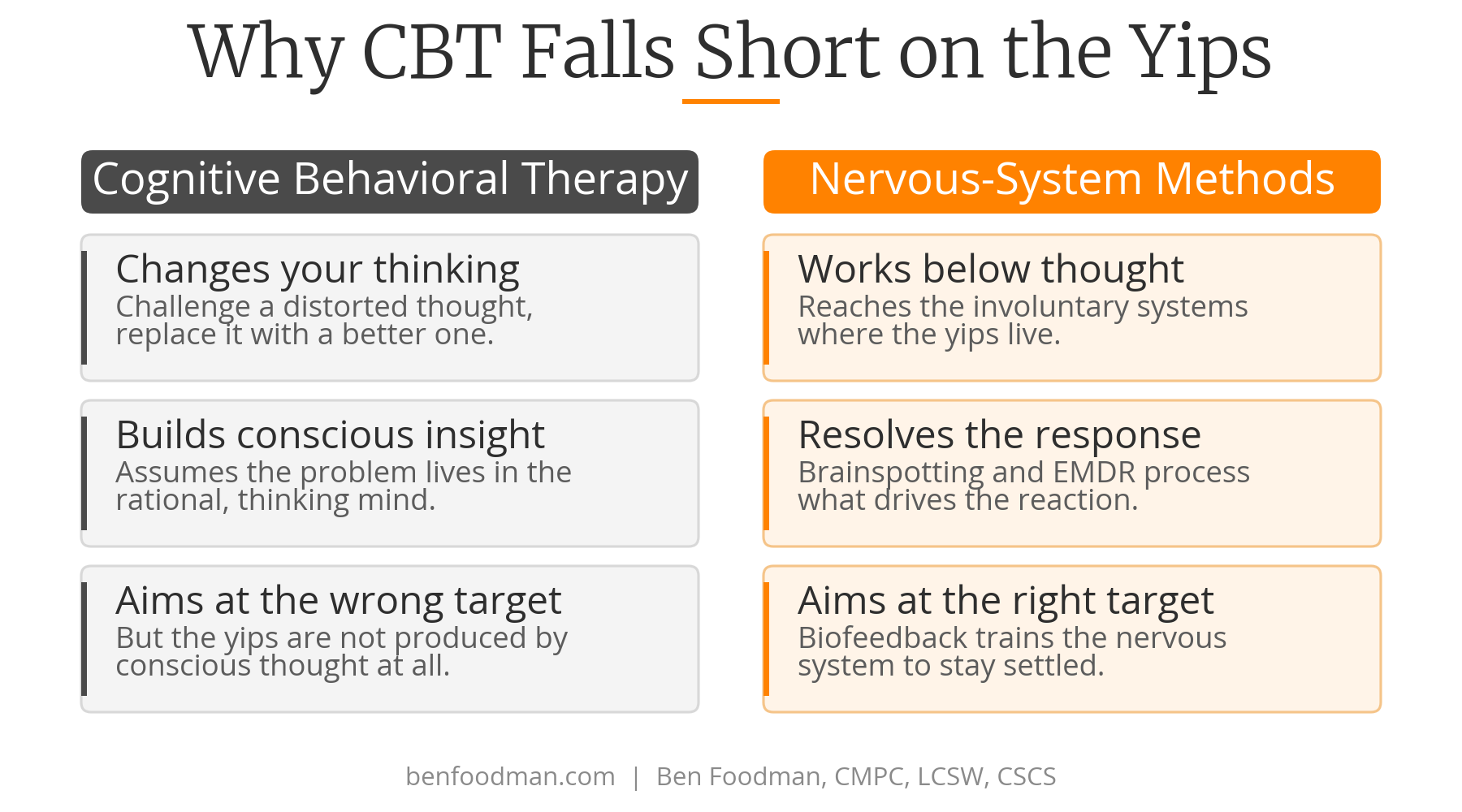
To be clear, these approaches are not useless. Cognitive behavioral therapy, positive self-talk, visualization, goal-setting, and pre-performance routines all have real value, and they help many baseball players with many performance challenges. The issue is not that the tools are bad. It is that they are aimed at the wrong target when it comes to the yips specifically. Here is the core of it. Cognitive behavioral therapy works by changing the way a person thinks. It builds insight. It helps an athlete notice a distorted thought, challenge it, and replace it with a more accurate or more useful one, and the logic is that better thinking produces better feeling and better performance. For a lot of sport psychology challenges, that chain holds, and it works. But it depends on one assumption: that the problem lives in conscious thought in the first place. The yips do not.
As we have established throughout this guide, the yips are an involuntary nervous-system response, the body dropping into a protective state below the level of awareness, driven by the deeper, automatic regions of the subcortical brain rather than the rational, thinking ones (Porges, 2011; Corrigan & Grand, 2013).
It is the same involuntary terrain I cover in my work on managing autonomic nervous system dysregulation in athletes. That is the mismatch.
Telling a player in a threat state to think more positively, repeat an affirmation, or visualize a clean throw is asking the conscious, logical mind to override a process the conscious, logical mind does not run.
The reaction is being generated somewhere the insight cannot reach. This is also why so much trauma and stress-response work has moved toward methods that go beneath the thinking mind rather than through it (van der Kolk, 2014).
You can give a player perfect insight into his yips and watch the throw sail anyway, because insight was never the missing piece.
Here is the spot for what this actually looks like in the room. I have had professional baseball players reach out to me, and explain how they are certain that when they have throws they are ‘yipping’ they are positive that it is related to some form of unprocessed trauma. They can clearly articulate what they are feeling in their body, when it happens and many other details. But to their demise, despite the countless number of sport psychologists that have failed them, and the endless therapy sessions that never helped them discover ‘deeper insight’ they were unable to resolve the physiological symptoms that were coming up during competition. But in almost all of these cases, when we switched to a somatic method such as Brainspotting or biofeedback, their yips either significantly reduced or were completely extinguished.
This is why Brainspotting, along with other tools like EMDR and biofeedback, reaches what traditional cognitive approaches cannot. Instead of working at the level of conscious thought, these methods work at the level where the yips actually live, the involuntary, subconscious systems of the nervous system. Brainspotting and EMDR resolve the underlying experiences, so the nervous system stops getting triggered the way it was, and biofeedback equips the player to keep himself regulated under the real pressures of competition. The reason this matters is simple: you cannot fix a nervous-system problem with better insight; the research strongly supports this. You have to go where the problem actually is. I break this down further in my piece on why Brainspotting is more effective for the yips than traditional sport psychology.

How Long Does It Take to Cure the Baseball Yips?
The blunt answer is that it varies, and any practitioner who promises a guaranteed timeline should be viewed with skepticism. The yips are an individual experience, shaped by what is driving them and by the player's own history, so the path out looks different from one player to the next. Several factors tend to influence how long the process takes:
The severity and duration of the yips. A player who seeks help early often has a different course than one who has struggled for years and built up layers of frustration and compensation on top of the original problem.
What is underneath the yips. Whether the response is tied to a single identifiable experience or to a more complex accumulation of stress affects how much there is to work through.
How much the player has already tried. Players who arrive after extensive mechanical drilling and repeated failed approaches sometimes carry an extra layer of discouragement, and that discouragement becomes part of what we address.
The player's engagement. Like any meaningful change, consistency and active participation in the process matter.
What I have found in my private practice is that if players have complex post-traumatic stress disorder (e.g. people with severe early childhood abuse, or multiple severe-surgeries or over 3 concussions), these cases can take months if not years to resolve the issue. However, on average I have found that typical yips cases require between 15-25 brainspotting sessions. Usually around between 7-10 appointments is when we start to see significant resolution, with the conclusion of services closer to 22-25 sessions total. Most baseball players report a significant reduction in symptoms (e.g. the sensations feel less intense or far more manageable), with many also reporting complete elimination of symptoms. Some athletes see complete elimination in 3-5 appointments, but this is very rare.
What matters most is the shift in approach. A player can spend a year drilling mechanics on a problem that was never mechanical and stay stuck the whole time, because the effort is aimed at the wrong target. Once the work is pointed at the actual source, the involuntary nervous-system response, progress becomes possible in a way it simply was not before. I walk through what that looks like with a real pitcher in my baseball yips case study. My vision with every baseball player I work with is to get the symptoms to be significantly reduced. But also, the goal is not just speed of recovery. It is resolving the underlying problem at its’ core so the player can go back to throwing or hitting freely, and stay there. In summary, I want to get my clients to the point where they never have to see me again, and I work myself out of a job.
There is no single fixed timeline for overcoming the baseball yips, because recovery depends on the individual player, the experiences underneath their yips, and how long the problem has been present. That said, because interventions like Brainspotting, EMDR, and biofeedback work at the root of the problem rather than just managing symptoms, many players start to see meaningful change faster than they expect, especially compared to the months or years they may have already spent chasing mechanical fixes.

Frequently Asked Questions About the Baseball Yips
-
The baseball yips are caused by an involuntary nervous-system response, not a mechanical flaw. When the brain perceives enough threat, whether from pressure, a specific past experience, or accumulated stress, it shifts the body into a protective state that interferes with movements that are supposed to run automatically.
-
Yes, many players are able to overcome the yips when the underlying nervous-system response is addressed directly rather than treated as a mechanical or lack of insight problem. Interventions like Brainspotting, EMDR, and biofeedback target the root of the problem, which is why they often succeed after mechanical and traditional approaches have failed.
-
No. The yips are not a sign of lost talent, weakness, or lost nerve. The proof is that the player can often still perform the movement in low-pressure situations like practice. The skill is still there; the nervous system has shifted into a state that interferes with executing it freely. This is an involuntary physiological response, not a character flaw.
-
Usually not. Because the yips are not a mechanical problem, drilling the movement harder often makes it worse by pulling even more conscious attention onto an action that is supposed to be automatic. More reps aimed at the wrong target (e.g. dry throwing) tend to reinforce the very interference causing the problem rather than resolving it.
-
The yips can potentially resurface, particularly if ongoing stress or new triggering experiences accumulate, but a player who has resolved the underlying response and built genuine self-regulation skills through tools like biofeedback is in a much stronger position to prevent recurrence. Addressing the root cause is what makes lasting recovery possible.

How Do Baseball Players Find a Qualified Sport Psychologist Who Specializes in the Yips?
To find a qualified professional who can actually help with the yips, baseball players should look for someone who understands the yips as a nervous-system problem and is trained in the interventions that address it at that level, such as Brainspotting, EMDR, and biofeedback, rather than someone who treats it as a purely mechanical or motivational issue. Not every sport psychology professional approaches the yips the same way, and that difference matters.
As this guide has explained, the yips are an involuntary nervous-system response, which means the people best equipped to help are the ones trained to work at that level, not only with traditional mental skills but with the somatic, brain-body interventions that reach the root of the problem. When you are evaluating someone, it is worth asking directly whether they understand the yips as a nervous-system issue and what specific interventions they actually use to address it. A few things worth looking for in a qualified professional:
Relevant credentials and clinical training. In addition to making sure that the professional is a Certified Mental Performance Consultant through the Association for Applied Sport Psychology, look for professionals who are trained and certified in Brainspotting & EMDR.
Brainspotting and EMDR in particular require formal training, and in the case of EMDR a licensed mental-health background, which is an important marker of someone qualified to do this work safely.
Genuine experience with athletes and the yips specifically. A professional who has actually worked with athletes through performance blocks brings an understanding that general practice does not automatically provide.
An approach aimed at the root, not just the symptoms. The right professional treats the underlying nervous-system response, rather than only coaching mechanics or offering motivational support.
If you are a baseball player struggling with the yips, at any level, from high school to the professional ranks, the most important thing to understand is that this is a solvable problem, and that the right kind of help exists. You do not have to keep drilling a problem that was never mechanical. You can address it at its actual source and get back to throwing and hitting freely. If you would like to learn more, scroll below to learn about my private sport psychology practice located in Charlotte, North Carolina. As a Certified Mental Performance Consultant (CMPC), licensed psychotherapist and Certified Strength & Conditioning Specialist (CSCS) I have over 10 years of experience working with baseball players dealing with the yips while also competing at every level ranging from high-school ball to the SEC, and MLB.

MEET YOUR YIPS SPECIALIST…
BEN FOODMAN
LCSW, CMPC, CSCS
CONTACT BEN TO SCHEDULE A FREE YIPS DISCOVERY CALL TODAY

ARE YOU NOT ENTERTAINED?! NO WORRIES, IF YOU STILL WANT MORE YIPS CONTENT, CHECK OUT MY PUBLISHED WORK BELOW!