
How Do Baseball Catchers Overcome The Throwing Yips?
The baseball catcher throwing yips are neither a mechanics problem nor a focus problem but are actually an involuntary stress response produced by the subcortical brain. This is why a catcher can fire a strike to second base but cannot make the simple toss back to the pitcher. Because the response originates below conscious thought, resolving it typically requires interventions that work at the nervous system level, such as Brainspotting, rather than cue words, positive self-talk or mechanical fixes alone. On average this process takes time and structured work, but catchers who use the correct mental training protocols typically see their throw return to baseline expectations.
Published on 8/1/26, written by Benjamin Foodman, CMPC, LCSW, CSCS
Ben Foodman is a licensed psychotherapist & Certified Mental Performance Consultant (CMPC) through the Association for Applied Sport Psychology (AASP). He owns his private practice located in Charlotte North Carolina where he specializes in working with athletes to help them overcome mental blocks (the yips), increase mental toughness and improve focus using techniques such as Brainspotting, biofeedback, exercise science and sport psychology. If you are interested in services, use the link here! Enjoy the article below!


Why Can I Throw To Second Base But Not Back To The Pitcher?
The throw back to the pitcher breaks first because it is the throw with the most time to think and requires a certain amount of ‘touch’ on the throw. High-intensity throws like a steal attempt to second base engage the motor system automatically, requires very little thought and use more gross-movement patterns and maximum force output. Because the competition environment imposes maximum stress inputs on the nervous system, the slow, easy toss gives the brain's threat detection system room to interfere. The yips are not a skill problem or a mental toughness problem, which is why your hardest throws are typically easy to execute whereas your easiest throws break down.
This is the detail that confuses every catcher who develops this problem, and it confused the baseball world for decades. A catcher who can easily throw out a player at second base on a stolen base attempt suddenly cannot complete a fifteen mile per hour lob that a little leaguer makes without thinking. Coaches see this and conclude the catcher is being soft, lacks mental toughness or is careless, because from the outside it looks like the athlete is failing at the easiest part of the job.
However, what we have come to understand is that the neuroscience says the opposite. The steal throw to second is what I refer to as a ‘controlled violence’ movement, meaning that the catcher is putting in near maximum power output into the throw, which mimics similar sensations to that of a ‘fight-response’ when humans are in a high-stress state. There is a runner, a clock, and a target, and the catcher's full attention is pulled outward onto the play. The return toss has none of that:
It happens well over a hundred times a game
The throw requires a certain amount of ‘touch’
This play happens in dead time with teammates, coaches and fans watching, and with nothing to occupy the conscious mind
That period in the game is exactly where an unresolved stress response surfaces. The subcortical brain, the region responsible for threat detection and survival responses, overwhelms the motor pattern precisely when the ‘thinking brain’ has room to anticipate the throw going wrong.
The mental block is not in your arm, your mechanics did not disappear, and you are not lacking mental toughness. This distinction matters because it determines what actually helps, which we will cover in the treatment section below. For the broader picture of how this same process shows up across every position, see my complete guide to the baseball yips here.
What Causes The Catcher Throwing Yips, And Why Do They Start Suddenly?
The catcher yips are caused in one of two ways: the first could be what is called a stress overload event such as a car accident, an injury severe enough that it requires surgery, abuse, or witnessing a violent event. The second could be gradual stress accumulation such as repetitive injuries, coaching pressure, and performance anxiety that reaches a tipping point. After these events have occurred, when the catcher is engaged in performance-related activities, the brain has still not fully assimilated these experiences into normal memory storage which in turn triggers the error signal (which is considered to be a self-defense mechanism) every time the catcher is competing.
When I collect a history from catchers dealing with this issue, the patterns are remarkably consistent. Some describe a single moment such as an overthrow that sailed into the stands, a toss that clipped the umpire, a bad throw in a bullpen with a coach watching. The mistake itself was trivial, but the embarrassment was not, and the next time the catcher went to make what was once considered a simple throw, this movement now came with a spike of self-consciousness that never left. In some instances, this can result from a singular event, or the problem could have crept in across a season that contained an injury, a position battle, a difficult coach, or pressure from recruiting or contract situations. This split is not just something I observe in my office. Researchers studying throwing yips in baseball players have classified cases by whether the initial onset was psychologically triggered or not and found differences in symptom intensity between those groups. When I collect histories from catchers dealing with the throwing yips, the same inventory shows up so consistently that I could almost fill it out in advance.
Injuries that were played through instead of rehabbed.
At least one surgery, sometimes several.
Years of foul tips and blocked balls that were shaken off in the moment because that is what catchers are taught to do.
A coaching voice that lived directly behind them for every pitch of every game, which no other position experiences.
An athlete identity that formed early, because kids who become catchers are usually the responsible ones, the field generals, the ones who learned young that the team runs through them.
None of these experiences causes the yips by itself. What I typically find is that no single moment broke the throw, but rather the load did.
The nervous system keeps a running tally of all of it. Each impact, each surgery, each season of absorbing criticism at close range gets recorded by the subcortical brain, the region built for threat detection, and that region does not care that the athlete's conscious mind has moved on.
When the accumulated load crosses a threshold, the brain starts treating the act of throwing itself as a threat and produces a protective error signal at the worst possible moment, the one throw with no urgency to override it. This is why the yips are involuntary.
The catcher is not choosing this response any more than someone chooses to flinch at a loud noise, and it is why the research on how unprocessed stress disrupts motor control matters more here than any mechanical fix.
A well-known example in baseball history followed exactly this arc, and it is worth knowing because of where it ended. New York Mets catcher Mackey Sasser developed throwing problems that became so popular, they were nicknamed ‘Sasseritis’. His difficulties were compounded by a coach who threatened to fine him for hesitating and by a violent home plate collision. Hypnotists and psychiatrists did not help, and his playing career ended without a resolution. Years later, working as a college coach and still carrying the problem, Sasser finally resolved it through work with Dr. David Grand, the developer of Brainspotting.

Can Getting Hit Cause The Catcher Yips?
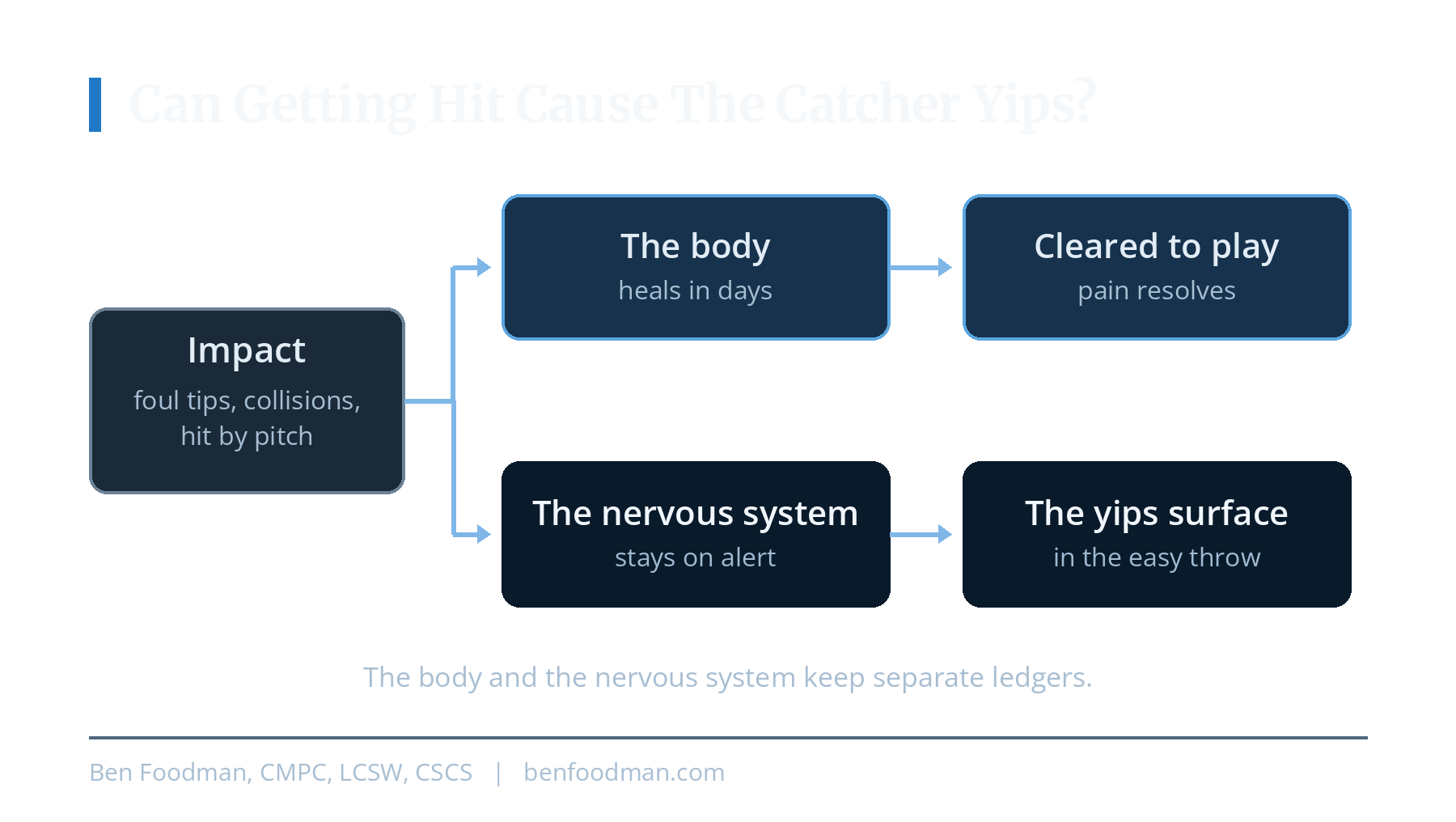
Yes. Catchers absorb more impact than any other position, and a foul tip, a collision at the plate, or a hit by pitch at bat can leave the nervous system in a state of protective hypervigilance even after the body has healed. This unresolved stress response frequently resurfaces as the yips, because the brain has linked the baseball itself with physical threat.
Catchers take a physical beating that no other position in baseball experiences. Foul tips off the mask and throat guard. Backswings to the helmet. Collisions at the plate. Blocked balls off the forearms and collarbones hundreds of times a season. Most catchers wear this as a badge of toughness, and physically, most of these impacts heal within days. But the longer an athlete competes in this position, there is no escaping the compounding toll this takes on their mind and body. What catchers and coaches don’t realize about this, is that the nervous system stores these experiences in unexpected ways.
When an impact is sudden, painful, and unpredictable, the subcortical brain can encode it as a survival-relevant event. This is because our brains are constantly creating maps of our environment that determine where our bodies end, and where the world begins. Most athletes are unaware of this and simply shrug off these experiences. But the protective flinch response stays chambered. Weeks or months later, that armed response starts leaking into an unrelated motor pattern, and a catcher who took a backswing to the mask in April cannot understand why his return toss is sailing in June. The conscious mind moved on, but the body did not.
This is the same mechanism behind the fear that hitters develop in the batter's box after a hit by pitch, which deserves its own full discussion and gets one in a separate article. For catchers, the practical takeaway is this: if your yips showed up in the same season as a significant impact, injury, or surgery, that is not a coincidence, and it is a strong signal that the intervention needed to fix this must target the nervous system level rather than in the batting cage. Unfortunately, this issue will continue to get overlooked in critical ways such as return-to-play decisions.
Return-to-play decisions are made exclusively on physical criteria.
Range of motion, strength testing, imaging, a clean concussion protocol.
A catcher gets cleared when the tissue has healed, and by every measure the medical staff is looking at, that clearance is correct.
What no one assesses at that appointment is whether the nervous system has processed what happened.
Predictably, the catcher comes back physically sound but neurologically unfinished, and everyone involved assumes the problem is closed.
What I typically see is that the yips do not show up during rehab, and they do not show up in the first week back. They surface weeks or months after clearance, often in a season that feels unrelated to the injury, which is exactly why nobody connects the two. The athlete has already filed the injury under handled because they are eager to return to play and retain their starting position. But because athletes are masters of dissociation, and real pressure moments won’t happen till they get back to spring, these reflex responses won’t show up until their return…which is too late to deal with at that point.

What Is The Best Treatment For The Catcher Throwing Yips?
Most recommended treatments for the catcher yips, such as structured throwing progressions, breathing routines, and shifting attention to an external target, are useful supports but do not resolve the problem on their own, because they work on the conscious brain while the yips originate in the deep subcortical regions of the brain. The intervention that typically addresses the root cause is Brainspotting, a neuroscience-based method that processes the stuck stress response at its subcortical source. On average this takes 15 to 25 sessions, and the sessions themselves are usually very uncomfortable, but catchers typically experience massive tension release afterward and a progressive return of the natural throw.
If you ask an AI tool or search Google about treatment for the throwing yips, you will get some version of the same list:
gradually rebuild confidence through a structured throwing progression
learn techniques to reduce overthinking
shift attention externally
use relaxation and breathing strategies before throws
practice game-like situations.
To be clear, none of it is wrong, and I use versions of several of those tools with the catchers I work with. Breathwork genuinely downregulates the nervous system's threat response and belongs in every catcher's pre-performance routine. External focus is genuinely better than internal focus during a throw. Throwing progressions genuinely rebuild evidence of competence at each distance and probably need to be a part of regular training due to the fact that the body will break down as the catcher gets deeper into the season.
But notice what every item on that list has in common. They are all instructions to the conscious mind, and the yips do not originate from that region of the brain. A catcher with the yips does not lack knowledge about how to throw and does not lack effort or mental toughness. The problem activates under evaluation and threat, which is subcortical territory. Tools aimed at the neocortex either increase focus or manage symptoms, but they rarely resolve the source, which is why so many catchers grind through months or years of progressions and cue words and end up right back where they started once the season pressure returns.
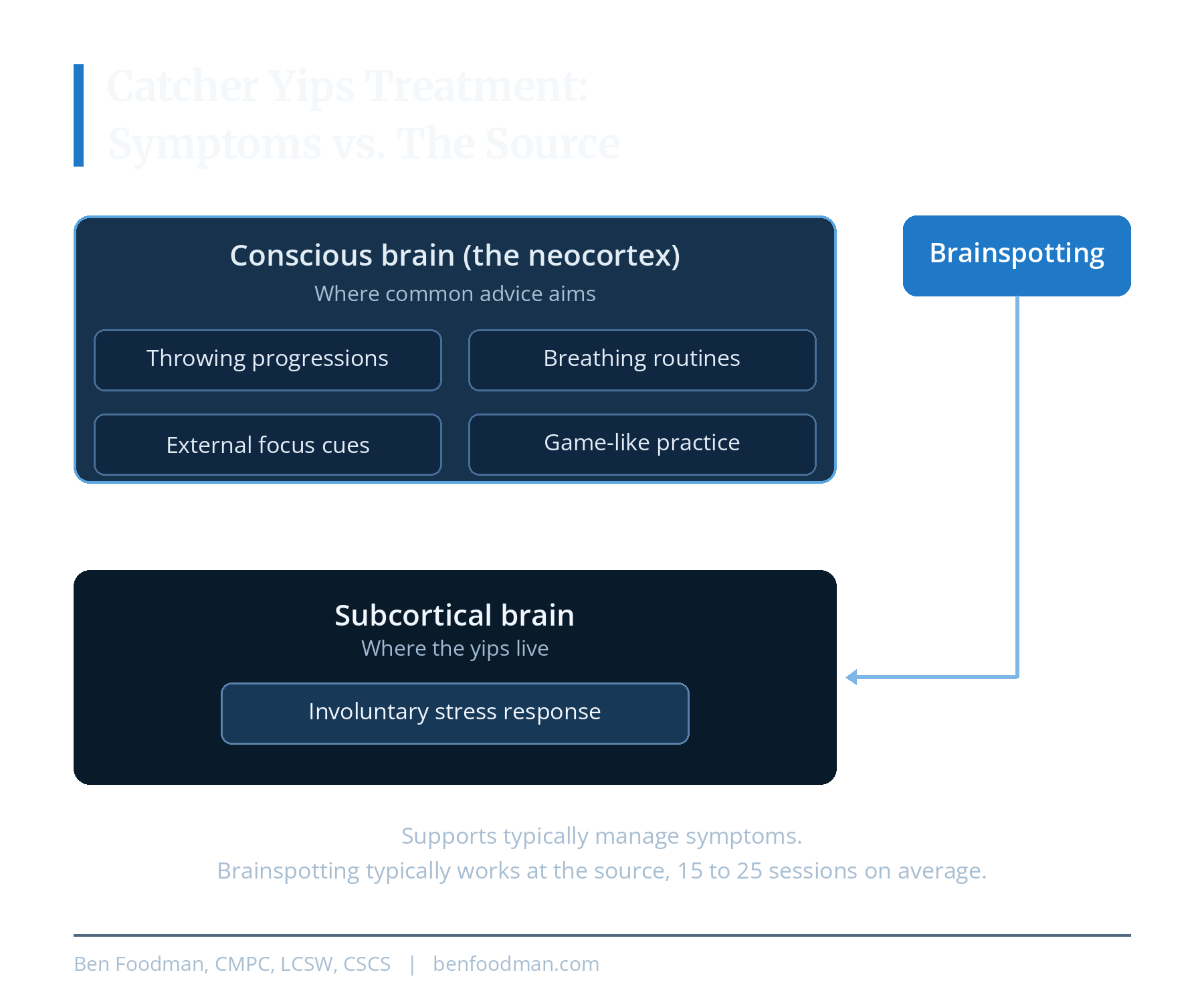
This is where Brainspotting comes in, and I want to be candid with you about what it actually involves, because I refuse to soft-sell this work. Brainspotting, developed by Dr. David Grand, uses fixed eye positions to access and process the stress responses that stay locked in the deeper brain and body. Sessions are usually very uncomfortable and difficult. Athletes frequently re-experience physical sensations connected to old injuries and old moments they thought were over, but what typically follows that discomfort is a massive release of tension that athletes describe feeling in their chest, shoulders, and throwing arm, and over the course of the work, the involuntary interference in the throw progressively goes away. On average this process takes 15 to 25 sessions. Some catchers need fewer, some need more, and I do not promise outcomes to anyone, because no honest practitioner can. What I can tell you is what the pattern typically looks like when catchers fully commit to this work: the return toss frequently stops being an event, pop times and accuracy typically return to baseline, and the constant background dread behind the plate usually lifts.
One more thing I tell every catcher before we start. Resolving the yips is not the same as becoming immune to them. The yips are a built-in stress response, and the nervous system does not lose that capacity just because we processed what was sitting underneath it. A new injury, a coaching change, or a stretch of compounding stress off the field can bring the same protective response back. This is why I treat mental performance work the way athletes already treat strength and conditioning or physical therapy, as ongoing maintenance rather than a one-time repair. Most of the catchers I work with move to a monthly cadence once the yips are resolved. A season puts real load on the nervous system, and as long as an athlete is still competing, that load keeps accumulating. As a licensed psychotherapist and current Certified Brainspotting Therapist, this is the core of how I work with catchers, layered with biofeedback so we can measure the nervous system change rather than guess at it. If you want the full picture of what a session actually looks like from the athlete's side, I wrote about it in detail here.
Frequently Asked Questions About The Catcher Yips
-
Occasionally the yips fade temporarily when pressure drops, such as during an offseason, but they typically return when evaluation and stress return, because the underlying stress response was never processed. In most cases the yips do not permanently resolve on their own, and waiting usually entrenches the pattern further.
-
Mechanical workarounds like a new arm slot or a different grip sometimes provide short-term relief because they make the throw feel novel, but they do not address the involuntary stress response driving the problem, and the yips typically migrate into the new pattern over time. Mechanics changes are a bandage, not a resolution.
-
With interventions that target the subcortical source, such as Brainspotting, the process on average takes 15 to 25 sessions, though this varies with each catcher's history and how much accumulated stress sits underneath the yips. Quick fixes that promise resolution in days typically address symptoms, not the source. It is also worth knowing that resolution is not the same as permanent immunity. The yips are a built-in stress response, so a new injury or a stretch of compounding stress can bring symptoms back, which is why ongoing maintenance work matters after the initial resolution.

Does Age Or Competition Level Change How Catchers Overcome The Yips?
The mechanism of the catcher yips is fairly identical at every level, and so is the intervention needed to fix the issue. What varies is not age but the individual history sitting underneath the yips: how much stress has accumulated, how long it went unaddressed, and how stable the rest of the athlete's life is. A youth catcher can be carrying as much stress if not more than a professional player in some cases, and stress is not something that always scales with competition level. What does change with level is the context around the work, including the athlete's bio-psychosocial history, what is at stake competitively, and who else is involved in the process.
I want to push back on an assumption I hear constantly, which is that a young catcher's yips are a smaller problem than a professional. Stress is not measured in divisions. A twelve-year-old can be carrying an injury history, a coach who humiliates him, and a family situation that makes baseball feel like the only thing that is holding his life together. A professional can be carrying comparatively little outside the sport itself. The number on the jersey and the level of the league tell you nothing about what is underneath the throwing issues. There is one more difference worth naming for the college and professional catchers reading this.
At your level, the yips carry a professional cost measured in roster spots and money, which adds a layer of performance anxiety on top of the original problem. Furthermore, because the workload and training load reach incredibly high levels at the collegiate and professional levels, it will take extra work and self-care to match the stress load demands that are being asked of you. As such, the catchers I see that perform the best are the ones who treat this like they would treat a torn ligament: a real, physical, resolvable issue that gets addressed early with the appropriate intervention rather than hidden until it costs them a season. If you would like to learn more about Brainspotting mental training, check out my guide here to see if this process is right for you.
Ready to implement these tactics? Book a consultation to see if services are right for you!
Sign up to learn more about new updates with Ben’s practice!
Check out older Training Report articles below for more resources!