
What Modern Mental Skills Training Do Racecar Drivers Use?
Racecar drivers competing in NASCAR, IndyCar, IMSA, WEC and Formula 1 use modern mental skills training that goes far beyond imagery and positive self-talk: neurofeedback measurements such as event-related potentials (ERPs) that reveal how the brain processes information at speed, DARPA-researched protocols such as tDCS that enhance focus and situational awareness, and bottom-up interventions such as Brainspotting that address the whiplash-related stress symptoms racing inevitably produces. These neuroscience-based approaches give drivers measurable edges in reaction time and concentration that traditional mindset work typically cannot reach.
Last updated 7/22/26, written by Benjamin Foodman, CMPC, LCSW, CSCS
About The Author
Ben Foodman is a licensed psychotherapist & Certified Mental Performance Consultant (CMPC) through the Association for Applied Sport Psychology (AASP). He owns his private practice located in Charlotte North Carolina where he specializes in working with athletes to help them overcome mental blocks (the yips), increase mental toughness and improve focus using techniques such as Brainspotting, biofeedback, exercise science and sport psychology. If you are interested in services, use the link here! Enjoy the article below!

Table Of Contents
Why Do Racecar Drivers Need Modern Mental Skills Training?
Racing is decided in milliseconds, and as cars have become more advanced, the mental demands on drivers have grown with them. While many traditional sport psychology interventions still rely on top-down approaches such as positive self-talk and cognitive behavioral methods, modern mental skills training uses direct measurement of brain activity and neuroscience-based protocols to sharpen the concentration, reaction time, and situational awareness that racing actually demands.
Racecar drivers competing in NASCAR, WEC, WRC, IMSA and other racing series need every advantage they can get to stay ahead of their competition.Because race cars have become so technologically advanced over the years, so too has the physical and mental demands of motorsports athletes. As such, racecar drivers have had to discover and utilize the most cutting edge training methods available. Most drivers at the top of their craft focus on using advanced strength & conditioning methods such as exercise-psychology based approaches like heat training and road biking. Others use experts in nutrition to optimize their energy performance. But many drivers are now trying to harness the field of sport psychology.
Ironically, while racecar drivers are trying to find new and creative ways of enhancing their minds, traditional sport psychologists have not evolved in regards to the interventions they use. A vast majority of sport psychologists still focus on using a ‘top-down’ approach and will try to ‘overload’ the athlete with predictable approaches such as positive self talk or cognitive behavioral therapy, all of which are outdated and not relevant for the needs of the modern racecar athlete. I wanted to take the time to use this issue of the Training Report to review some examples of modern mental skills training that are based on a neuroscience approach, which will be relevant for racecar driver performance demands. Let’s begin by reviewing neurofeedback ERPs.

What Are Event-Related Potentials (ERPs) In Racecar Driver Peak Performance?
Event-related potentials are a precise neurofeedback measurement of how the brain responds to specific stimuli, obtained by averaging EEG activity time-locked to those events. After QEEG brain mapping identifies where a driver's brain needs to speed up or slow down, ERPs reveal how much information the driver actually absorbs at speed. With a typical blink lasting 0.1 to 0.4 seconds, roughly 3600 moments per race exist where key details can be missed, and ERPs help identify whether that is happening at the wrong times.
Before we begin describing what ERPs are, we first need to explain what neurofeedback is and why it is relevant for this subject. Neurofeedback is a noninvasive, neuroscience intervention which measures & trains brainwaves.
This approach provides real-time feedback about where the athlete’s brain is functioning efficiently versus where their brain needs training. Ultimately, this mind-body approach can help athletes develop neural stability which leads to an increased stress-threshold tolerance.
Neurofeedbackworks through Operant Conditioning, which is a form of learning that uses a reward to modify behavior. For example, during a neurofeedback session as the brainwaves change in a healthier way, the athlete may hear a bell ring or will see a visual image changing on a computer screen . This feedback encourages the brain to more easily move into healthier functional ranges over time.
Research shows that neurofeedback promotes healthier blood flow to the cortex of the brain, and after repeated sessions long standing changes are maintained long after Neurofeedback training is complete. There are very standard neurofeedback protocols that athletes can research on their own and even perform on themselves if they desired.
But as previously mentioned, when elite athletes work with sport psychologists that have advanced training in neurofeedback, a new feature of this approach that is starting to gain significant traction in the sports neurofeedback community are ERPs.
When racecar drivers utilizes neurofeedback they first need to go through what is referred to as Brain Mapping technology (aka QEEG). A QEEG analyzes how different areas of an individual’s brain are functioning & interacting with one another. There are different names for certain brainwaves, but overall research suggests that the speedier brainwaves are used for thinking while the slower brain waves are used for relaxation and maintaining involuntary bodily functions. By identifying where the athlete’s brain needs to speed up or slow down, sport psychologists using this approach are able to design an individualized neurofeedback training program with the intention to help athletes optimize their brain wave functioning which in turn can improve driving performance. While a standard EEG provides a broad overview of brain activity, ERPs offer a more targeted approach by measuring brain responses to specific stimuli. This precision enables a deeper understanding of cognitive processes. In the article ERP-Based Endophenotypes: Application in Diagnosis and Neurotherapy, Kropotov et al state the following as an introduction to ERPs: An important aspect of brain functioning is the response of the brain to stimuli, and actions evoked by those stimuli. This electrical brain response is measured by event-related potentials (ERPs). Technically, ERPs are obtained by simple averaging of all EEG epochs in many sequentially presented trials in a single subject and for a single electrode. Consequently, ERPs can be considered as voltage deflections, generated by cortical neurons that are time-locked to specific events and associated with stages of information flow in specific cortical areas.

So why is this relevant to racecar drivers? Elite racecar drivers that are competing in the top seats are no longer looking to improve by seconds. In my experience, these athletes are looking for milliseconds of improvement. Because the margin for error is so tight (one could reasonably argue this margin falls outside an athlete’s ability to influence), the precision of the sport psychology intervention needs to be as sharp as possible. For instance, consider how often and how fast a racecar driver blinks. A typical blink lasts a mere 0.1 to 0.4 seconds. This rapid, almost imperceptible action occurs about 15 times per minute. While that seems irrelevant to racecar driving, the dynamic environment of these competitions can create podium making or breaking moments that happen within the millisecond time frame. If you are competing at 24 Hours Of Le Mans, as you are getting ready to through the Dunlop chicane you have to focus on many different environmental factors including where your competition is. And if you make one wrong mistake on how you approach entry and exit speed along with where the race line is, this can all happen in milliseconds. If you blink a total of 6 seconds per minute, that means there are going to be at least 3600 different moments throughout the race where you can miss key details. An ERP can potentially help identify how much information you are taking in when your eyes are open, and with additional measurement tools we can also potentially determine if you are blinking at certain stimuli or at inopportune moments, all of which can make or break a race.
Why Are DARPA Protocols Important For Driver Mental Focus Training?
The safest way for drivers to enhance focus is exercise psychology training matched to the sport's demands, such as uphill road biking, hot yoga, and prehab. For drivers chasing the slimmest margins beyond that, DARPA-researched protocols such as transcranial direct current stimulation (tDCS) apply low-intensity current to targeted brain regions, and military research suggests they can improve the situational awareness, attention, and working memory that decide split-second moments on track.
There are many different ways professional racecar drivers can enhance focus. The safest ROI protocol is using an exercise-psychology based training methodology. For example, focusing on selecting exercise and training approaches that both match the physical and mental demands of your sport will be the smartest way to train. Doing bicep curls or back squats would not be as efficient as doing road biking uphill, hot yoga or prehab-style based approaches. But if drivers are still looking to find gains in the slimmest of margins using new methods on the frontier of sport psychology, DARPA protocols will be one example they can turn to. DARPA stands for Defense Advanced Research Projects Agency, a United States agency that develops new technologies for national security. One area that DARPA has begun utilizing are different forms of technological interventions that can help paramilitary units increase focus and awareness. Specifically, one of the more popular interventions is tCDS (Transcranial Direct Current Stimulation).Transcranial Direct Current Stimulation has been defined as a neuromodulatory technique that delivers low-intensity, direct current to cortical areas facilitating or inhibiting spontaneous neuronal activity.

In the research article Transcranial Direct Current Stimulation Use in Warfighting: Benefits, Risks, and Future Prospects, by Davis & Smith, the authors state the following when describing what tDCS is and how it can be used for performance enhancement:
tDCS is a non-invasive technique that modulates cortical tissue excitability, increasing or decreasing cerebral activity by applying a very low direct current (usually no more than 2 mA; 0.06 mA/cm2 over a 35 cm2 pad) from electrodes placed on the scalp.
Approximately half of the current delivered to the head reaches and stimulates the brain. Research has shown a wide range of cognitive effects, mainly dependent on the site and polarity of stimulation (the montage), and duration and pattern of current flow (the protocol).
Generally, brain function is increased under the positive anode; with either little effect or decreased function under the cathodal placement site. tDCS does not directly cause or block the firing of neurons; the immediate effects are thought to be a result of polarity-specific shifts in resting membrane potential.
Enhancement effects of tDCS last beyond the duration of stimulation and can be detected up to 24 h after stimulation (depending on the montage, protocol, and cognitive aspect tested). The mechanism for these enduring effects are thought to be a result of long-term potentiation and long-term depression of neuronal synapses.
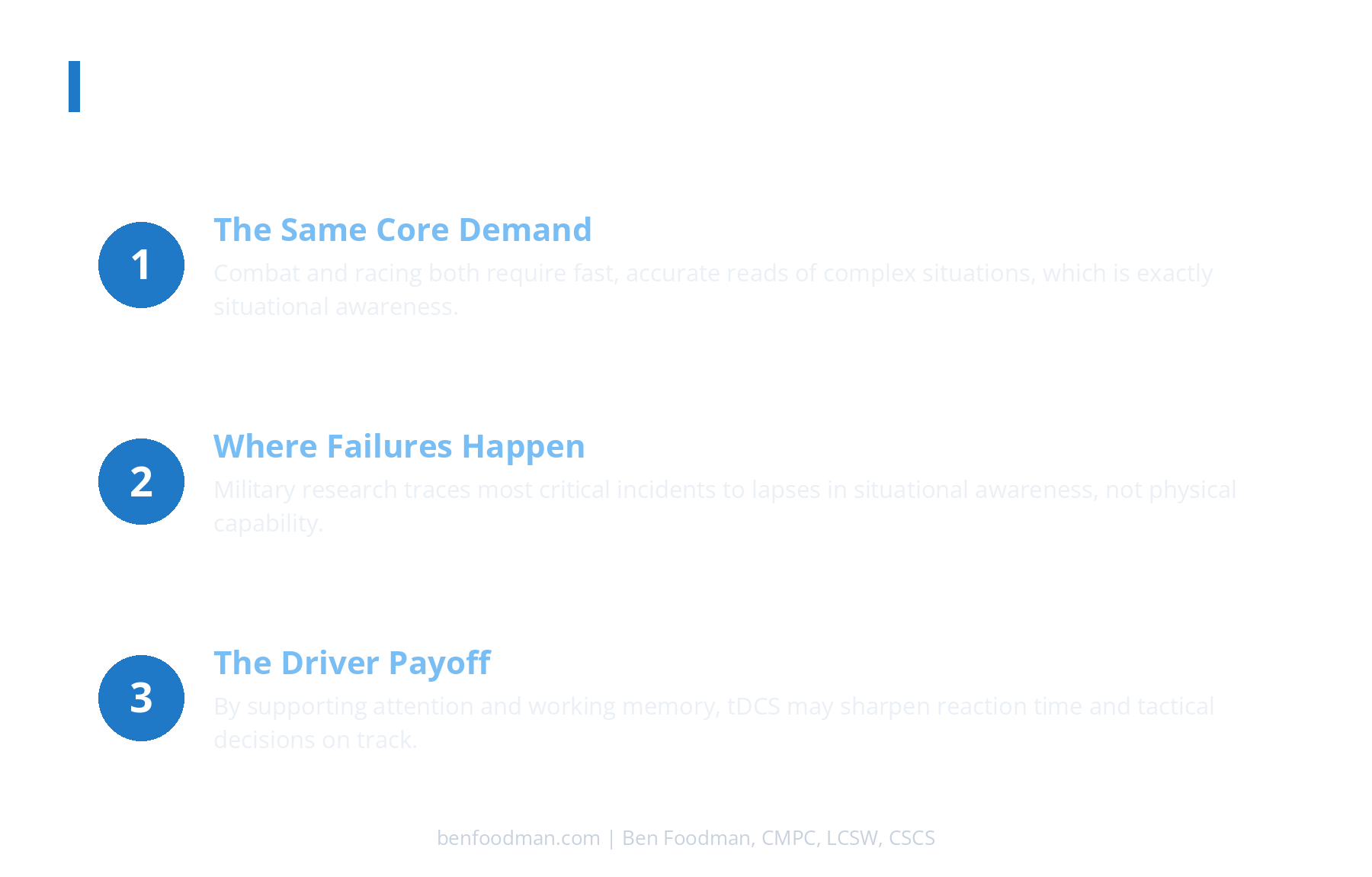
The authors continue: The ability to make quick assessments of complex and rapidly changing situations is vital across all military service branches and ranks, so maintaining situational awareness is an essential prerequisite of performing tasks in real-time. A review conducted by Hartel et al. (1991) concluded that situational awareness deficits were the primary cause of military aviation related incidents, and Murray et al. (2010) attributed the majority of critical incidents involving naval Marine Corps infantry to failures of perception regarding consequential environmental or situational features. As previously presented, there are signs that tDCS could improve a number of cognitive aspects relating to the attainment and maintenance of situation awareness. As well as the functioning of the perceptual senses (e.g., visual and auditory) themselves, attention and working memory are critical factors underlying in the acquisition of information in support of situational awareness. While this paper is mainly focused on psychological benefits accrued from tDCS on military personnel, many of the same mental demands that are present in combat are also in racecar driving. Having increase situational awareness is key for any motorsport athlete regardless of the racing series or level of competition. Drivers that are looking for any edge should consider working with a modern sport psychology professional that utilizes interventions such as DARPA protocols like tDCS, as it will increase the chances that the drivers have faster reaction times and make better tactical decisions on the track.
Frequently Asked Questions About Modern Mental Skills Training For Racecar Drivers
-
No, and most do not. The majority of sport psychologists still work with traditional top-down interventions, while tDCS sits on the frontier of applied sport psychology and neuroscience. Drivers interested in this type of training should specifically seek out professionals with training in neuromodulation protocols, and should expect these tools to supplement a complete mental training program rather than replace it.
-
No. Research on tDCS shows a wide range of cognitive effects that depend heavily on electrode placement, current protocol, and the individual athlete, and this remains an emerging area of study. Results vary from person to person, which is why these protocols should only be used under the guidance of trained professionals who understand both the technology and the specific demands of the athlete's sport.
-
Ask whether they use QEEG brain mapping to assess how your brain is functioning before any training begins, since individualized protocols designed from mapping data are the marker of serious neurofeedback work. Also ask about their specific neurofeedback training, how they measure progress across sessions, and how the training connects to your performance goals in the car.
How Do Racecar Drivers Address Whiplash Syndrome With Mental Training?
Crashing in racing is not a matter of if but when, and a meaningful portion of drivers develop symptoms consistent with whiplash syndrome: inexplicable errors with entry and exit speed, braking too early, abnormal muscle tension, and difficulty reading the car. Because these symptoms emanate from the subcortical brain, bottom-up interventions such as Brainspotting, somatic work, and neurofeedback typically reach them, while top-down approaches such as CBT typically cannot.
Crashing a car in racing is not a matter of IF but WHEN. I have written extensively about this issue, but one psychological phenomenon that is almost certain to happen to a significant portion of elite racecar drivers is Whiplash Syndrome. In the book The Body Bears The Burden by Robert Scaer, the author goes into great detail about how we understand what Whiplash Syndrome is and how it can affect racecar athletes. The author states the following: Patients suffering from even a minor to moderate velocity rear-end MVA often suffer from a confusing variety of symptoms. Not only do they ‘have the typical complaints of headache and neck pain and stiffness, they also often complain of emotional symptoms, depression, and anxiety. Neurological complaints are common, ranging from dizziness and vertigo, ringing in the ears, blurred vision, fainting spells and balance difficulties to remarkable problems with thinking, concentration, and memory. Rather than making a steady recovery like a comparable sports-related accident, whiplash patients often pursue a slow, unpredictable course. They often take several years to improve, with episodic periods of worsening that don’t make sense when related to other types of soft tissue injuries. Long-term studies in whiplash patients in general show that a majority (70 to 80 percent) returned to normal activities in six months. On the other hand, in other studies, persistent chronic pain has been noted in 18 percent of victims at three years and up to 40 percent to ten years.
Motorsport athletes that are both serious about extending the lifespan of their career and acting in a professional manner need to be honest about addressing this issue rather than ignoring the side effects of a car crash. Based on my experience with racecar drivers, I have found in my practice that approximately 20% of drivers are dealing with Whiplash Syndrome. Drivers will make inexplicable errors with entry and exit speed, be too quick to hit the brakes, are unable to determine if they are too loose or tight, and experience abnormal muscle tension in the cockpit pre, intra and post-race. To my knowledge, the only interventions that seem to be the most effective at fixing this issue are either Brainspotting, EMDR, Somatic Therapy or Neurofeedback. What I can definitively say is that traditional sport psychology approaches such as CBT (cognitive behavioral therapy), MI (motivational interviewing), REBT (rational emotive behavioral therapy) and other approaches similar to these are going to be ineffective for this issue because the brain’s internal alarm system is activated through the experience of Whiplash Syndrome, which means that the symptoms produced by this process will be emanating from the region of the brain known as the subcortical brain. This part of the brain does not typically respond to ‘top-down’ approaches, but rather ‘bottom-up’ interventions due to the somatic focus emphasized in Brainspotting, EMDR, Somatic Therapy and Neurofeedback. I go into this in even more detail on my racecar driver mental training methodology page here. I also talk provide additional resources on my comprehensive Brainspotting mental training guide here.
Note To Reader:
If you are an athlete reading this segment of the TRAINING REPORT, hopefully this content was helpful! I put the Training Report together because I felt like many of the discussions on issues such as the Yips/mental blocks, strength training & other subject matter on athlete performance concepts were really missing the mark on these ideas (e.g. how trauma is the direct cause of the Yips). If you are interested in learning more, make sure to subscribe below for when I put out new content on issues related to sport psychology & athlete performance! Also, if you are looking to work with a mental performance specialist, you are in the right place! USE THIS LINK to reach out to me to see if my services are the right fit for your goals!
ARE YOU ON THE LIST?
Make sure you’re signed up to Ben’s mailing list to receive news & updates on new strategies in sport psychology, upcoming workshops & products. Don’t wait, sign up now!
Check Out The Previous Training Reports!