
Can MLB Players Really Overcome A Hitting Slump? What Polyvagal Theory, Brainspotting, EMDR & Biofeedback Actually Do
MLB athletes and baseball players at all levels of competition can overcome hitting slumps if they use somatic-based interventions such as EMDR, Brainspotting and biofeedback. This is because the regions of the brain that are responsible for creating these mental blocks are also responsible for generating involuntary stress responses such as fight, flight, and freeze. Somatic-based interventions bypass the regions of the brain that are not involved with the creation of these stress responses and directly access the regions that are.
Updated on 7/4/26, written by Benjamin Foodman, CMPC, LCSW, CSCS
Ben Foodman is a licensed psychotherapist & Certified Mental Performance Consultant (CMPC) through the Association for Applied Sport Psychology (AASP). He owns his private practice located in Charlotte North Carolina where he specializes in working with athletes to help them overcome mental blocks (the yips), increase mental toughness and improve focus using techniques such as Brainspotting, biofeedback, exercise science and sport psychology. If you are interested in services, use the link here! Enjoy the article below!

Table Of Contents
Why Are Hitting Slumps A Nervous System Problem And Not A Mechanics Problem?
How Does Polyvagal Theory Explain Why MLB Players Suddenly Can't Hit?
What Does Brainspotting Actually Do For The Brain When A Baseball Player Is In A Hitting Slump?
How Does EMDR Help MLB Players Process The Anxiety And Trauma Underneath A Hitting Slump?
How Does Biofeedback Training Help MLB Players Make Sure The Hitting Slump Never Comes Back?
Case Study: How An MLB Hitter Overcame A Hitting Slump And Rebuilt His Confidence At The Plate

Why Are Hitting Slumps A Nervous System Problem And Not A Mechanics Problem?
Most baseball players have a swing coach that constantly monitors the athlete’s biomechanics. Because they are constantly monitored and tracked, the sudden, inexplicable change in performance tells you everything you need to know. The baseball player’s subcortical brain is overwhelmed with stress and as a result, is producing an involuntary stress response that comes in the form of overthinking, muscle tensions, increased heart rate and other unwanted physiological changes in the body.
When baseball players have come to work with me in Charlotte, North Carolina, they usually want my help with one of two things: overcome the yips in throwing or hitting slumps. I have spent a significant amount of time discussing the Yips in throwing, but for this issue of the Training Report, I wanted to go into the science of a hitting slump and how the yips actually plays a role in during this psychological phenomenon. The first question I usually get from baseball players on this, is how I know whether it is a nervous system problem versus a mechanics problem. The answer is fairly simple. When I ask players how they do in practice, most of the time they feel like their mechanics are solid, but when they get into a live game situation, they report all types of problems (e.g. excessive muscle tightness, blacking out, thinking too fast, temperature changes in different regions of the body, etc.). These experiences typically cause athletes to then retrain their swing thought and mechanics in order to correct the problem. Unfortunately, this only makes it worse.

How Does Polyvagal Theory Explain Why MLB Players Suddenly Can't Hit?
Polyvagal theory was developed by Dr. Stephen Porges, and refers to how an individual’s body has specific neurological structures that govern one’s defense mechanisms and engagement as a result of perceived stress or potential threats. When baseball players are hitting, this can be an incredibly stressful environment that oftentimes can produce stress responses discussed in Polyvagal theory.
In an article published in Frontiers In Integrative Neuroscience, the authors describe what Polyvagal theory is and how it can impact individuals in stressful situations:
Polyvagal Theory provides an innovative scientific perspective to study feelings of safety that incorporates an understanding of neuroanatomy and neurophysiology.
This perspective identifies neural circuits that downregulate neural regulation of threat reactions and functionally neutralize defensive strategies via neural circuits communicating cues of safety that enable feelings of safety to support interpersonal accessibility and homeostatic functions.
Basically, when humans feel safe, their nervous systems support the homeostatic functions of health, growth, and restoration, while they simultaneously become accessible to others without feeling or expressing threat and vulnerability.
Feelings of safety reflect a core fundamental process that has enabled humans to survive through the opportunistic features of trusting social engagements that have co-regulatory capacities to mitigate metabolically costly defense reactions.
Consider the environmental conditions a baseball player is subjected to when they are competing at bat: first, the social environment is hostile. The opposing team is looking for any moment to publicly humiliate you, opposing fans are saying disgusting things about you personally, and even worse, you feel the pressure of not wanting to let your team and coaches down which can oftentimes feel like an existential nightmare. You could get hit with the baseball which at the very least will physically hurt you, at worst you could get hit in the head and have some type of concussion or brain damage. Your performance can also dictate how long you maintain your position on the team or if they decide to cut you. Most baseball players are aware of all these things happening simultaneously, and as a result, will produce involuntary stress responses that are oftentimes very similar to fight, flight, freeze behaviors. Fortunately, there are mental training approaches that can help baseball players overcome these issues such as Brainspotting, EMDR (Eye Movement Desensitization & Reprocessing) & biofeedback.

What Does Brainspotting Actually Do For The Brain When A Baseball Player Is In A Hitting Slump?
Brainspotting is a powerful, focused mental training intervention that works by identifying, processing and releasing core neurophysiological sources of emotional/body pain, stress, trauma, dissociation and a variety of other challenging symptoms. Because many baseball players are dealing with some form of stored stress, this can affect swing mechanics. Brainspotting can help identify and release that stress.
In a research paper published in the International Journal of Environmental Research & Public Health, the authors describe what happens during a typical Brainspotting training session:
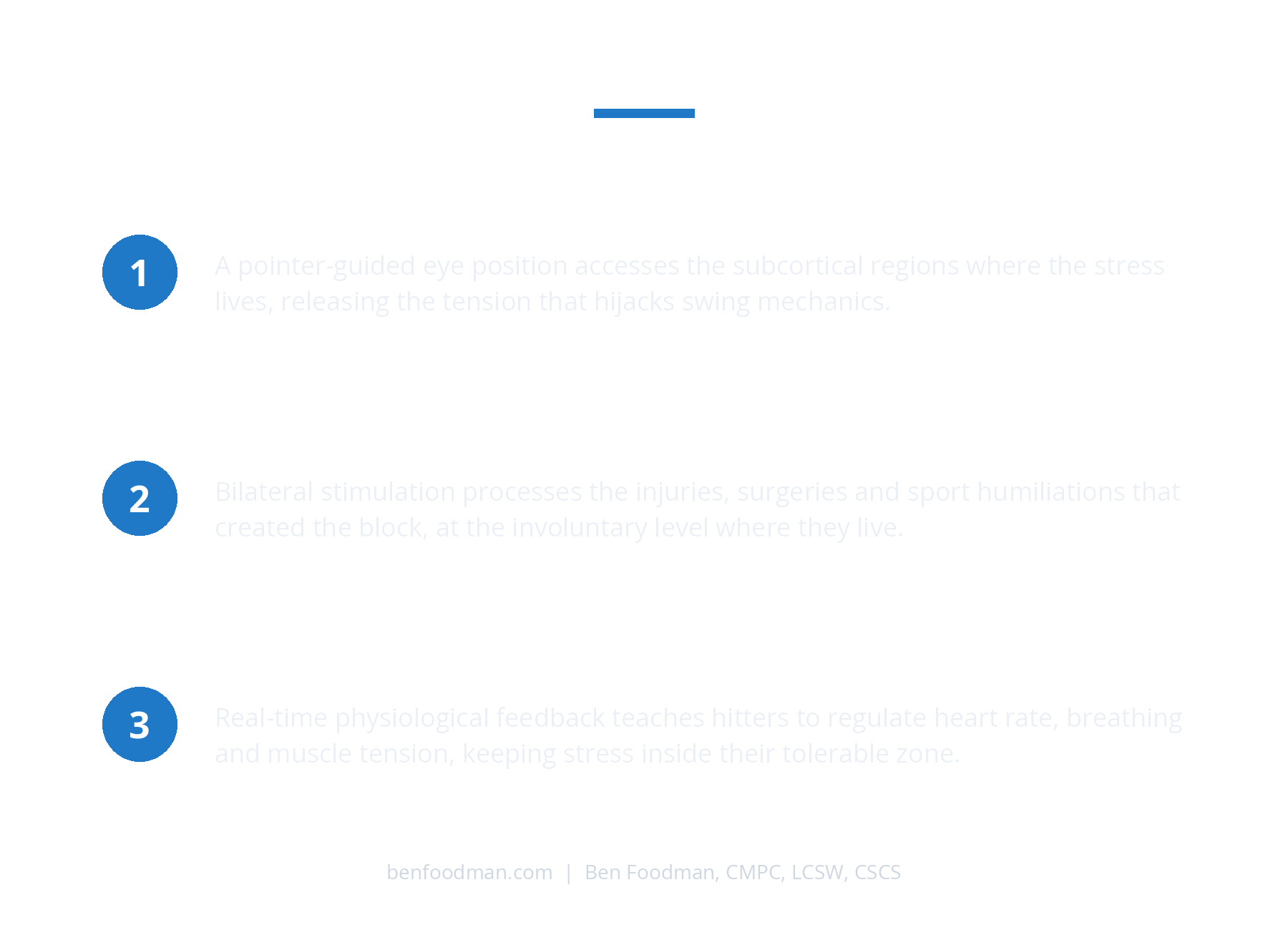
During a typical BSP session, the therapist guides, through a pointer, the eyes of the client across the field of vision to find an appropriate eye position (“Brainspot”) to “activate” the psychophysiological response to a traumatic memory. In BSP, the target is the visual point of activation.
The purpose is thus to identify the Brainspot as this visual point that appears to promote the client’s processing of the distressing or traumatic experience, as in the EMDR approach, the memories, thoughts, or sensations connected to it. In BSP, the distressing memory is processed without following specific series of steps or verbal reports.
For example, whereas in EMDR, the client generally receives intermittent BLS and has the possibility to share what she/he has been noticing, in BSP, the client continuously listens to a slowly acoustic BLS (“BioLateral Sound”) during the processing, and does not necessarily have to talk to the therapist during elaboration.
The processing phase in BSP is generally more focused on body sensations. Indeed, in many cases, the therapeutic intervention during the memory processing is limited just to bringing the client’s attention back to his/her own body. Nonetheless, a common feature of BSP is that this invites the clients mind fully pay attention to their inner experience.
There are many legitimate criticisms of this intervention worth acknowledging, most notably the fact that there is just not enough peer-reviewed research to support some of the claims made by practitioners in this field. Specifically, as of the publication date of this paper I am unaware of any meaningful meta-analyses or single-blind designs (blinded evaluators) or randomized controlled trials (RCTs) using sham or active placebos to review this intervention. Furthermore, some psychologists have even called into question the neuropsychological mechanisms that Brainspotting clinicians claim occur during this intervention. With that being said, there are many notable experts within the field of sport psychology and human development that substantiate the validity of claims made by Brainspotting & EMDR clinicians such as Dr. Bessel Van Der Kolk, Dr. Stephen Porges, & Robert C. Scaer. While Brainspotting does not work for everyone, I have found in my applied experience working with MLB, as well as SEC, ACC and elite high school baseball players, Brainspotting is by far and away a much more effective intervention compared to basic, low-impact sport psychology tools such as positive self-talk or cognitive behavioral therapy. I have found that approximately 30% of baseball players I use Brainspotting with see significant reductions if not outright elimination of yips-based, hitting slumps (that is hall of fame level in baseball terms).

How Does EMDR Help MLB Players Process The Anxiety And Trauma Underneath A Hitting Slump?
Like Brainspotting, EMDR (eye movement desensitization & reprocessing) is a mental training intervention that helps athletes psychologically prepare to release and withstand the neurophysiological responses associated with stress. These symptoms are often the main culprit causing hitting slumps for baseball players, and as such, makes EMDR an ideal intervention to use.
In an article published in the Journal for Applied Sport Psychology, the authors go into intricate detail explaining the theories that support how and why EMDR is a highly effective intervention for athletes undergoing mental blocks in their sport:
In EMDR, situations and triggers linked to past, present, and future concerns are identified, and target symptoms are rated as emotional and physical experiences along with negative self-referencing statements. Processing involves the therapist sitting facing and alongside the client, who is asked to watch the therapist’s fingers moving rapidly and rhythmically from side to side across the client’s range of eye movement in sets of 12 to 24 movements at an approximate frequency of two left–right cycles per second.
The client is supported in “noticing” experiences during therapy, similar to the process of mindfulness, aiding development of a sense of mastery and self-efficacy related to the traumatic incident, with more adaptive interpretations and imagery being reinforced using bilateral eye movements, typically at a slower frequency.
Two dominant hypotheses have been proposed to explain bilateral stimulation effects caused by eye movement. The first is that eliciting an “orienting response,” where a reduced arousal neurobiological state, similar to rapid eye movement sleep, may cause dysfunctional memories to be linked to more adaptive memory networks.
A second is that dual attention processing might disrupt working memory, with effects on emotionality of imagery and memory. Both hypotheses have considerable supporting evidence and may interactively support the therapeutic effects of EMDR, with symptoms of single incident trauma typically resolving within two to three sessions.
Although eye movements are the most commonly delivered form of bilateral stimulation, hand taps and auditory tones have also been used where clients are visually impaired or cannot tolerate eye movements. Underpinning EMDR, adaptive information processing theory proposes that healthy adjustment requires that new experiences are linked with emotions before being stored in neural memory networks with associated learning or experience.
Chronically traumatic experiences may remain unprocessed, typically stored in implicit memory with associated physical sensation and emotional experience isolated from new learning and influence. Lying outside conscious control, implicit memory may be reactivated by experiences, leading to reflexive behavioral responses.
Because a significant amount of baseball players I have worked with have experienced severe injuries, multiple surgeries, physical abuse, verbal abuse, emotional abuse, sports humiliations, overtraining syndrome, and many other stress-overload events, EMDR is often the perfect intervention to help these athletes overcome the stored stress from those events that are creating the mental blocks affecting swing thought and swing mechanics. While EMDR does not work for everyone, compared to traditional sport psychology interventions, it is by far and away a superior intervention. This is because traditional, low-impact, sport psychology tools focus on using insight-based techniques (e.g. positive reframing, positive self-talk), when in fact the underlying mechanisms that are causing hitting slumps and the Yips originate from regions of the brain that primarily generate dysregulation behaviors and involuntary responses.

How Does Biofeedback Training Help MLB Players Make Sure The Hitting Slump Never Comes Back?
Sport psychologists along with mental performance consultants use biofeedback to help athletes monitor their physiological reactions to stress, while also teaching them how to create performance-optimized responses in those situations.
Biofeedback is one of the most effective interventions used in sport psychology to help athletes reduce overall anxiety, and in some cases speed up the timeline from injury rehabilitation. In an article published in the Journal for Applied Sport Psychology, the authors describe how biofeedback works and why it can be so effective when working with athletes:
Biofeedback is a technique that allows individuals to change physiological activity for the purpose of self-regulation by the physical feedback signals from their own bodies, such as muscle activity, heart rate, and brain electrical activity.
Most studies focused on the clinical use of biofeedback for treating medical disorders such as hypertension; however, there is increasing interest in the aspect of performance enhancement in sport.
Some studies showed improved sport performance after biofeedback intervention using a five-stage training program that includes introduction, identification, simulation, transformation, and realization steps while other studies indicated that biofeedback training improves athletic performance by reducing anxiety.
Many baseball players I work with that are going through hitting slumps usually describe symptoms that are consistent with anxiety and stress responses which include the following: abnormal muscle tension, rapid breathing, increased heart rate, temperature changes in the body, nausea, etc. Interestingly, even at the professional level many of my clients have not integrated a consistent deep breathwork routine. The reason for this is because they have been previously told to “just breath” or “just take a few breaths” but are never given the science behind why they should do it nor the instruction on how to do it correctly. Based on the available research, biofeedback is one of the most consistently researched interventions and has the highest efficacy in terms of helping reduce the symptoms baseball players experience when hitting.

Case Study: How An MLB Hitter Overcame A Hitting Slump And Rebuilt His Confidence At The Plate
(Disclaimer: After reviewing this article, the client has granted me permission to discuss the information in this case study about how our work together helped him overcome his hitting slump. Information has been changed to protect the client’s identity and privacy)
Billy was referred to me by one of the sport psychologists working for an MLB team. Billy had been experiencing a severe hitting slump that was not showing any signs of improving. When Billy and I first spoke, I took a detailed history exploring his injury history, as well as his mental health status. Billy had a healthy social life and came from a loving family with no known history of physical or emotional abuse. However, Billy had an extensive injury history which included multiple surgeries, concussions, and long physical rehabilitation processes. Billy and I first started using Brainspotting to help him become desensitized to the tension he was feeling, which we both agreed was a result of all the injuries he had accumulated. During this time, we also had him start to use 40 minutes of deep breath work patterns on a daily basis. After 15 Brainspotting sessions and 2 biofeedback sessions, Billy reported that the tension he was feeling significantly reduced and as a result, his batting average significantly improved back to his normal baseline performance outcomes.

Frequently Asked Questions: MLB Players And Hitting Slumps
-
Yes, they can absolutely recover from hitting slumps but they need to be using the correct sport psychology interventions. Traditional sport psychology interventions such as cognitive behavioral therapy are largely ineffective and do not accurately target the underlying cause for this issue.
-
It depends on the history of each athlete. Athletes that have complex PTSD and early childhood abuse history will need much more time to effectively deal with the underlying issue, but I have found on average in my practice it can take 15-20 Brainspotting appointments total.
-
Baseball players will always go through hitting slumps. The core point that baseball players should focus on is their ability to achieve what is called their internal zone of optimal functioning (IZOF). Basically, this refers to how “in control” athletes feel in their bodies. Typically, baseball players that are going through abnormal hitting slumps are usually feeling anxiety or stress that is outside of their ability to tolerate (AKA their IZOF).

Why Do Brainspotting, EMDR, and Biofeedback Work Better Together For MLB Players Than Traditional Sport Psychology?
The reason these interventions are superior is because they intentionally target the regions of the brain that are highly active during sport performance situations, whereas traditional sport psychology does not.
Most sport psychology interventions are rooted in what is known as cognitive behavioral-based approaches. Essentially, the sport psychologist or mental performance consultant is trying to “counteract” the athlete’s negative thinking or emotional responses with more “positive” based thinking. The idea is that if the athlete can just gain better insight, this will help them reframe their perspective of the situation. But what most of the psychological research tells us that the majority of psychological issues that people experience are not due to lack of insight, but rather a type of “pressure” originating from the deeper regions of the brain. Research consistently shows us this through QEEG and FMRI results (imaging that shows how certain parts of the brain light up over certain issues). And in my professional experience, the more I have focused on using somatic-based interventions such as Brainspotting or biofeedback, the more success my athletes have had overcoming these issues. I cover this in much greater depth, including every intervention and what realistic recovery looks like, in my full baseball yips guide as well as my athlete Brainspotting resource page here.
Ready to implement these tactics? Book a consultation to see if services are right for you!
Sign up to learn more about new updates with Ben’s practice!
Check out older Training Report articles below for more resources!