

HOW DOES BRAINSPOTTING WORK FOR ATHLETES?

Brainspotting is a brain-based mental training approach that uses fixed eye positions to access and release stress responses held in the deeper, non-verbal regions of the brain, the same regions responsible for automatic athletic movement. While many athletes and coaches assume performance blocks like the yips are rooted in mechanics or a lack of confidence, current research points to these blocks originating in a conditioned stress response that the conscious mind cannot simply think its way out of. This guide explains exactly what Brainspotting is, how it works in the brain, what a session actually feels like, and how long it typically takes to see results.
Last Updated [7/7/26] | Written by Benjamin Foodman, CMPC, LCSW, CSCS — a Certified Mental Performance Consultant, Certified Brainspotting therapist and licensed psychotherapist based in Charlotte, NC, specializing in helping athletes across baseball, motorsport, and other sports overcome mental performance blocks using Brainspotting. Learn more here.

What Is Brainspotting?
Brainspotting is a brain-based mental training approach that uses fixed eye positions to locate and release stress responses stored in the deeper regions of the brain, below the level of conscious thought. For athletes, this intervention targets the root cause of performance blocks instead of managing symptoms with positive self-talk or reframing.
In 2003, Dr. David Grand discovered the approach while he was working with a competitive figure skater who could not land her triple loop even though she had done so plenty of times and clearly had the talent to compete with other elite ice skaters. She had already been through a year of weekly sessions with Dr. Grand himself, using talk-based and eye movement approaches, with little to show for it on the ice. During one session, while Dr. Grand slowly tracked her eye movements, her eyes wobbled and froze at one specific spot in her visual field. Instead of moving on, Grand held her gaze there. Over the next several minutes she processed material that a year of talking had never reached while also reporting significant spikes of somatic discomfort. The next morning, she landed the triple loop, and the block did not return. Her overnight result is the famous exception, not the promise. Most athletes typically need sustained work over multiple sessions, and this guide covers realistic timelines below.
That moment became the foundation of the method. Dr. Grand spent the following decade testing what he had observed: that where an athlete looks helps the athlete's brain connect to material on a deeper level which in turn can access the underlying, root cause of their problem. By holding the eye position, this lets the deeper brain process experiences that conversation alone cannot reach. He documented the discovery and the framework in his book Brainspotting: The Revolutionary New Therapy for Rapid and Effective Change. Grand later partnered with sport performance consultant Dr. Alan Goldberg to apply the method directly to sports in This Is Your Brain on Sports, which examined how accumulated sports injuries, failures, and humiliations produce repetitive performance problems, including performance blocks like the yips.
So why does this process help athletes overcome mental blocks in ways other sport psychology interventions can't? This is because certain regions of your brain that control automatic athletic movement are not the regions you talk with. When a frightening injury, a humiliating failure, or years of accumulated pressure get stored in those deeper regions, no amount of conscious effort reliably reaches them. This is why an athlete can know their swing is fine, want desperately to throw freely, and still watch their body do something else. Brainspotting works where that material actually exists, outside of our brain's ability to voluntarily move through these problems. To be clear about what Brainspotting is not: it is not visualization, it is not hypnosis, it is not positive self-talk, and it is not a relaxation technique. It is a focused processing method, and the work is usually very uncomfortable and difficult while it is happening. That honesty matters, and this guide will not pretend otherwise.
I would know as I have been through my own Brainspotting. During the first training session when I experienced it while processing a traumatic event that had happened to me nearly 30 years ago, I began to feel as if my stomach would crawl out of my throat and my eyes felt incredible pressure building behind them. But after the Brainspotting session, not only did the sensations go away, but all of the overthinking I had been dealing with for decades did as well. It completely changed my life and I knew that there was something special about this approach that needed to be shared with others… specifically athletes. Quick side note before you keep reading, if you are an athlete dealing with a mental block that you have been unable to fix, reach out to me and book a free consultation call using this link here.
How Does Brainspotting Work in the Brain?
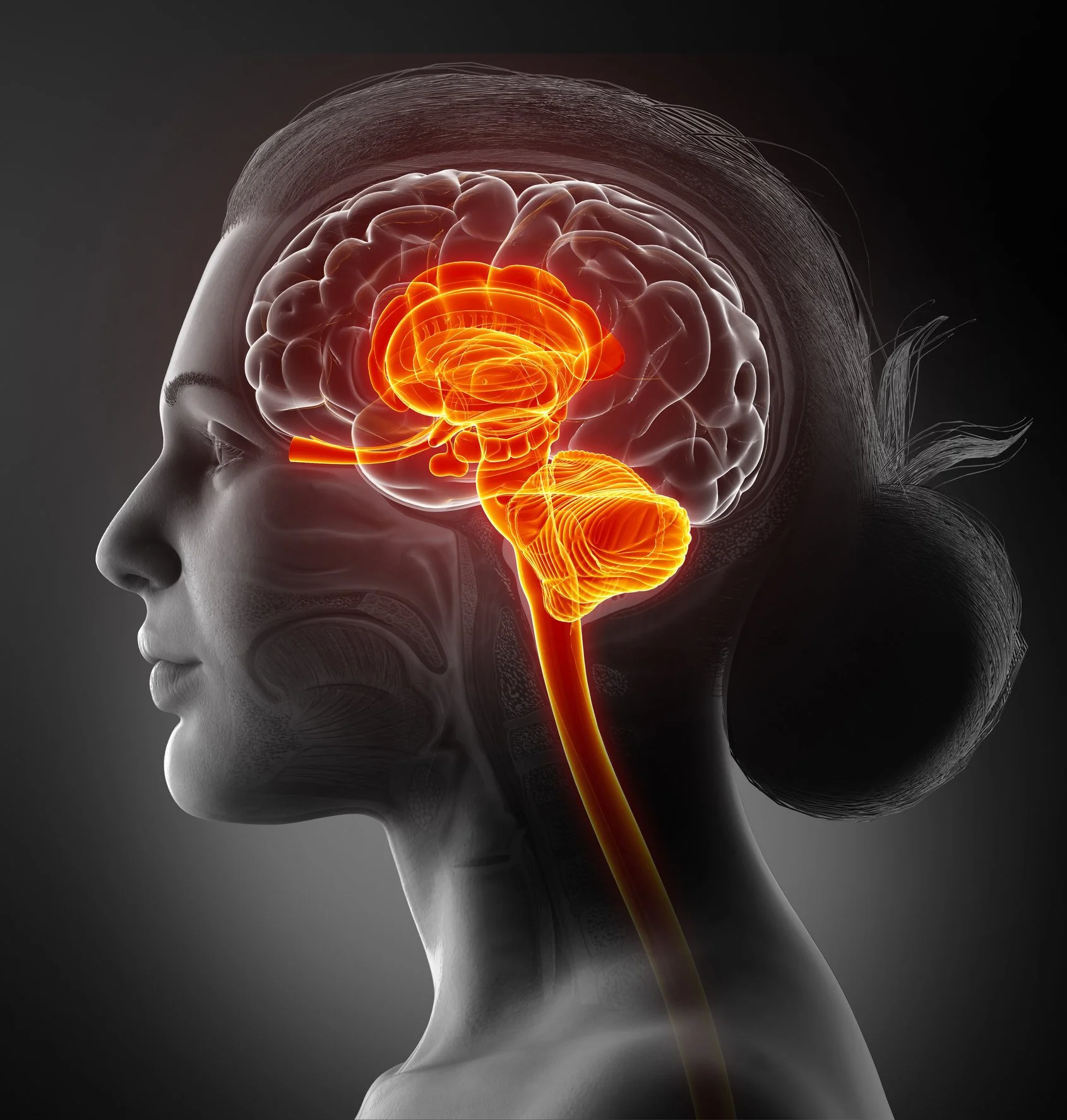
Brainspotting is believed to work by using a fixed eye position to access the deeper, non-verbal regions of the brain where stress responses are stored, allowing the brain to process and release them. While this is still a proposed model, the leading theory, developed by Dr. Frank Corrigan and Dr. David Grand, centers on the midbrain, the survival-oriented region that runs automatic responses the thinking brain cannot directly override.
Start with the part that is not in dispute, which is that where you look changes what your brain can access. Your eyes and your brain are wired together so tightly that eye position is not just an output of attention, it is a doorway into it. Anyone who has looked away to concentrate on a hard question or gazed away at a random point in the distance has felt a small version of this. Brainspotting takes that everyday link and uses it deliberately: a specific eye position, held with focus, appears to keep the brain oriented toward material it would otherwise slide away from.
The leading explanation for why this happens comes from a 2013 paper by Dr. Frank Corrigan and Dr. David Grand, published in the journal Medical Hypotheses. Their proposed model points to the midbrain, a deep survival-oriented structure, and to a pathway running from the eyes into regions that govern orientation, emotion, and body awareness rather than language and logic. The core idea is that holding a Brainspot, the eye position where the body shows a reflexive response signaling deep activation, engages this deep pathway and lets the brain complete a processing sequence that trauma or overwhelming stress had interrupted and left unfinished. A follow-up paper in 2015 extended the model to explain what happens during the sustained attention of a session, as the body activation gradually clears. As with most mechanism-level explanations in psychology and medicine, this model is proposed and still being tested rather than settled fact, and it continues to be refined alongside the growing body of outcome research covered later in this guide. This proposed mechanism does not stand alone, either. It aligns with polyvagal theory, Dr. Stephen Porges' well established framework for how the nervous system shifts between states of safety and survival below conscious control, discussed in the next section. Two independent lines of nervous system science pointing toward the same basic idea, that performance blocks operate beneath conscious reasoning, is exactly the kind of convergence that gives a still developing model like this one real credibility.
Here is why that matters for athletes at every level of sports. The midbrain and the surrounding deep structures run the automatic, fast, below-conscious processes of movement and threat response, and this part of the brain understands the world through stress and primal somatic signals rather than language. When a bad crash, a public failure, or years of piled-up pressure get encoded in the brain as a survival response, your logic-based brain cannot simply talk them into standing down, because the thinking brain does not have direct access to that wiring. Think of this like an odd-couple roommate situation: one roommate is like a college guidance counselor, calm and reasoning (the logic-based brain), and the other roommate is a blindfolded alligator, reacting on pure instinct (the survival brain). This is the mechanism behind the maddening experience every blocked athlete describes: full knowledge that the throw is safe, full desire to make it, but their body does something else anyway. The mental block does not respond to willpower or a better reframed thought. Brainspotting is an attempt to work at the level where it actually does.
How Is Brainspotting Different From EMDR?
Brainspotting and EMDR are both brain-based methods used to process stress and trauma that talk therapy alone often cannot reach, but they differ in three key ways. Brainspotting typically has clients hold their gaze at a single point while EMDR uses side to side eye movement or other alternating stimulation, EMDR follows a more structured eight-phase protocol with a built-in resourcing stage while Brainspotting is more fluid and led by the athlete's own nervous system, and EMDR has a substantially larger research base built over several decades compared to Brainspotting's newer and still-growing body of evidence.
The most visible difference between the two methods is what the eyes are doing. EMDR uses ocular bilateral stimulation, most often side to side eye movements guided by the therapist, though tapping or alternating tones can also be used. Brainspotting instead holds the eyes still at a single point, the Brainspot, where the body shows the strongest signal of activation. Both approaches work from the same basic principle, that eye position and movement are connected to how the brain accesses and processes stored experience. They simply use that connection in different ways, one through motion, one through stillness.
The two methods also differ in how much structure surrounds the processing itself. EMDR follows a defined eight phase protocol, and one of those phases is specifically built around resourcing, teaching the client tools like a safe place or a calming image before trauma processing begins. That structure works well for people who find predictability grounding. Brainspotting tends to be more fluid. Resourcing still happens, but it develops out of the therapist's attunement to what the athlete's body is showing in the moment rather than following a fixed sequence. Neither approach is inherently better. They are built around different levels of structure, and the right fit often comes down to how an individual athlete responds to structure versus flexibility.
One more difference is worth naming directly. EMDR has been studied for decades and has built a substantially larger body of peer reviewed research compared to Brainspotting, which is a newer method still building its evidence base. A 2017 study comparing the two approaches head to head in 76 adults with PTSD found both produced meaningful symptom reduction, with EMDR showing somewhat larger effect sizes in that sample. EMDR also has direct support in sport specific settings, including a published case study of a professional golfer whose decade-long putting block resolved with EMDR and graded exposure. Brainspotting's research base is smaller but growing, and one comparative study found it performed on par with EMDR and outperformed passive approaches like guided meditation, though that study used a non-clinical sample rather than athletes. In short: EMDR carries more research weight today, Brainspotting is newer and catching up, and both have real evidence behind them rather than just enthusiasm. What the current evidence does support for Brainspotting specifically is meaningful results for many people, particularly around the kind of nonverbal, body held blocks common in athletic performance issues, and that evidence base is covered in more depth later in this guide.
I am a Certified Brainspotting Therapist and have studied EMDR, though I am not formally trained in it. Brainspotting is my primary method for working with athletes. For athletes who are not near a Brainspotting trained therapist, EMDR is a highly effective alternative, and I will refer athletes to EMDR trained providers when that is the better fit.
Why Do Athletes Develop Mental Performance Blocks That Talking Can't Fix?
Performance blocks typically form as conditioned stress responses: the brain's automatic threat system, fight, flight, or freeze, firing in a sporting environment that is actually engineered to be safe. That mismatch is itself a state of dysregulation, and because it originates below conscious reasoning, understanding the block intellectually is often not enough to resolve it. Real change requires accessing and updating the stored response itself, not just talking about it.
Most performance blocks do not start as a thought. They start as an event, a bad crash, a pitch that hit someone, a play that ended in public failure or humiliation, or years of accumulated pressure that finally tips over. In that moment, the nervous system does what it is built to do. It catalogs the experience as a threat, along with the specific movement, sensation, or situation that was present when the threat occurred. That association gets stored below the level of conscious thought, the same deep brain regions covered earlier in this guide, and it can resurface every time a similar situation shows up again, even years later and even when the athlete consciously knows there is nothing to fear.
War, car accidents, and abuse predictably produce trauma, harm that happens despite every effort to prevent it. Sport is engineered to be different, with on-site medical staff, rules against the most dangerous movements, and protective equipment built in specifically to reduce risk. Yet athletes still produce trauma-like responses inside that safety-engineered environment, which is exactly what makes performance blocks so disorienting. Dr. Stephen Porges, whose polyvagal theory was introduced above, uses the term neuroception to describe the mostly unconscious process by which the nervous system decides whether a situation is safe or dangerous, often without matching what a person consciously knows to be true. A fight, flight, or freeze response firing inside that environment is a real mismatch between the unconscious assessment and the actual level of danger present, and that mismatch is itself a state of dysregulation. The athlete is not imagining the fear. Their body is reacting to a threat that is no longer present, using a survival system that is functioning exactly as it is built to, just aimed at the wrong moment. How polyvagal theory explains athlete peak performance and the yips cover this framework in more depth.
This is why simply talking about the problem often does not fix it. A well-known theory of fear and emotional change, developed by Edna Foa and Michael Kozak in 1986, describes fear as an information structure stored in memory, built from the feared situation, the body's response to it, and the meaning attached to it. For that structure to actually change, it has to be activated, not just discussed, and new information has to be integrated into it directly. For athletes, that integration tends to happen most effectively on a somatic level, in the body's felt experience, rather than through conscious explanation alone. An athlete can fully understand, intellectually, that their swing is mechanically sound and that there is nothing to be afraid of. That understanding lives in the logic-based brain. The block lives in the survival-based brain, the blindfolded alligator described earlier in this guide, and the alligator does not update its behavior because the college guidance counselor gave a convincing explanation. The athlete needs to understand this issue somatically and instinctively in order for the performance block to be resolved.
None of this means that talking has no value. Understanding what is happening, feeling heard, and building a working relationship with a coach or a sport psychologist all matter, and cognitive and behavioral approaches genuinely help many athletes work through the surface layer of a block. But for blocks that persist despite that kind of work, the missing piece is often access to the stored response itself, not more explanation of it. This is where Brainspotting fits into the athlete's mental training approach to dealing with this very specific issue.
What Issues Does Brainspotting Help Athletes With?
Brainspotting is used with athletes dealing with the yips, general performance blocks, performance anxiety, fear after an injury, and precision sport blocks like target panic in archery and golf. Each of these looks different on the surface, but they typically share the same underlying pattern: a conditioned stress response that talking alone has not been able to resolve.
The yips are the most well-known version of this problem, an involuntary block that shows up in throwing, putting, or other fine motor skills that used to be automatic. Brainspotting is one of the primary approaches I use for this specific issue, and a complete guide covering the yips is available for anyone who wants to go deeper on this issue specifically. Beyond the yips, many athletes develop broader performance blocks that never get a catchy name: a hitter who suddenly cannot pull the trigger on a good pitch, a gymnast who freezes before a skill they have landed a thousand times, a pitcher who loses the ability to throw strikes in specific situations. These are not about talent or preparation. They follow the same conditioned stress response pattern described earlier in this guide, just attached to a different movement or moment.
Performance anxiety is broader still, showing up as pre-competition dread, racing thoughts, or a body that will not calm down no matter how much an athlete tells it to. Brainspotting works with the nervous system directly, which is often where anxiety actually lives, rather than only addressing the thoughts that come along with it. Fear after an injury is its own category, sometimes called kinesiophobia in the sports medicine literature, where an athlete is physically cleared to return but their body still braces, hesitates, or holds back at the exact moment of the motion that caused the original injury. The physical healing and the nervous system's sense of safety do not always arrive on the same timeline, and Brainspotting is often used to help close that gap.
In precision sports, this same pattern shows up under a different name. Archers call it target panic, a well-documented block that research suggests affects the large majority of competitive archers at some point, showing up as hesitation, flinching, or an inability to release a shot cleanly. Golfers experience a close cousin of it in putting and chipping blocks. Regardless of the sport or the name attached to it, the underlying mechanism is the same one covered throughout this guide. Another sport that I have extensive experience with is racecar drivers who struggle with qualifying.
Qualifying is extremely stressful because the driver is asked to push the car to the edge of its handling limits. But the fear response that shows up during this portion of the competition is often more intense than even a seasoned driver expects of himself. They report braking too soon, not staying on the throttle as much as they are accustomed to, and experiencing intense muscle tension at points of entry security, the critical braking and turn-in phase of a corner where stability and grip are most in play. These motorsport responses are usually the result of a previous crash the driver experienced but never fully processed, and as a result, the driver experiences these kinds of mental blocks in high-stakes moments such as qualifying.
What Does Brainspotting Look Like Across Different Sports?
Brainspotting is used with athletes across a wide range of sports, not only baseball. Motorsport, golf, equestrian, and gymnastics athletes each experience their own version of the same conditioned stress response covered throughout this guide, even though every sport gives it a different name and a different set of symptoms.
Alongside baseball, motorsport is one of the sport populations I have the most experience with, spanning NASCAR, IndyCar, IMSA, and rally competition. Rally racing in particular exemplifies the physical stress demands that impact these athletes. A study of rally car drivers found that a single race stage lasting only 12 to 14 minutes produced a 93 percent increase in heart rate, reaching nearly 89 percent of peak heart rate, along with significant increases in stress hormones and a 395 percent increase in blood lactate, a physiological demand in the same range as near maximal exercise. When that level of physiological activation is not fully processed, whether from a specific frightening moment during a race or the cumulative toll of pushing the body this hard again and again, it becomes exactly the kind of stored, conditioned stress response covered earlier in this guide, one that can misfire in a future high-stakes moment like qualifying, even once the actual danger has passed.
How professional racecar drivers overcome mental blocks covers how this plays out specifically for NASCAR drivers. But if you would like to take an even deeper look at how drivers train the responses that decide laps, I have written a complete mental performance guide for racecar drivers. Baseball remains the sport most associated with Brainspotting on this site, and a complete guide to the yips covers that work in full depth, since it is where my caseload is heaviest. Brainspotting is also used with golfers working through putting and chipping blocks, equestrian athletes, softball pitchers dealing with the yips, and gymnasts and cheerleaders working through the twisties, each dealing with their own sport specific version of the pattern covered throughout this guide.
What Is a Brainspotting Session Actually Like?
A Brainspotting session involves me slowly moving a pointer along an eye-level line while the athlete keeps their gaze fixed on it as it moves. The athlete gives feedback about any somatic discomfort that shows up at specific points along the way. Once that point is identified, the athlete holds their gaze there until the discomfort fades. Sessions are usually very uncomfortable and difficult while this is happening, and athletes typically experience a significant release of tension afterward.
Most of a session happens without much talking. Once a Brainspot is located, the work is mostly quiet, and an athlete's job is simply to stay with whatever comes up, physical sensation, emotion, memory, or something that is hard to put into words at all. That discomfort is not a sign that something is going wrong. It is usually a sign that the nervous system is finally processing something it has been holding onto. Athletes typically report a marked release of tension by the end of a session, though how quickly and how fully that happens varies from person to person and issue to issue. During sessions, I look for the following physical cues:
rapid breathing
eye wincing
facial muscle tension
flat facial affect
Most importantly, I regularly check in verbally with athletes throughout a session to make sure they feel regulated enough to continue, and I process with them afterward to hear their thoughts on how the work can be improved. For example, some athletes report that bilateral stimulation tabs help them focus, while others find them distracting. Some prefer to process from a resource model, while others prefer activation. Regular communication and feedback from athletes on these preferences are critical to the work. A full walkthrough of what a session looks like from start to finish, including what to expect in a first session, is covered in this guide to Brainspotting sessions for athletes. If what you just read sounds different from other approaches you have tried to get over a mental block you or someone you know has been dealing with, reach out to me and book a free consultation call here.
What Does the Research Say About Brainspotting?
Brainspotting's research base is still young compared to older, more established approaches, but it has grown substantially and now includes actual randomized studies, not just pilot programs and case reports. A 2025 randomized trial of 100 clients found real, lasting benefit from adding Brainspotting to trauma treatment, a separate randomized study found Brainspotting's benefits held up at follow-up better than standard talk therapy, and a head-to-head comparison with EMDR, conducted across five countries, found Brainspotting produced comparable results to that far more established method.
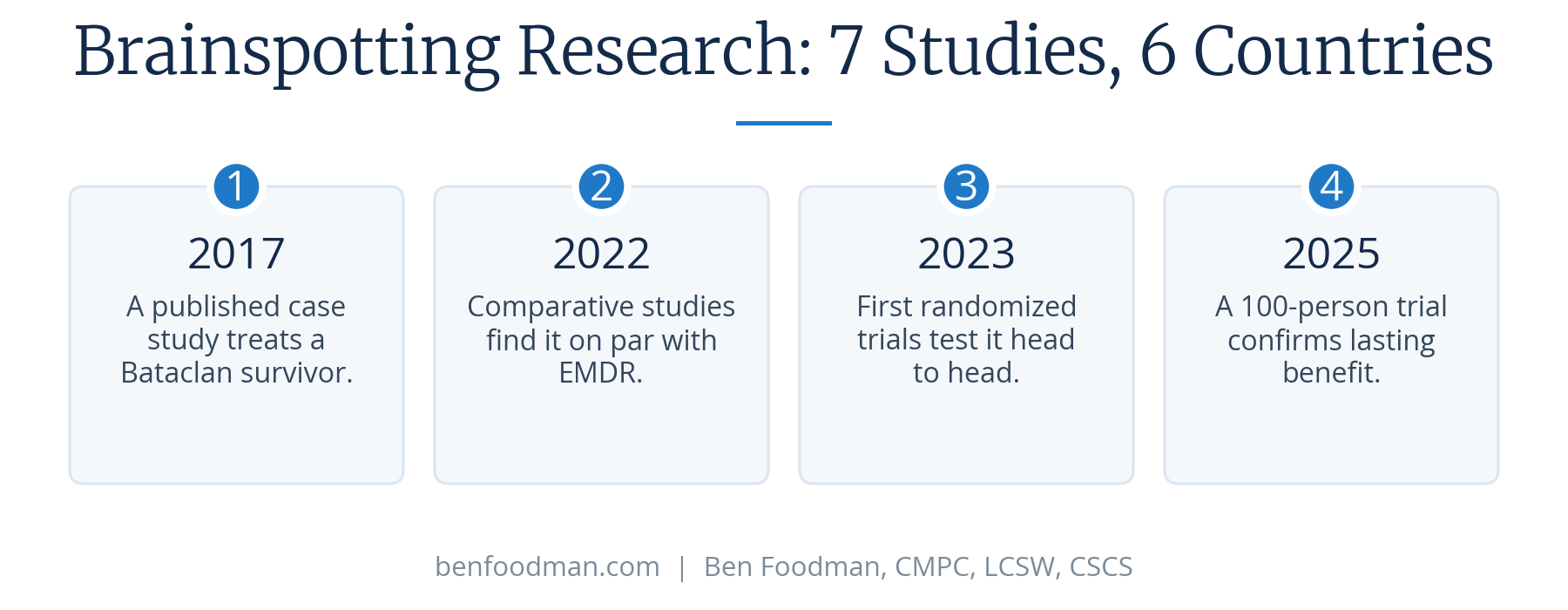
The evidence behind Brainspotting has grown steadily more rigorous over time. The earliest published account, a 2017 case study out of France, documented its use with a survivor of the 2015 terrorist attack at the Bataclan concert hall in Paris. That same year, a study spanning five countries, Germany, the United States, Austria, Switzerland, and Italy, compared Brainspotting directly against EMDR in 76 adults with PTSD. Both approaches produced significant symptom reduction, and the study's own statistical analysis found no significant difference between the two groups, even though Brainspotting's raw effect sizes were somewhat smaller immediately after treatment, a gap that narrowed further by a six-month follow-up.
By 2022, two more studies added to the picture. A comparative study in a non-clinical sample found Brainspotting performed on par with EMDR and outperformed passive approaches like guided meditation. Separately, a quasi-experimental study of 13 women with severe, long-standing PTSD at a residential treatment facility in the Philippines used two gold-standard clinical measures to track symptoms before treatment, immediately after three Brainspotting sessions, and again two weeks later. Scores dropped substantially, from an average in the severe range to a fraction of that, with large, statistically significant effects.
A small pilot study out of Canada added a further data point the following year. Then came the first genuinely randomized studies. A study out of a university psychology department randomly assigned 63 people seeking treatment for PTSD to either Brainspotting or their therapist's usual approach; 27 completed the full protocol. Both groups improved by the end of treatment, but at a one-month follow-up, the Brainspotting group continued to improve while the comparison group's symptoms drifted back up. Worth noting: the comparison group did not follow a single, standardized, evidence-based protocol, so this result speaks to Brainspotting's durability more clearly than it speaks to how it stacks up against a specific, defined alternative.
The most rigorous evidence to date comes from a 2025 randomized trial of 100 clients, conducted as part of a doctoral dissertation and published in a peer reviewed journal. Every client eventually received both cognitive behavioral therapy and Brainspotting, but the timing was randomized: half started Brainspotting right away alongside their talk therapy, half added it in later. The group that started Brainspotting immediately showed a significantly faster reduction in trauma symptoms after just four to five sessions, and by the end of treatment and three months later, both groups had improved substantially, though the group that started with Brainspotting got there faster.
Like any body of research, these studies raise their own questions, a few rely on smaller samples, and there is room to ask how broadly some of the results generalize. But taken together, this is a genuinely independent body of evidence: seven studies from at least six different countries and research teams, including two with actual random assignment, several using gold standard clinical measures, and results that point in a consistent direction across all of them. This is not yet the kind of single, large, multi-site randomized trial that would be needed to settle every open question the way a new medication eventually gets tested, and that kind of study has not been done. But the evidence base is real, methodologically serious, growing quickly, and remarkably consistent for a method that is barely two decades old.

How Long Does Brainspotting Typically Take to Work?
There is no single answer, since it depends heavily on what issues are being worked on. Research studies on Brainspotting for single, incident-specific distressing experiences have shown meaningful results in as few as three to five sessions. Athletes working with me on longer standing, more complex performance blocks, the kind built up over months or years of competition, typically work through 15 to 25 sessions on average.
The research covered earlier in this guide offers a genuinely useful data point here, but it needs the right context to be useful rather than misleading. Several of the studies described above focused on single, identifiable incidents rather than long-standing patterns, and in that context, results showed up quickly. One study found three sessions of Brainspotting produced results comparable to the eight to twelve sessions EMDR typically requires for the same kind of single-incident trauma, and the two randomized trials covered earlier used protocols of four to five sessions each. A single bad crash or a specific injury moment can sometimes resolve in a similarly contained number of sessions.
Most of the blocks athletes bring to Brainspotting are not that contained. The yips, long standing performance anxiety, or a block that has been building for years rarely trace back to one single moment. They are usually the accumulation of many smaller experiences, near misses, criticism, pressure, that have layered on top of each other over a long competitive history. Unwinding that kind of pattern typically takes longer than resolving a single incident, which is why my average with athletes runs between 15 and 25 sessions. Even after I help an athlete overcome a specific block, many continue using Brainspotting as an ongoing form of mental training, building comfort with the discomfort of compounding performance stress.
That range is an average, not a guarantee in either direction. Some athletes notice meaningful shifts earlier. The description of what a session feels like covered earlier in this guide, real discomfort followed by real release, often starts happening well before the full block is resolved. Others, particularly those with a longer or more complicated history, need more time. Progress is tracked throughout rather than assumed, so an athlete and I both have a clear sense of where things stand rather than working toward a number picked in advance.
What Do Results Typically Look Like?
Results vary by athlete and by how long a mental block has been present, but a common pattern shows up across many cases: athletes report feeling lighter or an early sense of relief within the first few sessions, followed by a gradual reduction in how often and how intensely the block shows up. They may notice an initial spike in the block, but then it quickly disappears during performances, and eventually they return to performing the specific skill without having to think about it.
The pattern described here is a composite, drawn from common reports across many athlete populations rather than any single case I have experienced in my practice. Early on, many athletes notice something shift before the specific performance issue has fully resolved. This issue often comes with brutal discomfort, and the release described earlier in this guide, real activation followed by a real sense of relief, often shows up in the first few sessions, well before the block itself is gone. That early shift matters, since it is usually the first sign that the nervous system is actually processing something rather than just talking around it.
From there, progress is typically gradual rather than sudden. The block does not usually disappear all at once. I usually describe this to athletes as being like waking up in a dream. You don't know the exact moment your dream starts, you just find yourself in it. But there are certainly detectable changes that gradually happen throughout the process. The mental block tends to show up less often, with less intensity, and for shorter stretches, over the course of the sessions described in the previous section. An athlete might notice they can get through a routine situation that used to trigger the block, then a slightly more pressured one, and so on, rather than experiencing one dramatic before-and-after moment.
What full resolution typically looks like is not the absence of all pressure or nerves, every athlete still feels the weight of competition. Typically, when athletes have overcome this issue, they are able to reset mentally much faster after a setback, whereas before, when something unwanted happened during a performance, they would spiral and their nervous system would elevate the symptoms of the mental block to uncontrollable levels of discomfort. It is the return of the specific skill to something closer to automatic, performed under pressure without the block symptom resurfacing the way it used to. Results vary, and this guide will not promise a specific outcome or timeline for any individual athlete, but this is the pattern that shows up often enough to describe honestly.
How Do Athletes Find a Qualified Brainspotting Professional?
Brainspotting has a defined certification process, not just a single training weekend, and the most reliable way to find someone qualified is through the official directory maintained by Brainspotting Trainings, the organization founded by David Grand.
Completing a Phase 1 training provides an introductory level of basic Brainspotting technique, but it does not make someone a Certified Brainspotting Therapist, let alone someone with valuable, applied experience. That title requires completing both Phase 1 and Phase 2 training, at least 50 documented hours of direct Brainspotting practice with clients, and a minimum of six hours of individual consultation with an approved Brainspotting Consultant, all reviewed and awarded by Brainspotting Trainings directly. Above that level sit Brainspotting Consultants, who have additional years of experience and are qualified to prepare other therapists for certification, and Brainspotting Trainers, who teach the Phase 1 and Phase 2 courses themselves. When researching a provider, it is worth asking directly whether they are certified, or only trained, since the two are not the same thing.
Certification alone does not guarantee experience with athletes specifically. Brainspotting training covers trauma and performance issues broadly, and a therapist can be fully certified without ever having worked with a competitive athlete. A licensed psychotherapist who holds certification in Brainspotting and, just as importantly, is a Certified Mental Performance Consultant through the Association for Applied Sport Psychology, should be able to speak directly to experience with sport specific issues like the yips, performance anxiety, or fear after an injury, not just general familiarity with the technique. The most reliable starting point is the official Brainspotting directory, which lists Certified Brainspotting Therapists, Consultants, and Trainers by location. I am listed there myself as a Certified Brainspotting Therapist based in Charlotte, NC.
FREQUENTLY ASKED QUESTIONS ABOUT BRAINSPOTTING FOR ATHLETES
-
Brainspotting is usually very uncomfortable and difficult during sessions, and athletes should expect that going in. The process involves accessing challenging emotions and memories the nervous system has been working hard to avoid. The payoff comes after: athletes typically experience a significant release of tension and report feeling noticeably better following sessions. The discomfort is not a side effect, but is actually a sign that the intervention is working as it is intended. A closer look at what a session actually feels like is covered earlier in this guide.
-
Progress is tracked throughout rather than assumed, so both the athlete and I have a clear sense of where things stand. Most athletes notice something shift, in tension, sleep, or how their body responds under pressure, before the specific performance issue fully resolves. On average, athletes work through 15 to 25 sessions, though this varies with how long-standing and complex the block is. A full breakdown of what results typically look like is covered earlier in this guide.
-
Brainspotting is not the right approach for every athlete, and fit is assessed before beginning the work. I specialize in performance-related blocks like the yips, mental blocks, and performance anxiety in athletes who are otherwise functionally stable. Athletes showing signs of complex trauma or significant dysregulation across multiple areas of life are typically better served by more extensive resourcing and clinical care first, and I refer out for that when it's indicated. I do not specialize in substance use issues or eating disorders, and athletes presenting with those concerns are referred to providers who do.
-
I do not accept insurance and I do not provide superbills. All services are private pay. A free consultation call is the best way to get specific questions about cost and payment answered directly.
MEET YOUR ATHLETE BRAINSPOTTING SPECIALIST…
BEN FOODMAN
LCSW, CMPC, CSCS
INTERESTED IN SERVICES?
Use the contact form below to schedule a free consultation call to see if Ben’s Brainspotting services are the right fit for what you are looking for!
ARE YOU NOT ENTERTAINED?! NO WORRIES, IF YOU STILL WANT MORE BRAINSPOTTING CONTENT, CHECK OUT MY PUBLISHED WORK BELOW!