How Do Racecar Drivers Mentally Train To Overcome Qualifying Pressure?
Because the pressure of qualifying can be so intense, racecar drivers oftentimes tighten up, brake too early, and lose the commitment needed to post the fastest lap possible. Most of the time this isn't because a driver lacks talent or is mentally weak — it's because their central nervous system shifts into an involuntary stress response that most drivers don't have the mental training tools to handle on their own unless they work with a sport psychology expert. This guide provides professional insight from Charlotte-based Certified Mental Performance Consultant Ben Foodman, who has worked with NASCAR, IMSA, IndyCar, and WRC drivers to overcome qualifying pressure using EMDR, Brainspotting, and biofeedback.
Updated on 7/3/26, written by Benjamin Foodman, CMPC, LCSW, CSCS
Ben Foodman is a licensed psychotherapist & Certified Mental Performance Consultant (CMPC) through the Association for Applied Sport Psychology (AASP). He owns his private practice located in Charlotte North Carolina where he specializes in working with athletes to help them overcome mental blocks (the yips), increase mental toughness and improve focus using techniques such as Brainspotting, biofeedback, exercise science and sport psychology. If you are interested in services, use the link here! Enjoy the article below!
Table Of Contents
Why Is Qualifying One of the Most Mentally Demanding Moments in Motorsport?
Why Do Racecar Drivers Tighten Up, Brake Too Early, or Lose Commitment During Qualifying?
How Do Racecar Drivers Mentally Train For Qualifying (The 4-Phase Protocol)
Frequently Asked Questions About Qualifying Pressure & Mental Training
Why Qualifying Pressure Is an Involuntary Stress Response, Not a Talent Problem

Why Is Qualifying One of the Most Mentally Demanding Moments in Motorsport?
Qualifying is one of the most mentally demanding moments in motorsport because it compresses maximum performance into a single, unforgiving window — there is no margin to settle in, no laps to build rhythm, and no opportunity to recover from a mistake.
Unlike the race itself, where a driver can manage tire wear, track position, and strategy over time, qualifying demands a perfect lap on command. In a race, a driver has time. They can ease into a rhythm, recover from an early mistake, and let strategy unfold over dozens or hundreds of laps. Qualifying offers none of that. The driver has one or two laps to extract everything the car has, and the result sets their starting position before the real competition even begins. A driver who fails to post a fast time is punished by starting further back in the field, which compromises the entire race before it starts. This is what makes qualifying so psychologically distinct. The pressure isn't spread out — it's concentrated into a few minutes where the margin between a great lap and a mistake is measured in tenths of a second.
The driver knows that the window is small, the stakes are high, and there is no second chance. That awareness alone is enough to shift the body and mind into a heightened stress state. For many drivers, the problem isn't that they lack the skill to post the time. It's that the pressure of the moment changes how their brain and body operate at the exact moment they need full access to their talent. For example, in an article published the Journal of Applied Sport psychology, researchers highlight how when coaches or sport performance staff implement pressure training, an athlete’s cognitive processing will typically decline unless there is a training methodology in place to prepare them for those high-pressure moments.
Why Do Racecar Drivers Tighten Up, Brake Too Early, or Lose Commitment During Qualifying?
Because the car needs to be driven to almost an unstable limit, the driver’s autonomic nervous system naturally switches to a sympathetic state which creates involuntary stress responses similar to classic defense mechanisms such as fight, flight or freeze.
Racecar drivers tighten up, brake too early, and lose commitment during qualifying because their central nervous system shifts into an involuntary stress response — and that response directly interferes with the precise, committed inputs a fast lap requires. This is not a conscious decision or a failure of will. It happens beneath the level of conscious control. When a driver perceives a high-stakes, high-threat situation, the body prepares to protect itself. Muscles tense, breathing becomes shallow and rapid, attention narrows, and the brain prioritizes caution and self-protection over fluid, committed action.
In the book The Body Keeps the Score, Dr. Bessel van der Kolk explains how the brain processes potential threats — and why that process matters for a racecar driver performing under pressure. Incoming sensory information from the eyes, ears, and body converges on the thalamus, which passes it to the amygdala to assess its emotional significance almost instantly. If the amygdala detects a threat, it signals the release of stress hormones to prepare the body to defend itself. Drawing on the work of neuroscientist Joseph LeDoux, van der Kolk calls this fast, reactive route the "low road." A slower "high road" runs through the hippocampus and prefrontal cortex, where the rational brain forms a more refined interpretation — but it takes longer to engage. When the amygdala's threat response is too intense, or the regulating regions of the brain are overwhelmed, a person loses control over their automatic responses. For a racecar driver, this is the mechanism underneath the involuntary tightening, hesitation, and loss of commitment that can sabotage a qualifying lap.
In most areas of life, this response is protective and useful. Behind the wheel during a qualifying lap, it's the opposite of what a driver needs. A fast lap requires the driver to commit fully — to keep their foot in the throttle a fraction longer, to brake later and with precision, to trust the car through a corner at the limit. But a nervous system in a protective stress state pushes the driver to do the safe thing instead: brake earlier, lift sooner, tense up rather than stay loose. The result is a lap that feels cautious and tight, often a few tenths slower than what the driver posted in practice when the pressure was lower. This is one of the clearest signals that the issue is psychological rather than mechanical: when a driver's practice times are consistently faster than their qualifying times, the car hasn't changed — the driver's internal state has.
Is Qualifying Pressure a Sign a Driver Has Lost Their Nerve?
No. Struggling with qualifying pressure is not a sign that a driver has lost their nerve, their courage, or their talent — it is an involuntary stress response generated by the nervous system, and it can happen to even the most fearless, accomplished drivers. Treating it as a character flaw is not only inaccurate, but it also actively keeps drivers stuck.
This misconception runs deep in motorsport culture. Drivers are expected to be tough, fearless, and unshakable, so when one starts tightening up in qualifying, the instinct — from the driver, the team, and sometimes the entire paddock — is to interpret it as weakness. The driver hears that they need to "man the f#ck up," "stop overthinking it," or "be more aggressive". But that framing fundamentally misunderstands what is actually happening.
What looks like lost nerve is really the nervous system doing exactly what it evolved to do: protect the driver from perceived threat. When the stakes are high and the margin for error is small, the brain's threat-detection system can trigger a protective stress response before the rational mind ever gets a vote. The driver isn't choosing to hesitate or tighten up — their physiology is making that choice for them, beneath the level of conscious control. This is the same involuntary response any human being would have under sufficient perceived threat. It has nothing to do with bravery.
In fact, based on my professional experience some of the drivers most affected by qualifying pressure are among the most talented and most driven, precisely because they care so deeply about the outcome. The intensity of their investment raises the perceived stakes, which can amplify the very stress response that holds them back. The problem was never a lack of nerve. It was the absence of tools to regulate a nervous system that is responding, understandably, to enormous pressure. For example, in an article published in the Journal of Applied Sport Psychology, researchers examined the use of EMDR (Eye Movement Desensitization and Reprocessing) with athletes and found improved performance outcomes associated with its use as part of mental training.
This distinction matters enormously, because it points toward the right solution. If qualifying struggles were truly a matter of weakness, the fix would be to toughen up — and drivers have been trying that approach for as long as the sport has existed, with limited success. But once a driver understands that they are dealing with a trainable, regulatable stress response rather than a fixed character trait, the entire problem changes shape. It becomes something that can be measured, trained, and overcome — which is exactly what the rest of this guide is about.
How Do Racecar Drivers Mentally Train for Qualifying? (The 4-Phase Protocol)
Use this 4-phase plan. The steps look simple, but their order matters for success. This protocol helps racecar drivers struggling with qualifying pressure get “quick-wins” and address the “low-hanging fruit” that can help them start to overcome this issue. This was a protocol that I developed when I was working with an Xfinity (now O’Reilly’s) driver. The driver came to see me because he was unable to overcome his nerves with qualifying. When we used this 4-phase protocol, he was able to successfully crush this problem. The following four-phase protocol is the framework I still use to this day with drivers to prepare them for the specific demands of a qualifying session.
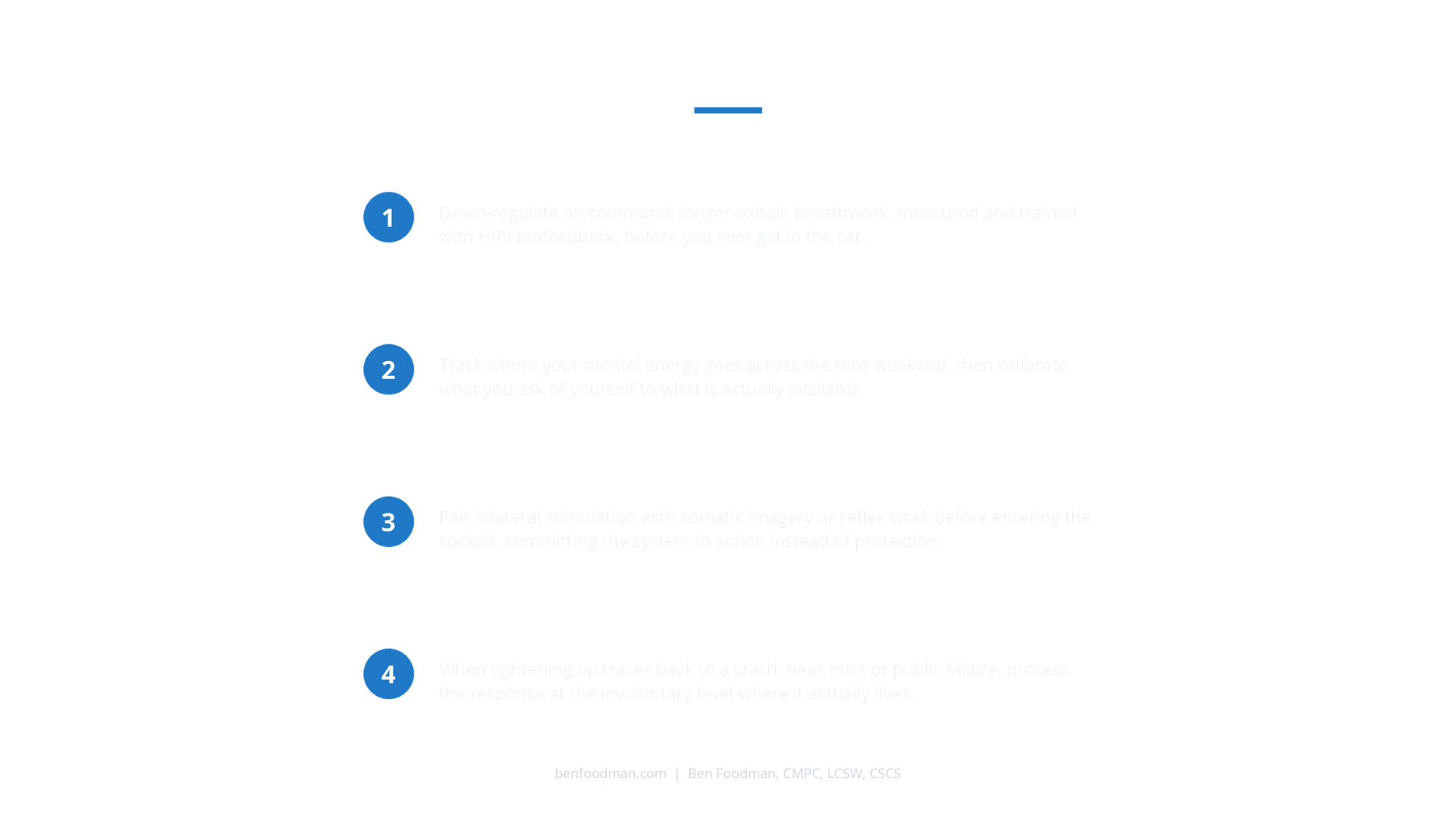
Phase 1: Build a Pre-Qualifying Parasympathetic Routine:
Before a driver can perform under pressure, they need to be able to down-regulate their nervous system on command. This phase focuses on breathwork — specifically a longer exhale relative to the inhale — to activate the parasympathetic nervous system and counter the stress response before the driver gets in the car. One way I measure the effectiveness of this is through the use of HRV biofeedback. This intervention utilizes electrocardiography (ECG) to record the electrical activity of the heart. ECG sensors are placed on the athlete's chest, forearms, and sometimes earlobes. Since heart rate variability (HRV) reflects the time between heartbeats, it directly relates to the electrical activity stimulating the heart, specifically the sinoatrial node (the heart's natural pacemaker).
Low HRV is associated with mortality, myocardial infarction, coronary heart disease, and congestive heart failure. But when HRV is trained, there are performance and health benefits.
When sport psychologists or CMPCs (Certified Mental Performance Consultants) help enhance HRV, HRV in this case is associated with improved autonomic nervous system balance.
Research published in the Journal of Applied Sport Psychology suggests that following these benefits, an athlete’s sport performance outcomes improve while also reducing the risk of complex motor skills from being compromised.
Phase 2: Measure Available Mental Energy:
A driver's mental capacity isn't constant across a race weekend. Travel, media obligations, sponsor commitments, physical fatigue, and the cumulative toll of competition all draw down the mental energy a driver has available. Knowing where a driver actually is allows the mental training to be calibrated to reality rather than assumption. While I have my own personal tools that I use with the more advanced drivers I work with, athletes at all levels should start tracking where their mental energy is being used both on and off the track in order to gain an accurate understanding of what they are cognitively capable of on race day, and what they are NOT capable of. Knowing what not to focus on is just as important as what to focus on.
Phase 3: Use Preloading to Commit the Nervous System:
Preloading is the process of intentionally synchronizing the body and mind before the performance begins — committing the central nervous system to the action ahead. For qualifying specifically, this matters enormously, because a fast lap demands total commitment and a nervous system that has been "preloaded" toward committed action rather than self-protection. An example of this would be to incorporate some type of bilateral stimulation paired with somatic focused imagery or exercises that challenge reflex responses prior to entering the cockpit. I have done all of these approaches with my drivers prior to qualifying.
Phase 4: Use Brainspotting to Process the Stress Stored Beneath the Surface
When a driver's tightening up in qualifying is connected to a specific experience — a previous crash, a violent near-miss, a high-profile failure, or witnessing another driver's wreck — the stress response is often rooted in material the nervous system is still holding onto beneath conscious awareness. This is where Brainspotting becomes a valuable tool.
Brainspotting was developed by Dr. David Grand, and the way it works helps explain why it can reach what traditional mental coaching often cannot. In a 2013 paper published in Medical Hypotheses, Dr. Frank Corrigan and Dr. David Grand hypothesize the following:
Brainspotting works by engaging deep regions of the midbrain — rather than only the conscious, rational brain — to access and process the stored body activation associated with a distressing experience.
In their model, a "Brainspot" is a specific point in a person's visual field that resonates with the physical activation they feel when recalling a difficult event; holding the gaze on that spot allows the nervous system to process the experience until the body activation clears.
What makes this relevant for a racecar driver is the level at which it operates. The qualifying stress response that causes a driver to tighten up isn't generated by conscious, logical thought — which is why telling a driver to simply push through it so often fails. Brainspotting is designed to work at the deeper, involuntary level where these stress responses actually live, which makes it a powerful tool for addressing the root of the problem rather than just its symptoms.
One of my cup drivers that I was working with in 2019 had previously suffered a serious crash. When they came to see me, they had never quite recovered from that crash and as a result, they were dealing with what is known as whiplash syndrome. We used a 15-week brainspotting protocol to help them become desensitized to the memory of the crash. As a result, their qualifying times began to improve which the driver attributed to their decreased stress-response in the cockpit that had been occurring pre-qualifying. If you are interested, I discuss this in more depth on this page here to help better understand the science behind how the nervous system impacts this process.

Why Do Sport Psychologists Use Brainspotting, EMDR & Biofeedback Instead of Traditional Mental Coaching For Drivers?
The top sport psychologists increasingly use Brainspotting, EMDR, and biofeedback with drivers because traditional mental coaching often addresses the conscious mind, while the qualifying stress response originates in deeper, involuntary regions of the brain that talk-based and willpower-based approaches struggle to reach.
Traditional mental coaching — positive self-talk, visualization, confidence-building, focus routines — has value, and it works for many performance challenges. But more advanced driver’s that are committed to mastery recognize that when the problem is as complex as an involuntary stress response rooted in the nervous system, they know that telling them to think more positively or visualize success often isn't enough. You can't reliably reason your way out of a response that isn't being generated by reason in the first place.
This is the gap that somatic, brain-body interventions are designed to fill. Brainspotting and EMDR work with the deeper regions of the brain where stress and trauma responses are stored, rather than only the conscious, verbal mind. Biofeedback gives the driver real-time data on what their nervous system is actually doing — heart rate, heart rate variability, and other markers — so they can learn to regulate states they previously couldn't even perceive (if you would like more information on EMDR and Brainspotting, check out my comprehensive resource here).
The point isn't that traditional mental coaching is wrong. It's that for the specific problem of an involuntary qualifying stress response; the intervention has to be more advanced and be able to reach the part of the system actually generating the problem. Basic mental coaches, non CMPCs, or non-licensed sport psychology experts do not have the tools or the applied experience to be able to administer these interventions and as a result, drivers need to seek out the top experts on these issues.
Frequently Asked Questions About Qualifying Pressure & Mental Training
-
When a driver consistently posts faster laps in practice than in qualifying, it's usually a sign that the issue is psychological rather than mechanical. The car, the track, and the driver's skill haven't changed — what's changed is the driver's internal state. The added pressure of qualifying shifts the nervous system into a protective stress response, which causes the driver to tense up, brake earlier, and lose the commitment that produced their faster practice laps.
-
Usually not. More repetition can build skill, but qualifying pressure isn't fundamentally a skill problem — it's a nervous-system regulation problem. Adding more seat time to an unaddressed stress response is the motorsport version of telling someone to "just push through it," and it often reinforces the very pattern the driver is trying to escape. The drivers really need to be using EMDR or Brainspotting to become ‘comfortable with the discomfort’ of qualifying.
-
It depends on the individual driver and what's underneath the problem. Some drivers see meaningful improvement in about 15-20 appointments using my interventions once the nervous system response is being addressed directly, while drivers carrying more significant unprocessed experiences — like a serious crash — may take longer. What matters more than the exact timeline is that this is a trainable, measurable problem, which means progress can be tracked rather than guessed at.
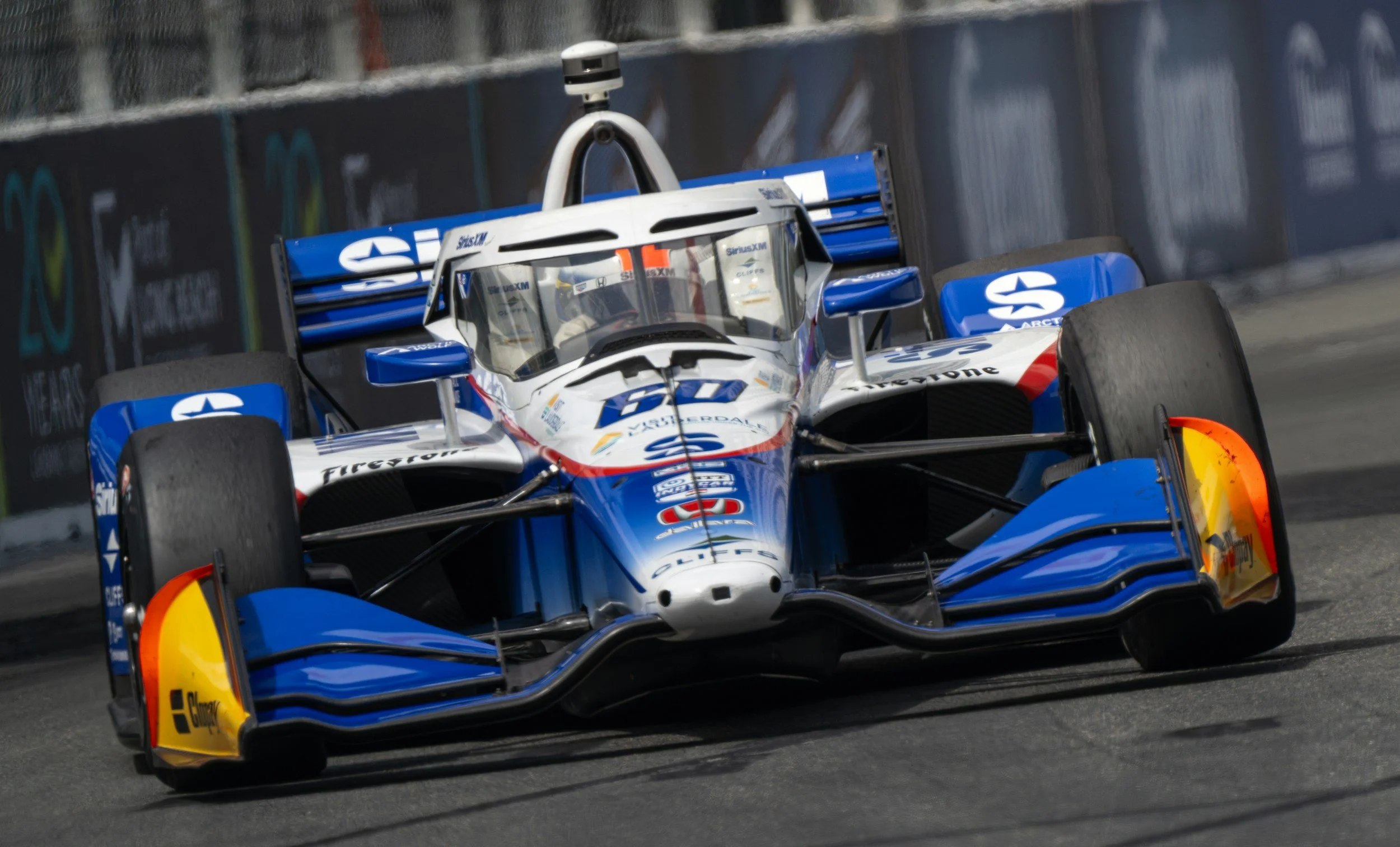
Why Qualifying Pressure Is an Involuntary Stress Response, Not a Talent Problem
Qualifying pressure is not a talent problem; it's an involuntary stress response and understanding that distinction is the first step toward solving it. A driver who tightens up in qualifying already has the talent; the proof is that they can post the time in practice, in testing, or in lower-pressure sessions.
The reason the pressure shows up the way it does is that the human nervous system is built to protect us under perceived threat. When the stakes are high and the window is small, the body shifts into a state designed for self-preservation — and that state is fundamentally at odds with the loose, committed, precise inputs a fast-qualifying lap requires. This isn't a character flaw. It's human physiology operating exactly as designed, just at the worst possible moment.
This reframe matters because motorsport culture often treats qualifying struggles as a sign of weakness — something a driver should be able to muscle through with enough toughness. That framing keeps drivers stuck, because it points them toward the wrong solution. You don't fix an involuntary stress response by trying to be tougher. You fix it by training the nervous system to stay regulated and committed under pressure — which is a trainable, measurable skill, not a fixed trait.
One final note: I am not advocating that drivers be completely calm and in a ‘zen-like’ state. There is a certain amount of tension and stress that is needed to hone focus (this is referred to as the Internal Zone of Optimal Functioning AKA IZOF). But drivers still need to be moving away from basic, traditional sport psychology tools such as motivational interviewing, or acceptance commitment therapy and should be consulting with individuals that use more modern, cutting-edge tools like EMDR, Brainspotting and biofeedback. If you would like to get more information on racecar driver mental performance, check out my comprehensive training guide here.
Ready to implement these tactics? Book a consultation to see if services are right for you!
Sign up to learn more about new updates with Ben’s practice!
Check out older Training Report articles below for more resources!