MENTAL PERFORMANCE SERVICES FOR ATHLETES IN CHARLOTTE, NC

Ben Foodman is a licensed psychotherapist and Certified Mental Performance Consultant (CMPC) in Charlotte, North Carolina who works exclusively with athletes on two categories of problems: mental blocks such as the yips, and the mental demands of competing and building a career at a high level.

BEN’S ATHLETES COMPETE FOR THE FOLLOWING ORGANIZATIONS:
NFL
•
Red Bull
•
Toyota
•
Subaru
•
Ford
•
IMSA
•
Chevrolet
•
MLB
•
NASCAR
•
PGA
•
SEC
•
FIA WRC
•
ACC
•
FIA WEC
•
NFL • Red Bull • Toyota • Subaru • Ford • IMSA • Chevrolet • MLB • NASCAR • PGA • SEC • FIA WRC • ACC • FIA WEC •

Every athlete trains physically, but only the athletes that are taken seriously and committed to their craft train mentally. Those athletes train their minds to become comfortable with the discomfort of performance stress so that their nervous system is performance optimized. This is where peak performance is achieved. Just as importantly, Ben's work doesn't just translate to benefits in an athlete's sport, but in their personal life too. He helps athletes detach from outcome-based, materialistic pursuits, which in turn helps them reduce their athletic identity and find value in who they are as a person. This leads to an athlete who does not run away from the pressure of performance, but runs toward it.
Ben's services fall into four areas: Brainspotting for mental blocks and sports-related trauma, biofeedback for autonomic nervous system control, mental skills and exercise psychology training for the specific psychological demands of your sport, and communication training for navigating coaches, general managers, media, and difficult team dynamics. All four can be done in-person or virtually, though Ben's preference is always to work with athletes in-person. These are the same methods Ben has used with athletes competing in the NFL, MLB, NASCAR, IMSA, and IndyCar, as well as ACC & SEC collegiate athletes, Olympians, and high school athletes working toward those levels.
Ben's practice is specifically designed for athletes who are committed to mastery, not dabblers or athletes who are winging it. To see whether Ben's practice can address your needs, the first step is to schedule a free video discovery call to identify the issues you are working on, clarify your goals, and determine if Ben can even help.
What Services Does Ben Foodman Offer Athletes?
Ben offers four services: Brainspotting for the yips and mental blocks, biofeedback for nervous system regulation, mental skills and exercise psychology training for sport-specific performance demands, and communication training for navigating coaches, front offices, media, and team dynamics.
Most athletes come to this practice for one of two reasons. The first is a mental block. Something that used to be automatic, throwing to first, a putt, a routine on the beam, has stopped working, and no amount of extra reps or mechanical adjustment has fixed it. The second is performance: the athlete is healthy and skilled but wants to compete with more focus, more aggression, and more resilience under pressure than they currently have access to.
The four services map onto those problems. Brainspotting addresses the unprocessed stress response underneath mental blocks like the yips or twisties. Biofeedback trains direct control over the autonomic nervous system, the part of your physiology that decides whether you stay composed or spiral when the pressure spikes. Mental skills and exercise psychology training builds the sport-specific psychological capacities your competition demands, from sustained concentration to competitive aggression. Communication training prepares you for the conversations that shape careers and establish an athlete's leadership capabilities: coaches, general managers, athletic administrators, media, and teammates.
Some athletes need one of these. Most need a combination, which is why services begin with an assessment rather than a menu. Each service is covered in detail below.
How Does Brainspotting Help Athletes Overcome the Yips and Mental Blocks?
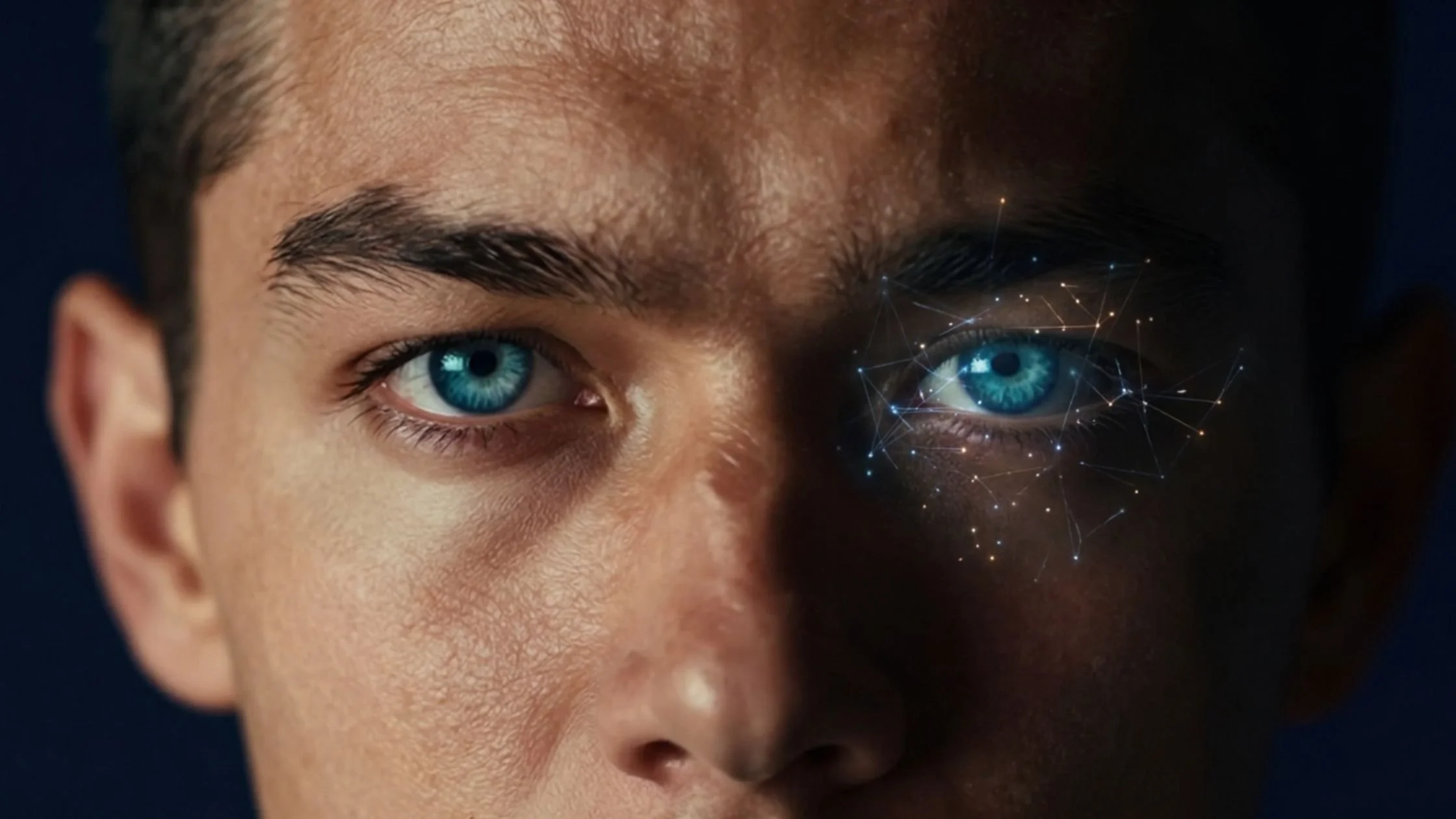
Brainspotting is a brain-based intervention that helps athletes process the unresolved stress responses underneath mental blocks like the yips, rather than managing symptoms at the surface. It is the primary method Ben uses for these cases, and this work typically takes 15 to 25 sessions.
Mental blocks are not a confidence problem or a focus problem. They are a conditioned stress response: the accumulation of stress from sports, injuries, and pressure that the nervous system has not fully processed, surfacing as a movement that will no longer execute. This is why extra reps, mechanical tweaks, and "just get out of your head" advice fail. They address the symptom while leaving the underlying activation untouched.
Brainspotting, developed by Dr. David Grand as a modified form of EMDR, uses fixed eye positions to access and process that underlying activation. Ben is a Certified Brainspotting Therapist and typically uses a two-step process for mental block cases: first, building the athlete's energy management skills so their nervous system can handle the processing work, then Brainspotting itself as the intervention that resolves the block.
Athletes should know what this work actually feels like. Brainspotting sessions are usually very uncomfortable and difficult, because the process involves accessing challenging emotions and memories the nervous system has been holding. Athletes consistently report a massive release of tension afterward, and that the discomfort is what makes the change durable. Progress varies by athlete, but on average this work runs 15 to 25 sessions, not counting other services, and can be done in-person or virtually. For a complete explanation of how Ben uses this method, read his guide here.
What Is Biofeedback Training for Athletes?
Biofeedback is a form of mental training that uses real-time physiological data to teach athletes direct control over their autonomic nervous system, the system that governs heart rate, breathing, and the stress response under competitive pressure.
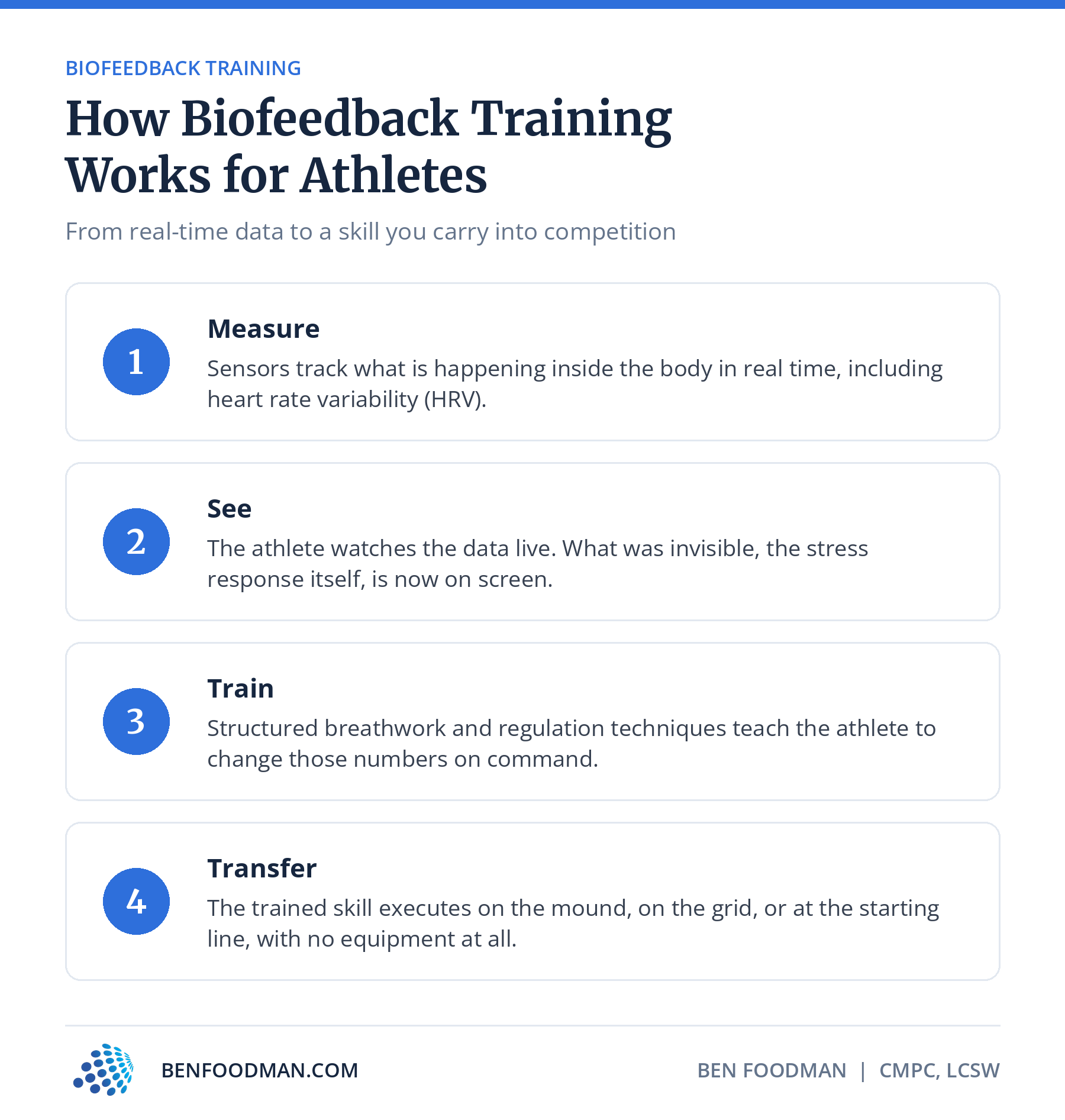
Most athletes have been told to "calm down" or "control their nerves" without ever being shown how. Biofeedback is the tool that gives athletes and coaches the answer to the how. Sensors track what is happening inside the athlete's body, measures like heart rate variability (HRV), and display it in real time. The athlete then learns, through structured breathwork and regulation techniques, to change those numbers on command. What starts as watching a screen becomes a trained skill the athlete can execute on the mound, on the grid, or at the starting line with no equipment at all.
In practice, this work centers on improving HRV and parasympathetic nervous system activity, the recovery side of the nervous system that allows an athlete to stay composed under pressure and reset quickly between plays, laps, or points. Ben uses evidence-based HeartMath technology for this training. Athletes working with him virtually acquire their own HeartMath equipment for use during sessions, so the training runs the same whether sessions happen in his Charlotte office or over video.
Biofeedback also does double duty across Ben's other services. It is a core part of the energy management phase that precedes Brainspotting work for mental blocks, and it gives performance-focused athletes an objective, measurable way to track whether their pre-competition routine is actually regulating their nervous system or just filling time.
What Is Mental Skills and Exercise Psychology Training for Athletes?
Mental skills training builds the specific psychological capacities an athlete's sport demands, such as focus, mental toughness, and competitive aggression, while exercise psychology uses physical training itself as a tool to condition the athlete's mind for those demands.
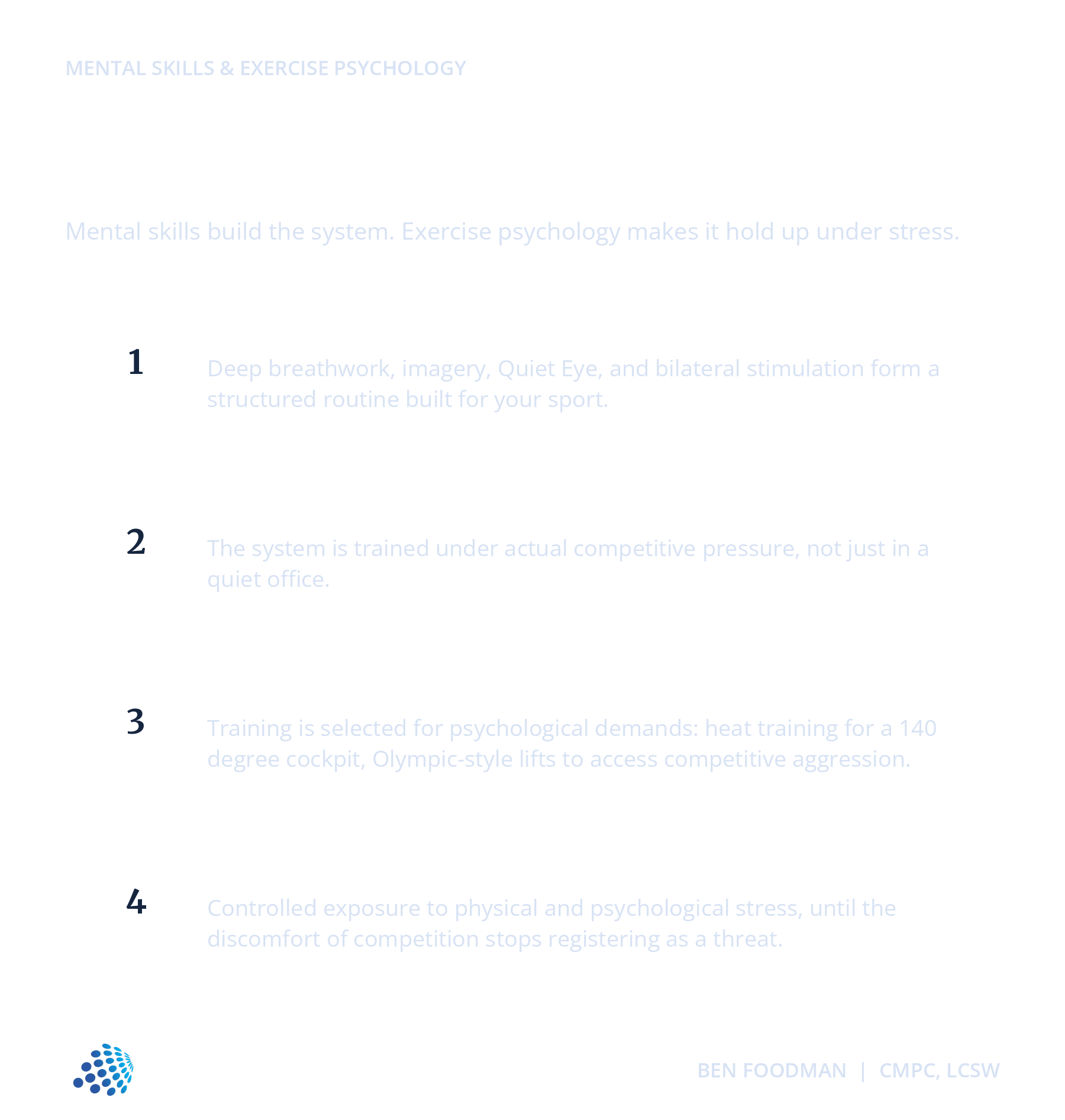
These two approaches work as one service because the mind does not train in isolation from the body. On the mental skills side, Ben builds athletes a structured pre-performance system drawn from methods like deep breathwork, imagery, Quiet Eye, and bilateral stimulation, then trains the athlete to execute that system under actual competitive stress, not just in a quiet office. The goal is never generic "confidence." It is the specific capacity your sport punishes you for lacking sustained concentration over a four-hour race, the ability to reset between pitches, or the competitive aggression to finish plays.
Exercise psychology approaches the same problem from the physical side. Ben, who is also a Certified Strength & Conditioning Specialist (CSCS), helps athletes select forms of physical training based on the psychological demands of their sport rather than physical adaptation alone. A NASCAR driver may emphasize heat training to build tolerance for a 140 degree cockpit. An athlete who cannot access competitive aggression may train Olympic-style lifts, because generating that level of muscle tension and sympathetic activation teaches the nervous system what the aggressive brace state feels like on command. The training session becomes a psychological rehearsal.
This is also where the "comfortable with discomfort" work happens in practice. Athletes learn to deliberately expose themselves to controlled stress, physical and psychological, until the discomfort of competition stops registering as a threat.

What Is Communication Training for Athletes?
Communication training prepares athletes for the high-stakes conversations that shape their careers: navigating coaches, general managers, and athletic administrators, handling media, and managing toxic teammate situations. Ben teaches athletes frame control and then rehearses these conversations with them until they are ready for the real thing.
Athletic careers are not decided only by performance. They are also decided in the conversations that shape relationships: the meeting where playing time gets discussed, the exit interview with a GM, the media scrum after a bad night, the locker room dynamic that is quietly draining a season. Most athletes walk into these moments with no preparation at all, and the athletes across from them, coaches, front office personnel, reporters, are often professionals at exactly this kind of exchange.
Ben trains athletes in frame control: understanding who is setting the terms of a conversation, recognizing the frames others are running, and holding your own position without becoming defensive or combative. Just as importantly, athletes do not simply learn these concepts. They practice them. Ben rehearses the actual upcoming conversation with the athlete, playing the coach, the GM, or the reporter, pressure-testing responses until the athlete can hold their frame under the same discomfort they will feel in the real conversation.
This work serves athletes leveraging new opportunities, a transfer portal decision, a contract conversation, a tryout, and athletes managing hard situations, a difficult coaching relationship, a toxic teammate, sudden media attention. It is also where leadership gets built: the athlete who can navigate these conversations calmly becomes the one coaches trust and teammates follow.
What Does Working With Ben Look Like?
Every engagement starts with a free video discovery call. If both sides agree to move forward, the first appointment is an assessment where Ben sets time-sensitive goals with the athlete and gives a good faith estimate of how long the work will take.
The discovery call is not a formality. Its purpose is to identify what you are actually dealing with, what you have already tried, and what you want to see change, and to determine whether Ben's practice is the right fit for it. Some athletes are not a fit, and Ben will say so directly rather than take on work he does not believe in.
For athletes moving forward, the assessment can happen in-person or virtually. This is where the plan gets built: specific goals, a timeline attached to them, and clarity about which services the work will draw on. For mental block cases like the yips, Ben typically uses a two-step process, first building the athlete's energy management skills, then Brainspotting as the intervention that resolves the block. For performance-focused athletes, the plan may combine mental skills training, exercise psychology, biofeedback, and communication training depending on what the athlete's sport demands.
Progress is not left to vibes. Because goals are time-sensitive and set in the first session, athletes can see whether the work is elevating performance. Approximately every two to three sessions, Ben checks in with athletes to see how they feel about the progress they are making toward those goals. To give potential clients an idea of what athletes come to work with Ben on: athletes dealing with mental blocks typically arrive reporting anxiety, lost motivation, decreased confidence, or unexpected fight, flight, freeze responses in competition, while athletes focused on performance typically arrive wanting deeper focus, greater mental energy capacity, and real mental toughness. In both cases, the structure is the same: named goals, a timeline, and measurement against both.

Does Ben Foodman Work With Teams and Athletic Organizations?
Yes. Ben works with teams, athletic departments, and motorsport organizations through Ibex Tactics, the team performance consultancy he co-founded, which specializes in performance-optimized team cohesion.
Individual mental performance work solves individual problems. But coaches and program leaders face a different problem entirely: they need their team to perform as a cohesive unit, and if it doesn't, they lose. Most leaders attack this through motivational speeches and one-time workshops, then watch the effect fade by the next road trip. Ibex Tactics was built to solve cohesion in a way that lasts.
Alongside his co-founder Alex Bolowich, Ben works with teams using the Team Cohesion Index, a proprietary assessment that measures cohesion across five pillars: communication, unit security, role ownership, emotional regulation, and performance readiness. Rather than guessing at what a locker room needs, the data shows leaders exactly where their team is aligned, where it is fractured, and which interventions will move it. From there, the work uses the same foundations as Ben's individual practice, desensitization to discomfort, advanced communication skills, and nervous system training, applied at the team level.
Coaches, athletic directors, and team principals can learn more here. Individual athletes: everything on this page is for you, and the Ibex work is a separate engagement, your work with Ben remains one-on-one and confidential.
Frequently Asked Questions About Ben's Services
-
Ben is a licensed psychotherapist, a Certified Mental Performance Consultant (CMPC) through the Association for Applied Sport Psychology, and a Certified Strength & Conditioning Specialist (CSCS), one of the few professionals in the Carolinas holding both clinical licensure and the CMPC, which is the highest professional certification in the field of sport psychology. He is also a Certified Brainspotting Therapist. That combination means he can address both the performance side and the clinical side of what athletes deal with, rather than referring out when the problem crosses the line between the two.
-
Fees depend on the scope of the problem and the goals set during the assessment, which is why the process starts with a free video discovery call rather than a rate sheet. Ben does not accept insurance and does not provide superbills.
-
Yes. All four services can be done in-person or virtually, though Ben's preference is always to work with athletes in-person. Athletes doing biofeedback virtually acquire their own HeartMath equipment for use during sessions.
-
High school, collegiate, and professional athletes. His current and former clients include athletes competing in the NFL, MLB, NASCAR, IMSA, and IndyCar, as well as ACC & SEC collegiate athletes and Olympians.
-
It depends on what the athlete is dealing with, which is why time-sensitive goals and a good faith estimate are set at the first assessment. For mental block cases like the yips, Brainspotting work typically runs 15 to 25 sessions. Athletes dealing with the yips specifically can read Ben's complete guide here.
-
Ben's practice is in Charlotte, North Carolina. He works in-person with athletes in the Charlotte area and those who travel in, including motorsport athletes based around the region's racing operations, and virtually with athletes anywhere. To learn more about how Ben works with professional racecar drivers, check out his comprehensive guide here.

ARE YOU READY TO CONQUER MENTAL BLOCKS & ACHIEVE PEAK MENTAL PERFORMANCE?
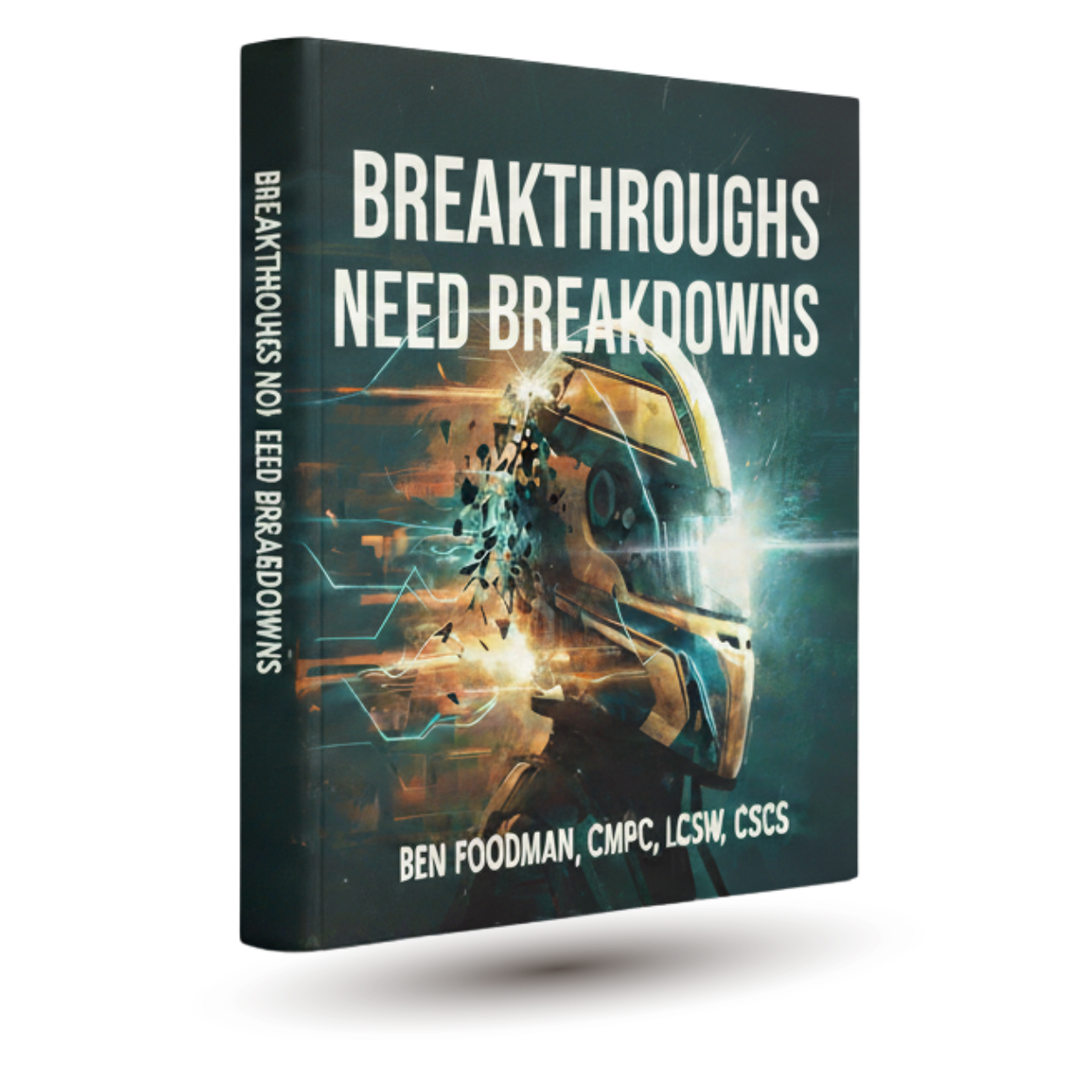
Get ready for the release of Ben Foodman’s upcoming book Breakthroughs Need Breakdowns! Check out the link below to learn more about the new authoritative book on the psychology of mental blocks in sports (AKA The Yips) and how to reach your true potential!

Interested In Services?
Use the contact form below to schedule a free discovery video call to see if Ben’s services are the right fit for what you are looking for!