
What Are 2 Expert Secrets About The Yips Cure That Baseball Players Need To Know?
Sport psychologists who are Yips experts understand that the yips is a type of trauma response to the environment. This is usually the result of compounding stress events that occur in the sport such as sports humiliations, serious injuries & social rejection. This is important to know because the Yips is a central nervous system response, and as such will need to be managed through the interventions of EMDR or Brainspotting. This article reviews 2 secrets on the science behind the Yips & neuroscience-based interventions to help overcome this issue.
Updated on 7/4/26, written by Benjamin Foodman, CMPC, LCSW, CSCS

About the Author
Ben Foodman is a licensed psychotherapist & performance specialist. He owns his private practice located in Charlotte North Carolina where he specializes in working with athletes to help them overcome mental blocks (the yips), PTSD, ADD / ADHD and achieve flow states through the techniques of Brainspotting & Neurofeedback. If you are interested in services, use the link here! Enjoy the article below!

What Are The Yips & What Are The Symptoms?
The yips are an involuntary loss of fine motor control during routine baseball skills. Common symptoms include suddenly being unable to locate throws, wild or short-hopped tosses, reduced velocity, freezing mid-motion, and locking up at the plate. The yips are typically a nervous system stress response, not a mechanical flaw.
A phrase that you will commonly hear about baseball is that it is a game of failure. There are very few sports where you can average .300 in anything and be considered ‘hall of fame’ status worthy. What this should tell everyone is that baseball is by far one of the most psychologically demanding sports in the world. And while there are many positive experiences that athletes, coaches and fans can extract from this experience, there are many negative ones as well. One of those common negative experiences are when baseball players get the Yips.
While I have talked extensively about baseball and the Yips in previous Training Reports, I wanted to go over some additional nuanced ideas that I have on the subject that I believe will be helpful for athletes and coaches. For this issue of the Training Report I want to go over 2 secrets about the Yips that most people don’t know about. First in part I. I will review one secret that almost all sport psychologists get wrong about the Yips, then in part II. I will review another secret fact about how baseball players will never become immune to the Yips. However in part III. I will discuss why this does not matter and what interventions can help with the Yips. Let’s now review the first secret.

What Do Sport Psychologists & Baseball Coaches Get Wrong About The Yips?
The most common mistake is treating the yips as the problem itself. The yips are a collection of symptoms produced by unprocessed trauma and compounding sport stress, which is why approaches that only manage symptoms typically produce short-lived results.
Time and time again when I work with baseball players, they constantly tell me about their previous failures working with sport psychologists and mental performance consultants on dealing with the dreaded yips. They are always constantly ‘defensive’ about whether or not I can actually help them with this issue because of how long they have dealt with it. This is completely understandable because the vast majority of sport psychologists only have training on how to either manage or treat the Yips. But this is exactly the problem that professionals in the sport psychology space make.

When baseball players get the Yips, they are under the impression that the Yips is the actual problem. The secret is that the Yips IS NOT the actual problem. The Yips is a collection of symptoms that are produced as a result of unprocessed trauma that the athlete has not dealt with. Essentially, when athletes participate in sports they are engaged in a type of ‘stress-test’ that requires full mind-body focus. If any part of the mind or body has an unresolved issue, it will send an error signal to the athlete’s conscious awareness that it is unable to give full mental focus. That error signal is the Yips.

Why Can’t Sport Psychologists Help Baseball Players Become Yip Proof?
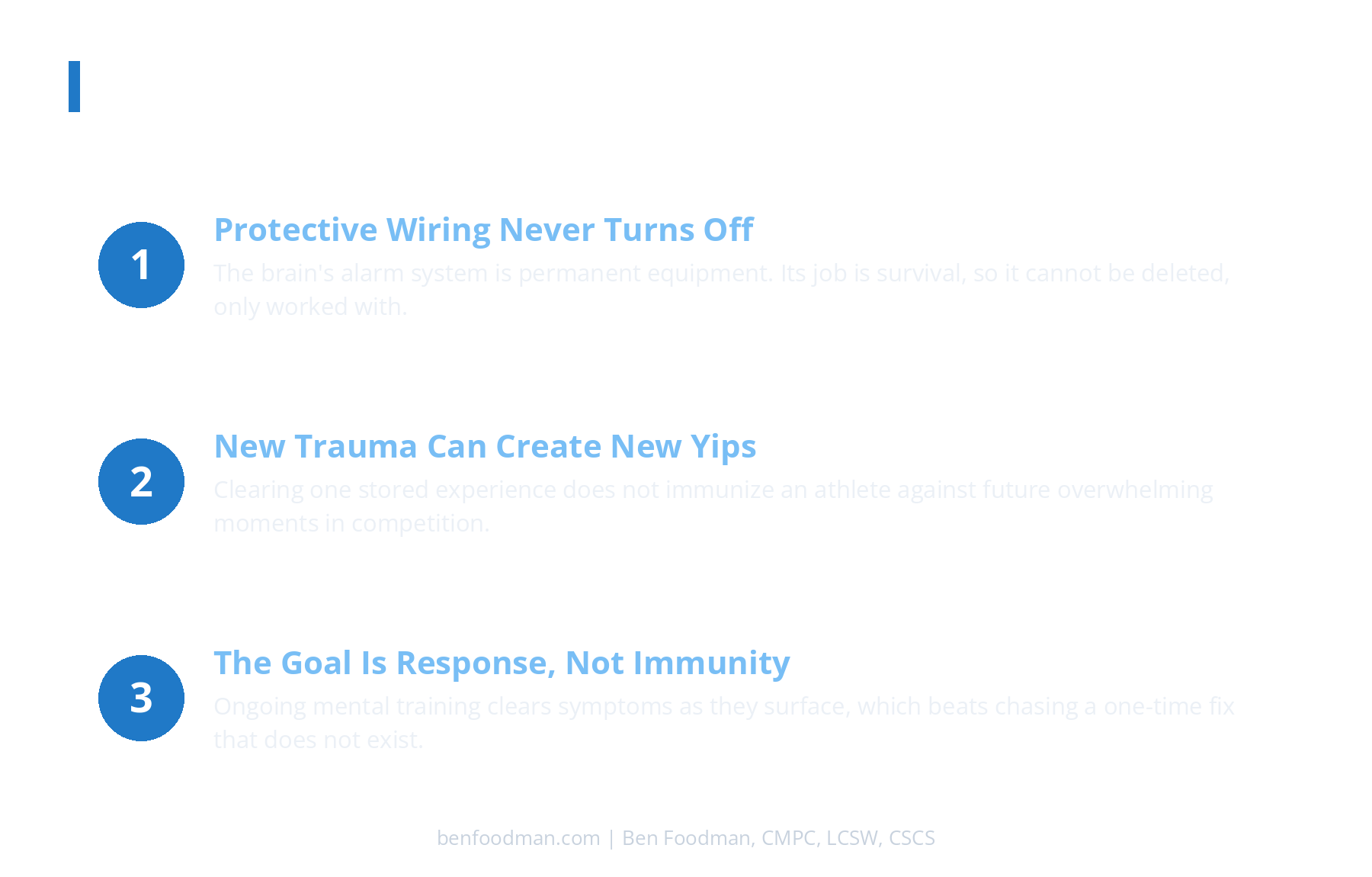
No athlete can become permanently yip proof because the brain's protective wiring never turns off. Even after an athlete clears the original unprocessed trauma, new traumatic experiences can create new yips symptoms, which is why ongoing mental training matters more than a one-time fix.
Sport psychologists are absolutely capable of helping baseball players beat the Yips, but not permanently. That is because even if the athlete is able to successfully address the underlying trauma issue, like all humans they have built in ‘software’ that will produce Yips responses if they experience new trauma. To better understand this, we need to have baseline knowledge on how trauma works. In the book This Is Your Brain On Sports by David Grand and Alan Goldberg, the authors describe the systems in our brain that create these responses:
‘In parallel fashion, the brain attempts to always move toward a state of psychological equilibrium. Over the course of our lives, we are exposed to a variety of life experiences, some positive, some neutral, and some negative.
Through a natural assimilation process, the brain adaptively processes these experiences, so they are constructively integrated. What is useful from the experience is learned and stored in the brain with the appropriate emotion and is available for future use.
When an experience is successfully assimilated or digested it is stored in the brain with little attached intense emotion or physical sensation. When we recall such an incident, we don’t reexperience the old emotion or sensation with it.
In this way we are informed by our past experiences and memories but not controlled by them and with sports our present athletic performances are not burdened by emotional or physical baggage from the past, only learned experience.
By contrast, trauma or any strongly negatively charged experience isn’t adequately assimilated or processed. Instead, the upsetting incident remains stuck in the system in broken pieces’
‘The body instantly memorizes the physical experience of the trauma in exquisite detail, including the body sensations of the impact and pain, along with the associated sights, sounds, smells and tastes.
The attached emotions and where they are felt in the body are frozen as well. The brain is overwhelmed and instead of getting digested, all of the information attached to the injury, including the negative thoughts is stored in the brain in exactly the same form it was initially experienced.
Days, week, months or even years later when the athlete is in a situation reminiscent of the original trauma or experiences prolonged stress, the upsetting experience may be unconsciously activated, thus interfering with the performance of the moment.
These components represent all of the sensory details from the earlier event that were frozen in the brain and body in their original disturbing state: the images, lighting, emotions, physical movements, sounds, or smells.
The unique sensory details later returning to consciousness cause the performance disrupting symptoms so common in mental blocks.’
When we think about the experiences of athletes in sports competitions, they experience many things that could be considered traumatic. Let’s look at the experiences in baseball for instance: broken bones, surgery for career-ending injuries, seeing teammates get injured, getting hit in the body or face with a baseball, abusive coaches, abusive fans, ‘sports’ parents, etc. Even if one clears a previous unprocessed trauma, there are many new potential obstacles that could create new traumas, and we will have ‘programs’ baked into our brain’s DNA to deal with these issues. So what methods can sport psychologists use to help players clear the Yips and unprocessed trauma?
How Do Sport Psychologists Help Baseball Players Consistently Clear The Yips?
Trauma-informed, somatic-based interventions such as Brainspotting typically offer the most direct route to clearing yips symptoms because they target the nervous system where the response is stored, rather than trying to out-think it with coping skills.
There is a growing movement of sport psychologists that are starting to recognize the importance of using trauma-informed and somatic-based psychotherapy into their work with athletes. This is because there is a large body of evidence that is beginning to explain the neuroscience of PTSD and trauma responses while simultaneously establishing how the previous mentioned therapies are the correct tools for these issues:
One intervention that is gaining massive popularity amongst athletes and sport psychologists is Brainspotting.
The sport psychology community is becoming more curious about this intervention because of both the success that Brainspotting is having in working with athlete populations and also because it is specifically tailored to deal with athlete PTSD.
Developed in 2003 by Dr. David Grand, who discovered the technique while helping a competitive figure skater work through a performance block.
Using what was known as EMDR, he noticed that during this protocol there were specific eye movement patterns that appeared to be associated with certain traumatic memories.
So why is this important when we are talking about using interventions like Brainspotting & EMDR?
In Brainspotting we say ‘where you look affects how you feel’ and through this process clients have the ability to access the parts of their brain that traditional psychotherapy approaches such as cognitive behavioral therapy are unable to do.
This results in clients being able to directly address the true ‘underlying’ issue (which we refer to as a Brain Spot) that has created conflict allowing individuals to move from needing to constantly cope, to not needing to cope at all.
Muscle guarding that continues during and after injury rehabilitation is the body’s way of communicating that there is still unprocessed trauma and cannot be ameliorated through traditional sport psychology coping methods.
Brainspotting is still very new and has very little research behind it, which is a valid criticism of the intervention. But it is rooted in EMDR principles and its’ founder is an EMDR trainer. This is important because EMDR has a plethora of research that strongly supports its’ efficacy. Through my work with professionals in the sports performance space, I have had tremendous success helping athletes clear their symptoms of the Yips using Brainspotting!
If you would like to learn more, use this link! If you are still interested in reading more, I expand on this and walk through the complete recovery approach in my definitive baseball yips guide as well as my Brainspotting resource. Fair warning: Brainspotting is usually very uncomfortable and difficult while you are in the session, and the massive tension release typically comes after. I walk through exactly what happens in a Brainspotting session for athletes so you know what you are signing up for.

Frequently Asked Questions About How To Cure the Yips
-
The Yips isn’t a disease. It’s a trauma and/or stress response to the high-pressure environment. If baseball players are trying to reduce the symptoms using either EMDR (Eye Movement Desensitization and Reprocessing) or Brainspotting, on average it typically takes 15 to 25 sessions to reduce and/or eliminate symptoms.
-
While the research is still not strong in this area, there is some evidence to suggest that using neurofeedback or biofeedback can be helpful. Experts recommend starting with biofeedback first before trying neurofeedback.
-
You can never guarantee if they will or won’t return. The best chance baseball players have to keep the Yips from returning is to consistently mentally train with EMDR, Brainspotting and/or biofeedback to manage the compounding psychological stress that baseball has on an athlete’s mind and body.
Note To Reader:
If you are an athlete reading this segment of the TRAINING REPORT, hopefully this content was helpful! I put the Training Report together because I felt like many of the discussions on issues such as the Yips/mental blocks, strength training & other subject matter on athlete performance concepts were really missing the mark on these ideas (e.g. how trauma is the direct cause of the Yips). If you are interested in learning more, make sure to subscribe below for when I put out new content on issues related to sport psychology & athlete performance! Also, if you are looking to work with a mental performance specialist, you are in the right place! USE THIS LINK to reach out to me to see if my services are the right fit for your goals!
ARE YOU ON THE LIST?
Make sure you’re signed up to Ben’s mailing list to receive news & updates on new strategies in sport psychology, upcoming workshops & products. Don’t wait, sign up now!
Check Out The Previous Training Reports!