
What Happens in a Brainspotting Session for Athletes?
A Brainspotting session for athletes is a structured, one-on-one process where a trained specialist helps you find the eye position connected to the stress response behind your mental block, the yips, or a performance slump, then uses that fixed gaze position to help your brain and nervous system process the true underlying issue. Brainspotting can be a very uncomfortable form of mental training where athletes can access challenging emotions or memories. But the end result is that athletes who go through Brainspotting become comfortable with discomfort, which is the true essence of what it means to train for sports. This guide walks through exactly what happens before, during, and after a Brainspotting session, written by Charlotte-based Certified Mental Performance Consultant Ben Foodman, who uses Brainspotting with baseball players, racecar drivers, and athletes competing at every level of sport.
Published on 7/3/26, written by Benjamin Foodman, CMPC, LCSW, CSCS
Ben Foodman is a licensed psychotherapist & Certified Mental Performance Consultant (CMPC) through the Association for Applied Sport Psychology (AASP). He owns his private practice located in Charlotte North Carolina where he specializes in working with athletes to help them overcome mental blocks (the yips), increase mental toughness and improve focus using techniques such as Brainspotting, biofeedback, exercise science and sport psychology. If you are interested in services, use the link here! Enjoy the article below!

Why Do Athletes Seek Out a Brainspotting Session?
Athletes usually book a Brainspotting session for one of two reasons: a mental block that will not respond to more practice, such as the yips, or a sudden drop in performance that follows an injury, a humiliating moment, or an accumulation of competitive stress.
Traditional sport psychologists continue to rely on methods such as cognitive behavioral therapy, approaches that treat the mind as if it operates separately from the rest of the system. Many of these traditional sport psychologists view problems such as the yips or sudden drops in performance as a 'lack of insight' problem: if the athlete can just learn to think about the issue correctly, it should resolve. But as Bessel van der Kolk argues in The Body Keeps the Score, these issues live in the nervous system and the body, not in thought patterns, and no amount of insight talks the body out of a threat response. The yips literature backs this up: researchers have defined the yips as a motor phenomenon of involuntary movements, and that word involuntary is the whole story: the brain has tagged a specific movement or competitive situation as a threat, and the nervous system keeps generating a protective response outside of conscious control no matter how much the athlete wants to perform or how hard they 'train through it'.
This is the pattern I cover in depth in the baseball yips guide, and it shows up across every sport I work with, from baseball players who suddenly cannot make a routine throw to racecar drivers who tighten up under qualifying pressure. Brainspotting is designed to work with that protective response directly, at the deeper regions of the brain where it is produced, rather than trying to talk the athlete out of it. If you want the deeper science of why Brainspotting works, I have covered that in previous issues of the Training Report. This article answers the more practical question athletes ask me on nearly every discovery call: what actually happens when I sit down in your office?

What Happens Before an Athlete's First Brainspotting Session?
Athletes typically go through an assessment that rules out specific underlying issues that may require a different type of specialist. Once that has been established, specialists who use Brainspotting typically teach regulation techniques first, because Brainspotting can cause significant discomfort.
Every professional is different in how they introduce Brainspotting to athletes. However, there are some critical steps that should be taken before Brainspotting begins. First, every athlete needs to undergo a thorough assessment that gathers information such as the following:
injury history
sport specific demands (e.g. golfers compete in explosive, self-paced movements whereas cross country athletes compete in continuous, endurance-based demands)
prevalence of anxiety or depression symptoms
sleep hygiene
organizational skills
trauma history
Second, athletes should receive thorough training on their stress-recovery system, specifically through the principles of General Adaptation Syndrome (GAS). The first part of this begins by giving athletes psychoeducation on the neuropsychology and internal mechanisms that regulate these stress and recovery systems, followed by the implementation of two tools:
The first tool is a self-monitoring system that has them checking on their psychological stress-load, then matching their training and performance demands to the energy actually available. This helps athletes begin the process of reducing overtraining, becoming better stewards of their psychological stress load, and shifting focus towards more efficient performances.
The second tool is a very specific type of deep-breath work. This breathwork needs to be completed on a daily basis, and always before practice and competition. The goal of this breathwork is to synchronize the autonomic nervous system so that the athlete is in a higher parasympathetic state, which in turn can lead to a more performance-optimized psychological disposition.
Once these habits have been implemented into the athlete's daily regimen, the specialist will typically allocate a session to introduce what Brainspotting is to the athlete, how it works, and then briefly demonstrate Brainspotting to the athlete. In my practice, I have found that the following explanations resonate the most with athletes:
When explaining what Brainspotting is, I start off by telling athletes that where we look affects how we feel. Brainspotting helps athletes access the regions of the brain that are primarily responsible for producing the stress responses they experience during sports, while bypassing the regions that are not.
When describing how it helps athletes improve their mental game, I compare it to strength training. We lift weights and train our cardiovascular system to be physically ready for sports, and likewise Brainspotting is a form of mental training that helps athletes become more comfortable with discomfort, which in turn increases their mental toughness.
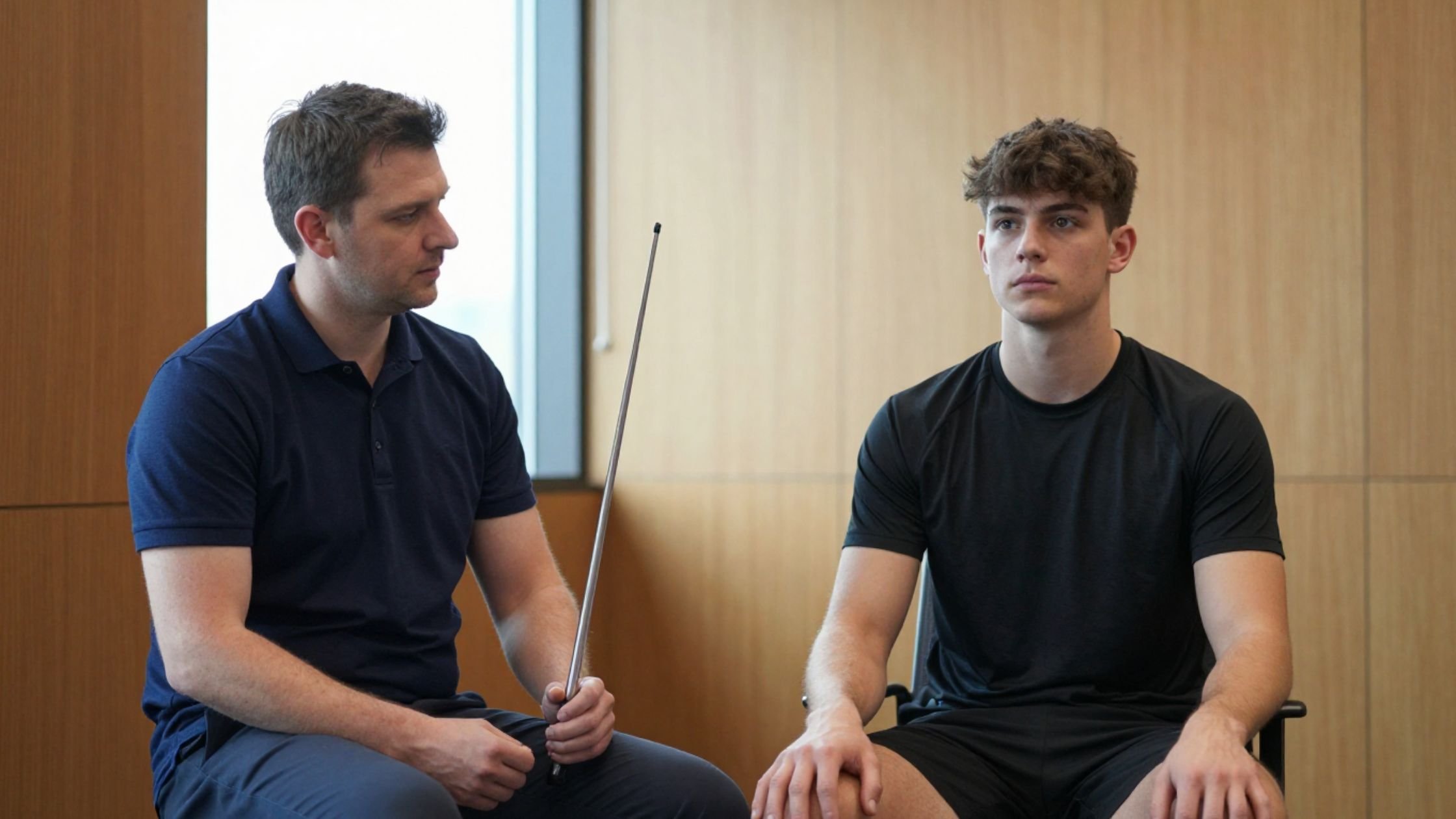
After I have gone through those stages, I then have the athlete go through a very brief Brainspotting session. I ask them to identify a thought or an emotion that stresses them out during a competition setting, where they feel this discomfort in their body, and then I have them fix their gaze on a pointer I am holding while I move it throughout their visual field, asking them to identify how they feel.
Once this is all completed, I ask the athlete any questions they have about the process, and then we schedule the next Brainspotting appointment with a few caveats. First, Brainspotting appointments should be scheduled on days when there is not competition or high training loads. Because Brainspotting can be mentally taxing, this can negatively affect performance outcomes if done on a high-stress performance day. Second, athletes need to make sure that after Brainspotting appointments they hydrate and eat afterwards. This can help regulate the athlete's nervous system and speed up the time they will need to mentally reset.
What Happens During a Brainspotting Session?
During a Brainspotting session, the athlete and mental performance consultant identify the specific performance issue, notice where the athlete feels the activation in their body, and then locate the eye position where that activation is strongest. The athlete holds their gaze on that spot, usually guided by a pointer, which in turn will help the athlete’s subcortical brain process the stress resulting in the athlete becoming more psychologically resilient during high-stress situations (aka Mental Toughness training).
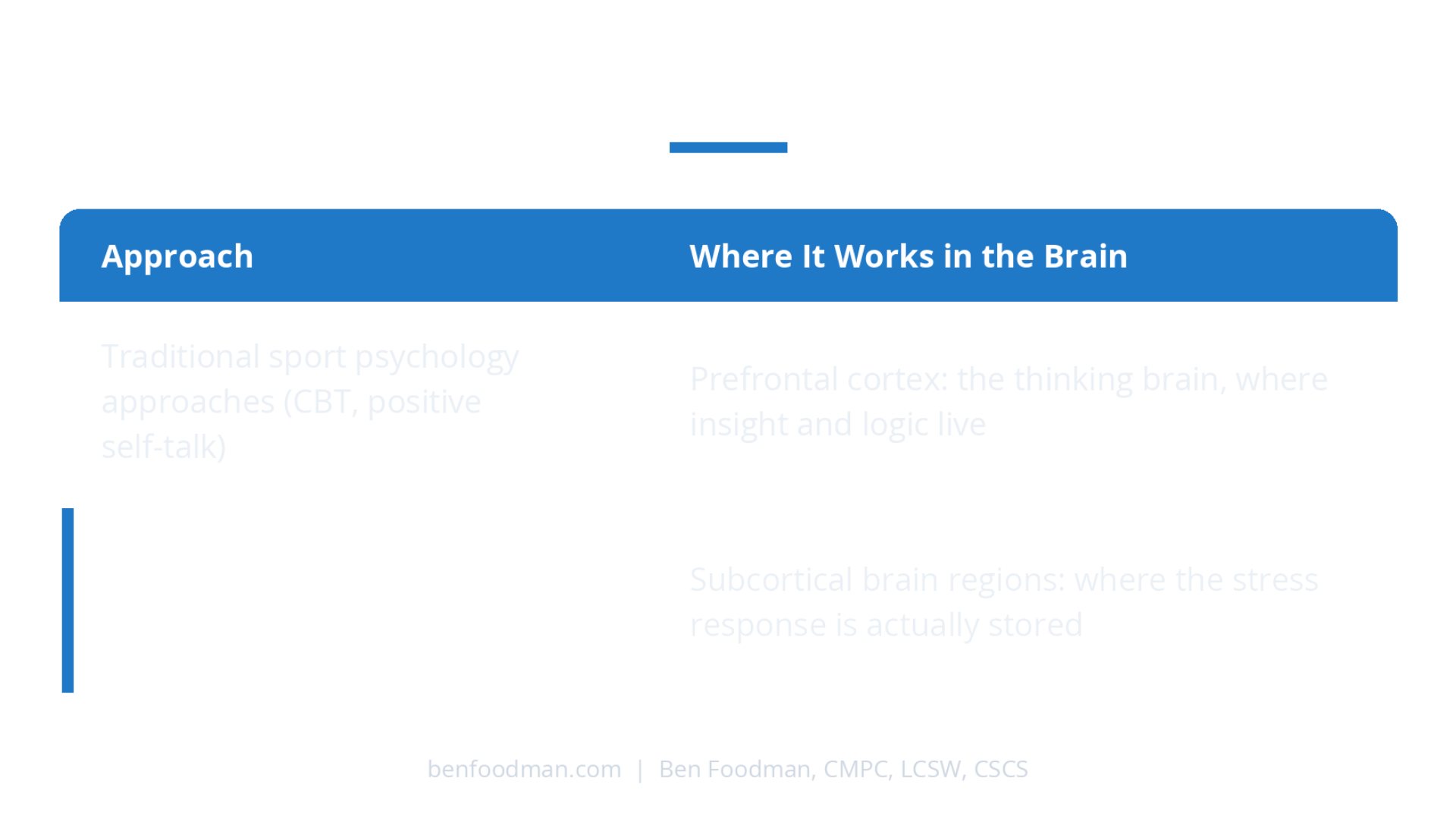
The core discovery behind Brainspotting is that where you look affects how you feel. When an athlete thinks about the throw they cannot make or the crash they cannot shake, and slowly tracks their eyes across their visual field, there are specific eye positions where the distress noticeably spikes or intensifies. That eye position, the Brainspot, appears to correspond to where the unprocessed experience is held in the deeper, subcortical regions of the brain. A typical session moves through a few stages:
First, we identify the issue and get a baseline understanding of what the athlete is somatically experiencing: the athlete briefly describes what happens in performance, and rates how activated they feel thinking about it.
Second, we find the body location: athletes are often surprised how quickly they can point to it, a tight chest, a clenched jaw, a hollow feeling in the stomach or temperature changes in their body (e.g. their head feels hot).
Third, we find the brainspot using the pointer, watching for the reflexive responses that signal we have located the right spot. When an athlete’s gaze is on the brainspot, they will either self-report a spike in discomfort or their body may begin to visibly tighten up.
Fourth, the athlete simply holds their gaze there and lets whatever comes up come up. My job during processing is what the Brainspotting literature calls dual attunement: tracking the athlete closely and keeping the frame safe while their own brain leads the work.
What a Typical Course of Brainspotting Looks Like With an Athlete
Here is how this typically unfolds, using a pattern I see regularly in my work with baseball pitchers experiencing the yips. In a first session, the pitcher visualizes 'yipping a pitch' and describes what shows up in his body: his hands begin to sweat, his throat starts to feel tight. I then have him fix his gaze on the pointer as I move it slowly along an x-axis at eye level. At a certain position, I will notice a reflexive response, a swallow, a wince, a shift in his breathing. I hold the pointer on that spot for about a minute, then calmly ask what he is noticing.
The most common report is that the tension is intense, sometimes worse than what he feels on the mound. That is the brainspot, and he holds his gaze there for the remainder of the session, often around 45 minutes. We repeat this process weekly. Somewhere around the midpoint of the work, pitchers typically report that the yips are becoming noticeably less intense and that they feel more comfortable on the mound. By the end of a full course of sessions, the involuntary spike that used to hijack the throw is either gone or no longer strong enough to interfere, and the line I hear most often is some version of 'baseball is fun again.'
Do Athletes Have to Relive Bad Memories During a Brainspotting Session?
In some cases, yes. If athletes have traumatic memories of sports injuries, sports humiliations or other events that occurred outside of sports, it will be important to process that information. But sometimes athletes just need to focus on distressing ideas such as potential sports failures or possible scenarios of sport-related injuries. It just depends on the individual case.
One of the most common concerns that athletes have is how uncomfortable this process can be. Traditional talk-based approaches often require the athlete to describe the problem repeatedly and in detail. Brainspotting works differently. Because the technique accesses the subcortical brain regions where the stress response is actually stored, the athlete does not need to build a verbal narrative for the processing to occur, but instead focuses more on the negative somatic experiences that are happening to them. There are definitely some athletes who talk a lot during Brainspotting sessions, but there are also others who say almost nothing. Both processes can work effectively.
This matters for athletes in particular, because sport-related stress responses are often tied to moments athletes have never told anyone about: the errant throw that hit a teammate, the crash, the public failure in front of scouts or family. The body keeps the record of those experiences whether or not the athlete ever puts them into words. Brainspotting meets the athlete where the record actually exists, and this process can be incredibly uncomfortable. With that being said, while the initial stages of Brainspotting are not fun, athletes go through it because of what is on the other side: mental blocks that begin to release, faster resets after setbacks, and performance stress that no longer carries the same charge. For many athletes, that shift transforms their experience of competition.
In my own practice, while not common, there have been times when athletes uncovered a memory they had not consciously connected to their performance issue, or gained a reframed perspective that made them more uncomfortable than they initially anticipated. Obviously, if the issue is one that requires a more specialized approach (e.g. something around eating disorders, or early childhood abuse), then those athletes are connected to experts who have significant reps in those areas. But assuming the issue is within my scope of practice, we will spend several sessions processing how they feel, and answering any questions they have until they feel comfortable proceeding into the next Brainspotting session.

How Long Are Brainspotting Sessions and How Many Do Athletes Need?
The length of sessions and the number of sessions will depend on the individual athlete's history, goals, and severity of mental block symptoms. In my practice, sessions typically last about one hour, and athletes on average require anywhere from 15 to 25 total Brainspotting appointments before seeing significant results in their game.
Most athletes do just fine meeting once per week or once every two weeks, with each session lasting approximately one hour. During processing, athletes will often hold their gaze on that single pointer position for the entire session, and learning to stay with one fixed spot for that long while difficult material surfaces is itself part of the mental training. There are some exceptions to the scheduling rule. For example, the timeline can compress if athletes choose to do what are called intensives. These Brainspotting sessions can last up to two hours, allowing for deeper processing and giving the athlete more time to mentally train to become comfortable with the discomfort of their particular issue. There are also some athletes who have complex issues which in some cases will require well beyond the average 15 to 25 sessions. Fortunately, most mental performance experts who are seasoned in using Brainspotting can determine early on if the work will take an extended amount of time, which in turn helps the athlete decide if this is the right time for them to engage in Brainspotting mental training.

What Do Athletes Notice After a Brainspotting Session?
After the first Brainspotting appointments athletes typically report feeling mentally tired. If they practice the day of, they also report feeling somewhat off. But after several appointments athletes typically state that they feel lighter, as if a weight has been removed from their body. This in turn results in athletes feeling sharper and less hesitant to take risks during competition.
Even when athletes are not consciously thinking about the session afterward, processing does not stop when the Brainspotting appointment ends. The brain continues consolidating in the hours and days afterward, which is one reason athletes are often surprised that the change shows up not as a dramatic moment in the office, but as an absence of the negative feelings that would typically bother them during practice or performance. The throw an athlete could not make, or the corner a driver could not commit to, simply starts happening again, without the spike of dread that used to come before it. Over time, pre-performance sensations such as nausea, sweating, muscle tension or temperature changes in the body slowly dissipate, and athletes feel 'more in control' than they have felt in a long time. I cover this across different athlete populations I work with, especially with racecar drivers. You can read up more on that in my comprehensive racecar driver mental training guide here.

Are Brainspotting Sessions Done In-Person or Virtually?
Brainspotting sessions can be done virtually or in person. However, the athlete's individual needs, history, and disposition should influence which approach best fits their processing.
Athletes can have great success with either format. Typically, youth athletes aged 18 and younger will do better with in-person work because so much of their life is already spent online. Disconnecting from being online and interacting in person can be far more effective for this age group. However, there are plenty of youth athletes who I have had great success working with online. Some of the advantages of doing Brainspotting work in person include the following:
There is visual depth behind the pointer that holds the athlete's gaze, which makes it easier to guide their processing.
It is easier to see changes in body language, such as body twitches or muscle tension that occur when a brainspot is found.
The visual field is much bigger and not confined to a computer screen.
While virtual work does not carry all of those advantages, remote Brainspotting has its own:
Athletes have very busy schedules, and meeting virtually saves them the commute to the office.
Athletes can often fit in more Brainspotting sessions because no travel time is needed.
There are other ways to have the athlete activate a brainspot that do not require a pointer (e.g. having the athlete look off-screen at different areas of the room they are in).
This is also how I work with athletes who compete or live outside of Charlotte North Carolina, which allows them the opportunity to receive this coaching service.

Frequently Asked Questions About Brainspotting Sessions
-
No, but they are closely related. Brainspotting actually grew out of EMDR, and both are somatic approaches that work with the brain and nervous system rather than through talk alone. The mechanisms differ: EMDR typically uses guided eye movements in a rhythmic side-to-side pattern, while Brainspotting uses a single fixed gaze position held over time. Because of that lineage, Brainspotting training includes substantial education on EMDR. My formal training is in Brainspotting, and it is the method I use with athletes.
-
No. Athletes work with me on performance issues, not diagnoses. The yips, mental blocks, post-injury hesitation, and pressure responses do not require any diagnostic label to be worked on effectively.
-
Every athlete's case is different. With that being said, Brainspotting can be done either in-season or in the off-season. If done in-season, the athlete needs to make sure sessions land on days with no competition, or on light training days. For athletes with the option, the off-season is often the ideal window to begin, because the schedule allows for consistent weekly sessions without competing against performance demands.
-
Before your first Brainspotting session, keep your schedule light for the day. If you do have to train, keep it to a low-stakes, low-impact workload. Also hydrate with electrolytes and arrive well-fed, because Brainspotting is mentally taxing work and your nervous system will need the resources.
-
No. In my practice, Brainspotting is used as a form of mental training, specifically a form of focused mindfulness. Because I am focused on coaching rather than treating clinical issues such as PTSD or depression, I do not take insurance, nor do I provide superbills.

How Do Athletes Start Their First Brainspotting Session?
Starting Brainspotting begins with a free, confidential discovery video call, where we assess whether your mental block, case of the yips, or performance issue is a fit for this work and map out what your first sessions will look like, along with the investment, schedule cadence, and estimated timeline for accomplishing your goals.
If you have read this far, you already suspect what I tell athletes on nearly every call: the problem you are fighting is not a talent problem, a toughness problem, or a mechanics problem. You have most likely addressed those issues already, and are now realizing you need to add a final piece to your mental training, which is to condition your nervous system to withstand the compounding psychological stress that comes with competing in sports. Brainspotting sessions exist to build that conditioning at the level of the brain where the stress response actually lives.
You can learn more about how I integrate Brainspotting with biofeedback and other interventions, or reach out through the contact form to schedule your discovery call. If you decide you would like to move forward, please plan for the discovery call to last approximately one hour, as I like to take my time collecting a detailed baseline history to determine if my training and approach match your specific needs. If they do not, I will provide you with the appropriate referral options. If you have more questions or would like to learn more about Brainspotting, check out my comprehensive Brainspotting guide here.
Ready to implement these tactics? Book a consultation to see if services are right for you!
Sign up to learn more about new updates with Ben’s practice!
Check out older Training Report articles below for more resources!